I have to admit, I tend to play zydeco and cajun tunes with English titles because demonstrating my language ignorance on the radio is right up there with playing Pictionary in terms of personal embarrasment. But this last week, we’ve been hosting a young women from France who has decided to live in Olympia, where her parents met, fell in love and is her birthplace. So I invited Noémie to sit on my show this morning and what a great time.
Me and Noémie in the KAOS control room right before today’s show.
The result is a wonderful mix of French-language songs from Louisiana. Songs from Beausoleil, Pine Leaf Boys, Gina Delafose, Bonsour Catin, Clifton Chenier, Helen Gillet, Sweet Crude and more.
Hello. Today’s show marked three full years of airing a show about New Orleans music in a town over 2200 miles away from the Crescent City. My thanks to community radio station KAOS and its listeners and supporters for letting me do this show.
The show kicks off with Theryl “Houseman” Declouet with his infamous introduction regarding the third world status of New Orleans at a Galactic concert and flows quickly into Shamarr Allen’s “Party All Night.” Al Hirt takes a turn and so does patron saint of this website and the show, Ernie K-Doe, with his classic “A Certain Girl.” Who is she? Can’t tell ya. I have reggae and hornpipes, jazz and blues and an amazing live airing of the Radiator’s 7 Devils from the 2006 New Orleans Jazz and Heritage Festival. It was that concert that cinched the deal for me that I would be coming back to New Orleans as often as I could.
Here’s the edited show from today (September 7, 2017) marking three years. Thank you for listening.
The 12th anniversary of Hurricane Katrina and the flooding of New Orleans has been marked by deadly flood waters around the planet–from Houston to Bangladesh. Today’s show, originally aired on KAOS and presented in edited form below, is dedicated to all flood victims. As weather intensifies in the future, we all run the risk of being weather victims.
This week’s show starts with wetland preservation advocate Tab Benoit, singing “Shelter Me.” Clarence “Gatemouth” “Brown follows with his seminal song “Hurricane.” Mr. Brown died of cancer on September 10, 2005 after having to evacuate his Katrina-damaged home in Slidell (near New Orleans) two weeks earlier. Marva Wright re-enacts the ground level experience in New Orleans during the flooding in “The Levee Is Breaking Down” and the Free Agents Brass Band perform their song of survival “We Made It Through the Water.” Here’s the complete playlist.
This week’s show starts with the Young Tuxedo Brass Band in honor of Walter Payton, father of trumpeter Nicholas Payton and the sousaphone player for that storied New Orleans band.
I then take a twist toward more contemporary music with Quintron and Miss Pussycat, Sneaky Pete, Jello Biafra and the New Orleans Raunch and Soul All Stars, Helen Gillet and the Dirty Bourbon River Show. I then head back into R&B, including playing High Blood Pressure from the Huey “Piano” Smith album I bought in Ballard last weekend and another round of brass bands. I mixed tracks from new releases by Benny Turner, Naughty Professor and Stanton Moore. The show, as edited below, finishes with Cowboy Mouth’s relationship dirge “Broken Up.” Enjoy!
No one needs to convince Taylor Smith of the ability of radio to perpetuate musical traditions and nurture new ones.
As the bandleader and composer for The Roamin’ Jasmine, Smith has become well acquainted, as do most successful New Orleans musicians, with the city’s traditional jazz standards. But its been his ability to apply a New Orleans style rhythm and blues spin on classic blues numbers that sets his music apart.
For example, check out his take on Blind Lemon Jefferson’s Wartime Blue (from the band’s second album). With the band’s latest release “Live at Horace’s,” Jefferson’s Hangman Blues gets updated with a New Orleans mambo groove.
“When we started, the guys I recruited to play in the band all played traditional jazz standards, and we all knew a lot of that repertoire so we started playing a lot of that stuff. But soon after coming to New Orleans, I got interested in the classic 1950’s Rhythm and blues tunes and started arranging versions of those tunes for the group.”
“I got to give credit to the great New Orleans radio station WWOZ cause that’s where I’ve heard so much of that music.”
WWOZ, like KAOS, is a community radio station, supported by listeners and underwrites with volunteer deejays. Smith singled out “50’s R&B with Neil Pellegrin” (Tuesdays starting at 5 p.m. West Coast Time) and R & B Oldies with Rare On The Air (Wednesdays at the same hour). From my personal experience, I’ll also add Blues and R&B with Gentilly Jr. same time slot on Mondays.
It was WWOZ’s playing of “That’s a Pretty Good Love” a b-side song to Big Maybelle’s hit Candy that inspired Smith to cover it on his live release.
Smith is a Boston native who graduated from the University of Miami jazz school but fell in love with New Orleans during a college break excursion. His band’s first release was in 2014. They’ve toured England twice and will be performing in Australia this fall as part of a collaboration with Lachlan Bryan (and the Wildes).
Here’s the full interview from my show starting with a spin of “That’s A Pretty Good Love.”
New Orleans does not have a comprehensive museum that tells the city’s story as the birthplace of jazz. In a way, the whole city is a museum. However, Louis Armstrong Park offers a few opportunities to touch the history of New Orleans jazz. This week’s show took a bit of tour through the park.
Louis Armstrong Park sits on Rampart Street across from the French Quarter and on the edge of the oldest African American neighborhood in the U.S.
The park emerged from a botched urban renewal project where sadly many families were displaced and historic buildings destroyed. The park contains the currently unusable municipal auditorium, the Mahalia Jackson Theater for the Performing Arts and a few buildings owned by the New Orleans Jazz National Historical Park. The common space includes a water feature and several cool sculptures.
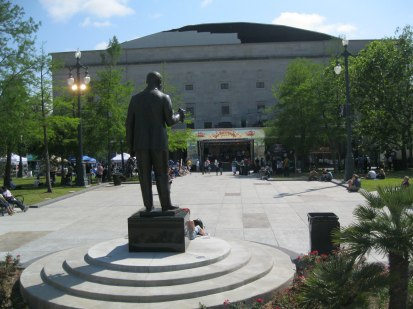
As might be expected, a larger than life statute of Louis Armstrong holds a prominent spot in the park overlooking the unused auditorium.
Louis Armstrong grew up not too far from where his statue stands in the park. In fact, his statue stares in the direction of Storyville – a legal red light district that provided brothels, saloons and steady flow of clientele who enjoyed the music that evolved into jazz. it was this neighborhood that Armstrong grew up and began playing the horn. Once he left New Orleans for Chicago, he rarely returned but his impact on the city looms large like the statue over his park.
The statute of Buddy Bolden in the Louis Armstrong Park captures his improvisational, open style of play.
If any one person could be considered the father of Jazz, Charles “Buddy” Bolden would likely have the strongest claim, and yet there is not a lot we know about his life except that for about seven years, he was the hottest musician in New Orleans. Bolden played his coronet by ear blending the many sounds he heard including rag time, gospel and blues to create an improvisational style of music that inspired other jazz pioneers. His career was cut short in 1907 when he was committed to an asylum possibly suffering from schizophrenia.
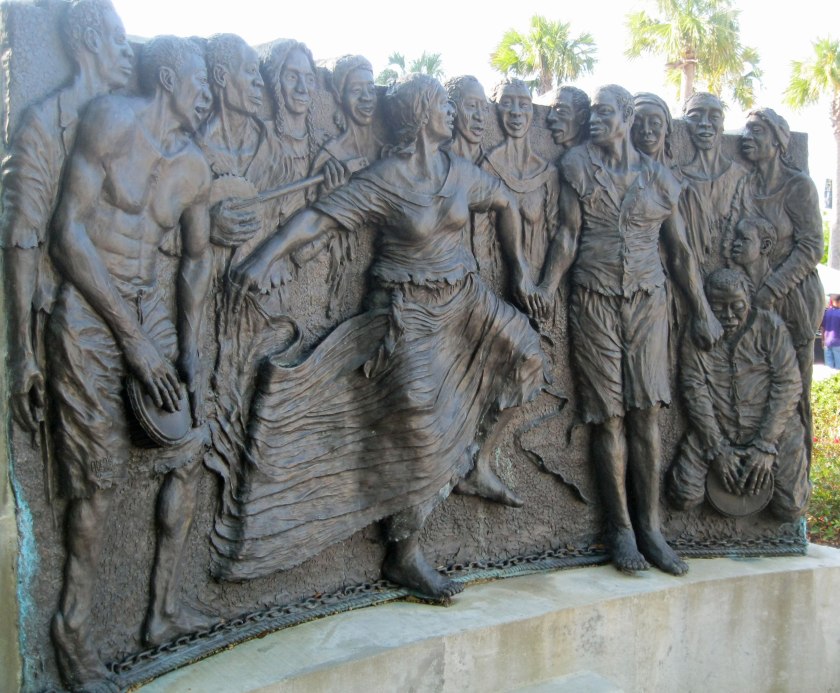
The grounds of the park are sacred because its where African Americans, slaves and free blacks, gathered on Sundays to trade, talk, play music and dance. Congo Square is widely recognized as the cauldron from which the rhythms of jazz emerged. Part of this area has been renovated and a sculpture depicting the Sunday jazz session quickly captures the visitor’s eye.
Congo Square Memorial
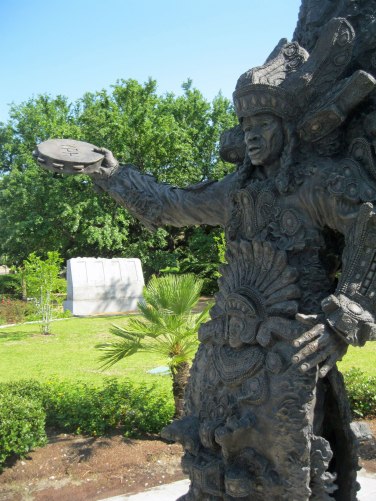
The Black Indians of Mardi Gras do not perform jazz but rather perform their own unique percussion based music that includes call and response vocals. The park also includes a statue honoring the Chief of Mardi Gras Indian Chiefs, Allison “Tootie” Montana, Big Chief of the Yellow Pocahontas. Tootie Montana is known for elevating the practice of masking as Native Americans to a high art form. Originally a tradition that involved revenge and violence, Mardi Gras Indians today are revered for their detailed use of beads and feathers in constructing elaborate costumes. The goal is not be the toughest, but the prettiest.
Today would be Cosimo Matassa’s 91st birthday. While not a professional musician, it would be difficult to imagine New Orleans music history without his J&M studio on Rampart Street, and later on Governor Nichols, where Fats Domino, Little Richard, Lee Dorsey, and hundreds of others cut their original R&B classics. Here’s a bit about him from this blog.
I’ll feature some choice selections from the Matassa heyday on today’s show. I’ll also play recent releases from the Smoking Time Jazz Club, Debbie Davis and Josh Paxton and the Dirty Bourbon River Show.
Because of all this northwest rain, I’ve been feeling blue so I pursued my version of retail therapy. This means cruising the Louisiana Music Factory’s website and backfilling on some serious gaps in my collection. So listen for Charmaine Neville, Kirk Joseph and some surprises from the Orleans Record compilation.
I’ve been busy with other non-radio projects the last few months but I’ll be posting new content soon. Thanks for reading and don’t forget to listen as well. Love you.
If you’re a sucker for a good mystery like I am, then you might appreciate the story of Kid Stormy Weather. That is, what little of the story we know. (Here’s the podcast of my radio show that goes with this story or click the player below.)
We know that Edmond Joseph, recorded two songs on October 17, 1935 with Vocalion records, apparently at a mobile recording unit in Jackson Mississippi. Those two songs are the only tangible evidence of Kid Stormy Weather’s musical career. The rest is more legend than record.
Professor Longhair apparently cited Kid Stormy Weather as an influence on his piano style
Professor Longhair apparently cited the barrelhouse pianist as an influence. Henry Roeland Boyd was 17 years old in 1935, just the right impressionable age to be sneaking into the South Rampart honky-tonks that Kid Stormy Weather allegedly inhabited. But we just don’t know where the “Kid” came from, when he died or how he became an influence on the unique, fluid piano style of Professor Longhair.
In the two sides he recorded, “Short Hair Blues” and “Bread and Water Blues,” his quick hands are on display but its also apparent that the recording unit only captured a taste of his talent. Unless there is an oral history out there not available on the Internet, Edmond “Kid Stormy Weather” Joseph’s story may very well be lost to history.
We know more about other New Orleans blues artists though. Two that I’ll be focusing on with this week’s show (along with Kid Stormy Weather) are performers who performed early in their careers in minstrel shows.
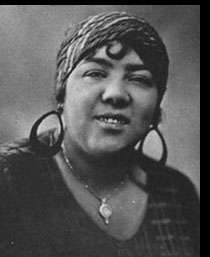
Lizzie Miles
While Lizzie Miles, born Elizabeth Mary Landreaux, didn’t think of herself as a blues singer, her early recordings were most definitely in that genre. Born in the Marigny neighborhood of New Orleans in 1895, she initially worked with jazz pioneers King Oliver, Kid Ory and Bunk Johnson before they had migrated to Chicago. She then toured with minstrel shows through the south eventually performing in Chicago, and Europe and recording with Jelly Roll Morton in New York. And like many New Orleans musicians, she found her way home near the end of her life, dying in 1963. I’ll be playing “I Hate a Man Like You” on this week’s show.
Creole George Guesnon played banjo and guitar and was prolific song writer. . He got his first big break playing with Celestin’s Original Tuxedo Jazz Orchestra. The next year, he replaced Danny Barker in Willie Pajaud’s orchestra. He performed with the Rabbit Foot Minstrels and found his way to New York, recording with Decca and living briefly with Jelly Roll Morton. He served with the Merchant Marines during World War II and then returned to New Orleans performing with Kid Thomas and showing up regularly at the new performance space at the time, Preservation Hall. He died in 1968 and was buried in St. Louis Cemetery No. 2. I’ll be playing his “Graveyard Love Blues” on this week’s show. Hope you can join me.
So much great music, I couldn’t put it all in one post so here’s part two. (Check out 2016 Part 1) As you will quickly notice, there is no order to my lists. The only rule is I only list music from New Orleans (and nearby locales) I play on my show. Like the following:
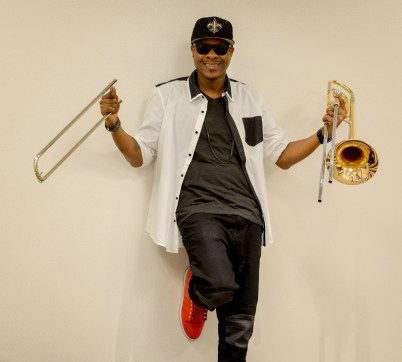
Corey Henry
Corey Henry – I’ve been waiting for Lapeitah, Henry’s debut solo album, ever since I heard “Boe Money” the song that carries his nickname on Galactic’s 2010 Ya Ka May release. Henry’s powerful trombone and songwriting mix of funk, R&B, soul and hip hop creates the experience I associate with the music I hear at New Orleans nightclubs. It’s no coincidence that Henry and his Treme Funket was the undisputed heir apparent of Kermit Ruffins legendary Thursday spot at Vaughn’s. Lapeitah does an excellent job of putting you in that Ninth Ward club with him.
The New Orleans Suspects – Just as you would not want to ever miss a live performance of the New Orleans Suspects, you should not go without possessing their fourth album–and second one with original songs. Kaleidoscoped delivers eight original numbers that makes me miss New Orleans and the original grooves that these journeymen musicians produce.
Kenny Neal – Bloodline hooks you from the opening number “Ain’t Gon Let the Blues Die.” And the rest of the album holds true to the promise. Nominated for best contemporary blues album grammy, this 2016 release is a full nod toward the amazing support this successful blues artist has received from his family members, who back him up on vocals and instruments throughout the album.
Bobby Rush – Porcupine Meat just scored Rush’s fourth grammy nomination– this time for best traditional blues album. Though he lives in Mississippi by way of Chicago and his birthplace Homer, La., this release is actually the first one that the 83-year-old blues veteran has recorded in New Orleans and some cool folks stop by to help out, such as Cornell Williams (bass), Kirk Joseph (sousaphone), Shane Theriot (guitar), and David Torkanowsky (keyboards). Be sure to cue up and listen to “Funk O De Funk.”
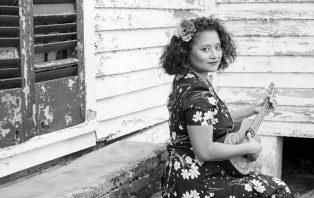
Miss Sophie Lee – Nightclub owner Sophie Lee returns to the recording studio with Traverse the Universe. She has a sweet voice and her band does a nice turn with the handful of standards on the album but its her original songs, particularly her title track, that had me reaching for it to play regularly on my show.
Jeff Chaz – Chaz and his trio are hardworking blues musicians who can be seen regularly playing on Frenchmen Street and the French Quarter. He put out two releases this year: Sounds Like the Blues to Me and The Silence is Killing Me. Both are solid blues albums with numbers like “Fried Chicken Store” and “Savin’ Everything for You.” The latter release offers a holiday tune as well – “Merry Christmas to You.”
Herlin Riley – A regular with the Lincoln Center Jazz Orchestra, Riley can be a straight up jazz drummer but there’s no question where his roots lie. As he says: “As a boy growing up in New Orleans, way before you heard that big bass drum in the street parades, you could feel it coming from four or five blocks away, and it would literally beckon you to come on down to the street, check out this music, and participate in it. ” Riley jazzes it up on New Directions but by the time you get to his hip version of Tutti Ma, you will like the direction he’s headed.
Dr. John – Recorded in 2014 in the historic Saenger Theater on Canal Street in New Orleans, The Musical Mojo of Dr. John offers two discs of many of New Orleans elite such as Irma Thomas, Cyril and Aaron Neville, Anders Osborne, Big Chief Monk Boudreaux, Zigaboo Modeliste and Dave Malone, paired with familiar outsiders like Bruce Springsteen, John Fogerty, Chuck Leavell, and Mavis Staples. With the venerable Mac Rebennak (Dr. John) in the middle, how can you not be satisfied wit dat package!
Smoky Greenwell – Another visiting musician who came to the city for a gig and stayed a lifetime, Greenwell has been cranking out the blues in New Orleans for 35 years and his last two releases are arguably his best. I particularly like it when he puts down his harmonica and reaches for his saxophone on South Louisiana Blues.
Gina Forsyth
Gina Forsyth– This New Orleans-based musician is wickedly good on fiddle and guitar. Yea, you don’t expect this type of music in New Orleans. So what. Copper Rooster and Other Tunes and Tales provides a dozen and a half smile inducing old timey numbers that will have you reaching for the play again button.
Mark and the Pentones – This blues trio, fronted by guitarist Mark Penton, may be one of the best reasons to stumble down Bourbon Street. Currently anchoring the swing shift at Funky Pirate Blues Club on Fridays and Saturdays, the Pentones released its debut album, Don’t Leave Nothin Behind, late last year with some subtle surprises among the 11 tracks. I particularly like “Jodie,” “Too Many Second Lines” and “I B Cing You.”
Keith Stone – The Prodigal Returns is the aptly named debut album of a native New Orleanian who sowed some wild oats in the 90’s as an area blues guitarist, settled down to be a minister in Kentucky and then came back home after Hurricane Katrina. The album features playful piano, strong guitar licks, and a solid horn arrangements. If you’re a dislocated NOLA homeboy feeling the tug of that big magnet at the end of the Mississippi River, this album will talk to you.
Louisiana Soul Revival Featuring Doug Duffey – Okay, I’ve wandered all the way up to Monroe, La. to grab this one. But all’s fair if the music is great. From the distinctive bass line opening of “Funky Bidneh” to the inviting saxophone on its last track “Love Into My Life”, this band’s debut release has a full sound that puts you front and center of your own Soul Revival.
Anders Osborne – This prolific musician, songwriter, and producer released two albums this year. Spacedust and Ocean Views and Flower Box. My station didn’t get Flower Box (that happens but don’t let it happen to your album) and I almost missed Spacedust because the music director justifiably placed it in our Folk, Country and Bluegrass shelf. I love his voice and his songs and I don’t care what shelf I have to check, I’ll be regularly reaching for his music to play on my show.
Allen Toussaint – This one breaks my heart. A year after his death, I still grieve. American Tunes is his last studio album, released this year posthumously. There’s little between you and Toussaint other than his piano, a drummer and bass. He doesn’t even sing except on a Paul Simon cover– though others do. As I listento him run through Big Chief , he’s in the room with me, playing the piano, with his leather sandal and sock clad feet working the pedals.
Now don’t forget that you can catch my show on a live stream at http://www.kaosradio.org every Thursday from 10 a.m. to noon Pacific Coast Time and I serve up podcasts of past shows as well. Also, you here’s part 1 of this post.
Here’s this year’s survey of New Orleans music releases that deserve your attention. This is music I played on my radio show Sweeney’s Gumbo YaYa. (By the way, so many release, here’s Part Two )
Eric Lindell – When I listen to Matters of the Heart, I imagine an artist on a serious Zoloft high. When I first started playing this CD on KAOS, it seemed liked every track bubbled over with happy feelings and love. But there’s deep stuff as well on this release that harken back to Lindell’s blues days. This is a strong release that just makes me wish even more he would break out of his habit of only touring sunny places and get his happy butt up to the Northwest.
Honey Island Swamp Band – When Hurricane Katrina stirred a serious dose of New Orleans talent into our national musical melting pot, four New Orleans musicians found themselves in San Francisco and formed this band. Demolition Dayis its second full-length album and the first recorded in New Orleans — under the direction of North Mississippi All-Stars Luther Dickinson, who also co-produced Lindell’s release. The CD captures the essence of the band’s jam band live personae while delivering tight singular songs that define the band’s self-described genre “Bayou Americana.”
John “Papa” Gros
John “Papa” Gros – After over a dozen years fronting Papa Grows Funk, which anchored the Monday slot at the famed Maple Leaf Bar, this standout keyboardist has produced a solo release that reflects the wide range of his talent and interests. River’s on Fire has it all: rock, funk, reggae, a love song, and a serious nod to mentor and New Orleans saint, Allen Toussaint. I hope new releases become an annual Papa ritual.
Benny Turner – With his fourth release, this veteran bluesman takes us back with a set of previously recorded but hard to find funky, blues numbers, including a duet with Marva Wright, the powerhouse New Orleans blues and gospel singer who died in 2010. Turner played bass and managed Ms. Wright’s band for 20 years. What a treat it is to hear her voice again on “Pity on this Lovesick Fool.” The CD’s title track “When She’s Gone” is about another important woman in Turner’s life, his mother
Dee-1– As a card-carrying AARP member, I’m not qualified to review rap. But David Augustine Jr., who performs under the name Dee-1, doesn’t care because this inclusive artist erects a big enough tent for us all to be in and listen to his stories. Originally attracted by the humor he expresses in paying off his student loan (Sallie Mae Back) and his love for his aging but paid for car (NO Car Note), I find myself drawn to the many other fine tracks on his 2016 mixtape Slingshot David– released on the heels of the Alton Sterling shooting in Baton Rouge this summer.
Leyla McCalla – Singing in Haitian Creole, French and English and accompanied by her own haunting cello playing, Leyla McCalla digs deep into the roots tying Haiti and New Orleans together. A Day for the Hunter, A Day for the Prey is an exploration of the oppressed and the oppressor and an excellent follow up to her previous release where she put music to the words of Langston Hughes.
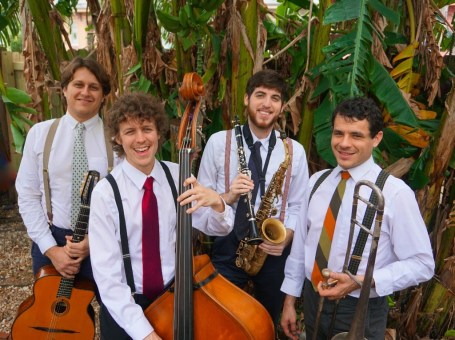
The Roamin’ Jasmin –Taylor Smith, leader and bass player of The Roamin’ Jasmine, once again demonstrates with his band’s second release his genius at fresh, upbeat arrangements of obscure blues, jazz, rockabilly and R&B tunes. An amazing achievement for this young New Orleans transplant. I’d be remiss if I didn’t mention that his five original numbers, including the title track Blues Shuffle Heart, are quite good.
Meschiya Lake –She is such a kick. In fact, you and your partner will be kicking up your heels on the living room rug every time you play Bad Kids Club, released December of last year but close enough to count in this year’s summary. Looking for the slow number, no problem. Her songs are listed by beats per second. This release showcases a singer and band arriving at peak performance.
Lena Prima – Blessed with a strong voice and famous pedigree, Lena Prima and the Lena Prima Band demonstrate that hard work doesn’t hurt either. This tight group has provided countless evenings entertaining Carousel Room patrons at the Monteleone Hotel. And that experience pours out in the nearly solid hour of hip-swinging numbers on Live at the Dew Drop Jazz & Social Hall. Play this release, close your eyes and transport yourself.
Cha Wa
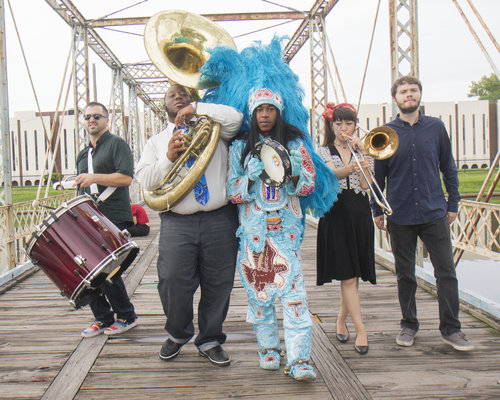
Cha Wa -. With vocals by Creole Wild West Spyboy Honey Banister and J’Wan Boudreaux, grandson of Big Chief Monk Boudreaux, Funk ‘n’ Feathers is helping to expand the audience for the music of the Mardi Gras Indian — a truly original cultural tradition in New Orleans. The release got a lot of play not only on my show but also other KAOS world music programs in our shared weekday time block. If you’re familiar with Mardi Gras Indian songs, you’ve heard it all before. But not quite this way.
Roddie Romero & the Hub-City All-Stars – I have not been totally faithful to New Orleans on my radio show this year and this group is one reason why I’ve been reaching upriver to Lafayette for additional tunes. The product of boyhood friends Roddie Romero and keyboardist/songwriter Eric Adcock, Gulfstream makes rural Louisiana come so alive you can smell the salt tang of the bayou just by listening to it. (Breaking News – Gulfstream is a 2017 Grammy nominee for Best Regional Roots Music Album. Here’s more about the album.
Darcy Malone and the Tangle – Still Life has a retro Alt Band feel with some fun twists . Clearly, the Tangle is not your typical Frenchmen Street band. But it could only happen in New Orleans. Darcy is the daughter of The Radiator’s guitarist Dave Malone, and the saxophone and keyboards that keep things interesting are by LSU music grad Jagon Eldridge. Here’s your proof that the NOLA music scene continues to grow.
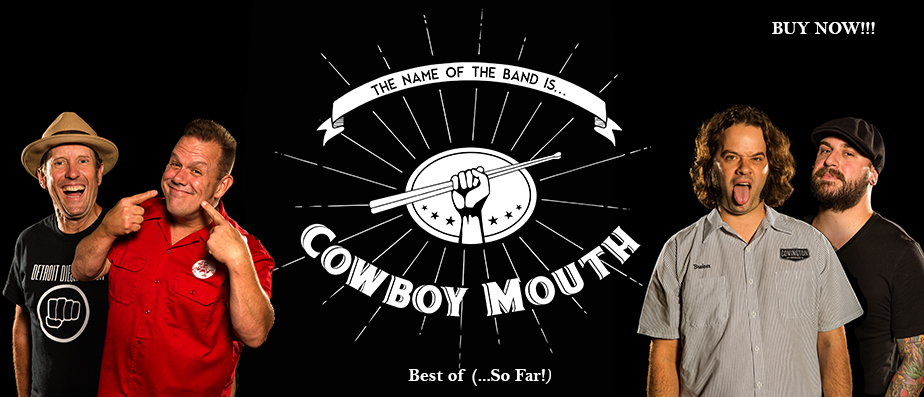
Cowboy Mouth: Speaking of which, this band has been challenging the New Orleans music stereotype for 25 years. The Name of the Band Is… provides new recordings of nine of the band’s regular live show songs and three fresh tracks.The band’s strength continues to be drummer Fred LeBlanc’s sharp and clear vocals that showcases the lyrics, which you want to hear, while still allowing you to rock out.
I’ll be back next week with more releases from 2016. Until then, catch my show. Oh, and here’s the podcast of one of the 2016 Review shows.


 The show kicks off with Theryl “Houseman” Declouet with his infamous introduction regarding the third world status of New Orleans at a Galactic concert and flows quickly into Shamarr Allen’s “Party All Night.” Al Hirt takes a turn and so does patron saint of this website and the show,
  As the bandleader and composer for The Roamin’ Jasmine, Smith has become well acquainted, as do most successful New Orleans musicians, with the city’s traditional jazz standards. But its been his ability to apply a New Orleans style rhythm and blues spin on classic blues numbers that sets his music apart.

 The Black Indians of Mardi Gras do not perform jazz but rather perform their own unique percussion based music that includes call and response vocals. The park also includes a statue honoring the Chief of Mardi Gras Indian Chiefs, Allison “Tootie” Montana, Big Chief of the Yellow Pocahontas. Tootie Montana is known for elevating the practice of masking as Native Americans to a high art form. Originally a tradition that involved revenge and violence, Mardi Gras Indians today are revered for their detailed use of beads and feathers in constructing elaborate costumes. The goal is not be the toughest, but the prettiest.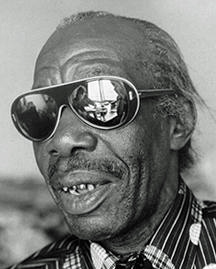
 Miss Sophie Lee
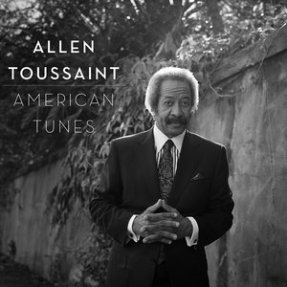 Allen Toussaint – This one breaks my heart. A year after his death, I still grieve. American Tunes is his last studio album, released this year posthumously. There’s little between you and Toussaint other than his piano, a drummer and bass. He doesn’t even sing except on a Paul Simon cover– though others do. As I listento him run through Big Chief , he’s in the room with me, playing the piano, with his leather sandal and sock clad feet working the pedals.
 Sweeney's Gumbo YaYa