African American NOLA musicians rocked the nation

With the onset of African American History Month, I thought it worthwhile to address the role of New Orleans in launching Rock n’ Roll. Cause the very fact that the city’s contribution is relatively unknown is a reflection in part of the broader subjugation of the African-American credit for creating the music in the first place.

Whether you date the beginning of Rock n’ Roll to Louis Jordan’s Saturday Night Fish Fry, Roy Brown’s Good Rockin’ Tonight,  Fats Domino’s The Fat Man, or even the non-New Orleans recording of Rocket 88 by Jackie Brenston, what’s abundantly clear is that this music originated from African Americans–not white boys like Elvis Presley and Bill Haley.

Alan Freed, the white deejay credited for popularizing the term Rock n’ Roll, essentially used the term to rebrand Rhythm and Blues which was associated with black music. For that matter, the term Rhythm and Blues was created by a Billboard Magazine writer in 1949 to replace the previously used term “Race Music.”
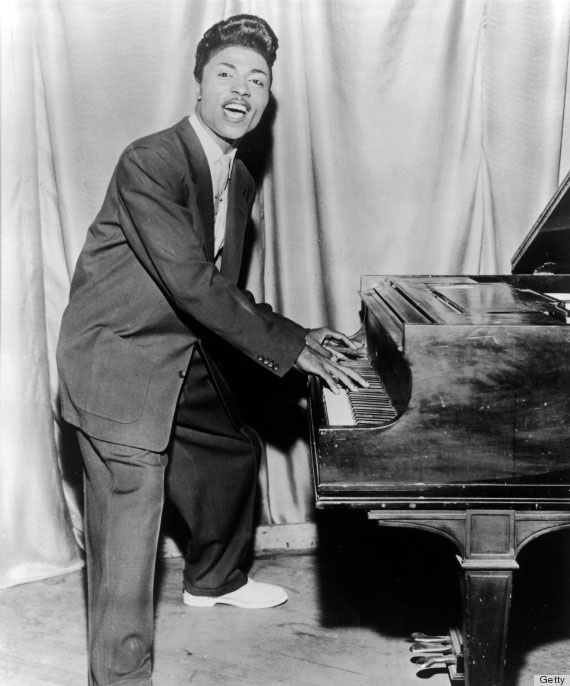
littlerichard
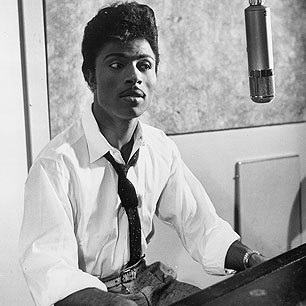
Little Richard recorded almost all of his big hits in New Orleans.

Back to New Orleans, many of these early Rock hits were recorded in the J&M Studio on Rampart Street on New Orleans — located within a Russell Wilson touchdown pass of Congo Square where people of color (free and enslaved) gathered on Sundays and practiced the drum beats and rhythms that fueled jazz, swing, jump blues and Rock n’ Roll.  The studio also recorded a great many other early Rock hits, including almost all of Little Richard’s hits.

Through radio, white youth were exposed to black artists–a wonderful testament of the integrating power of the air waves.  In a bizarre twist, some white deejays hosted “Rhythm and Blues” shows and pretended to be black when introducing the songs. To sound authentic, a New Orleans deejay hired an African American to write his script.

While Fats Domino is unlikely to be included in the pantheon of civil rights leaders, his music and performances went a long way toward breaking down the walls of segregation. First, his records sold more than any artists other than Elvis during the 50s. (One million copies of The Fat Man were sold within the first three years of its release)

But it was in Domino’s performances where push came to shove. After all, can you really stand still to his music? (Go ahead, try!) Even though performance halls attempted to segregate white and black audiences, dancing ensued and elbows rubbed, flummoxing police and other security who often caused riots by trying to break up the mingling.

Antoine “Fats” Domino was on the vanguard of Rock n’ Roll, performing to white and black audiences and selling more records than any other Rock musician, except for Elvis.

That mingling particularly scared Southern segregationist who contributed to the public venom poured on Rock n’ Roll, providing more than the usual incentive for music promoters to put a white face on this popular music.

Yet Domino continued to perform throughout the country, at a time when black musicians often had to sleep in their cars or buses because hotels would not accept them.

When he appeared on television, his band, all African American musicians, were often hidden from sight.

If you’re interested in learning more about Fats Domino during his period, I recommend “Blue Monday: Fats Domino and the Lost Dawn of Rock n’ Roll” by Rick Coleman. It was Coleman’s book who tipped me off to the Pat Boone shadow.  Boone recorded a number of African American rock numbers, illustrating just how easy it is to sap the soul from a number.

Here is Fat’s doing Ain’t That a Shame.  And here’s Boone doing the same song which he apparently wanted to retitle “Isn’t That a Shame”. . . It sure was.
Mardi Gras Indians integral to New Orleans sound

You cannot truly understand New Orleans music without having some awareness of the Black Indians of Mardi Gras, or what is more commonly referred to as “Mardi Gras Indians.”

This more than century-old tradition of certain African Americans in New Orleans wearing elaborately designed, handmade suits in honor of Native Americans on Mardi Gras Day belies any easy explanation.

I like the Folklife in Louisiana tribute to Allison “Tootie” Montana as a good starting point on this unique folk tradition.  (I also highly recommend again the book “Nine Lives” which features Tootie’s story from the perspective of his wife, Joyce Montana).

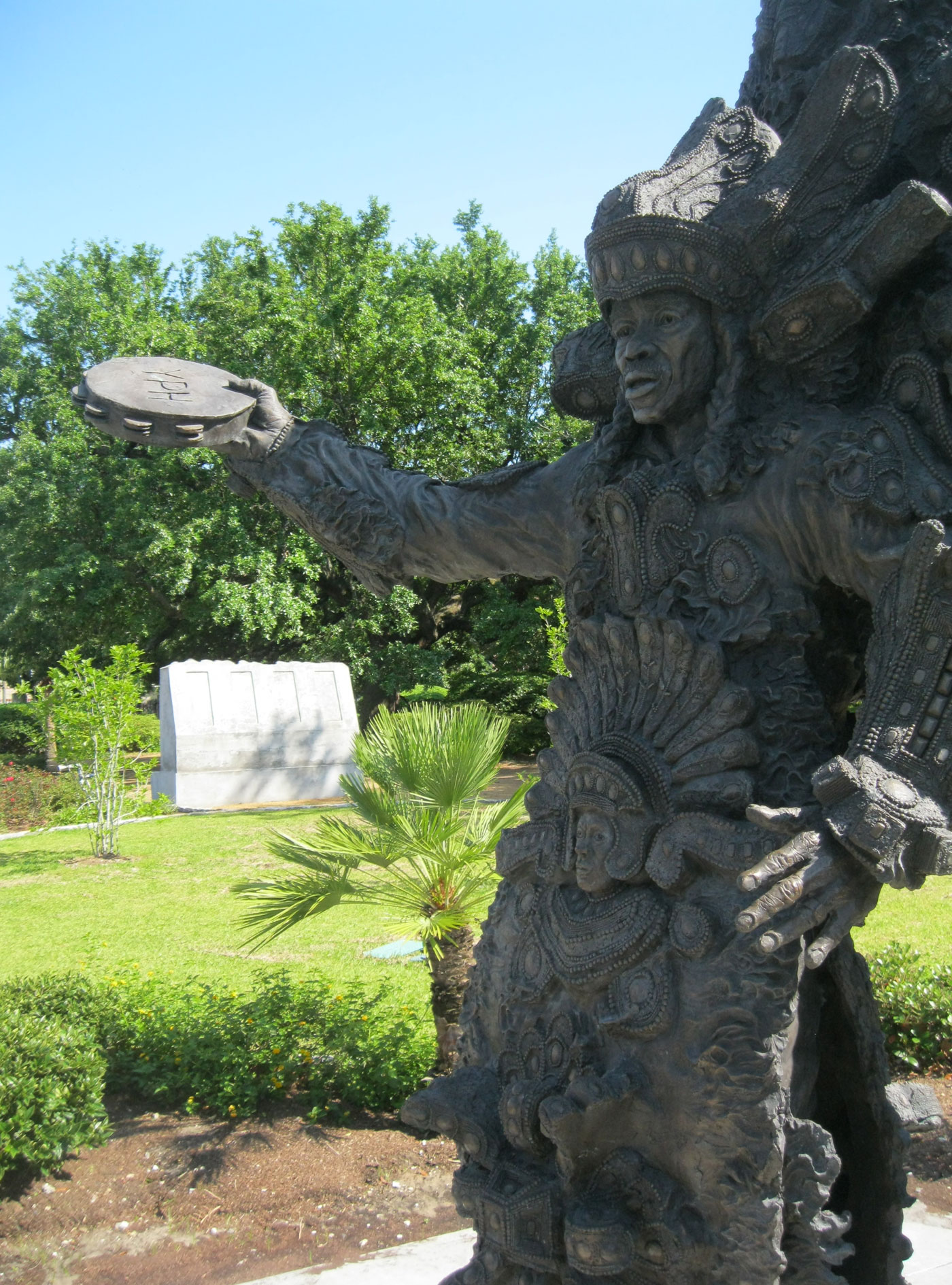
Big Chief Allison "Tootie" Montana is remembered with this statue in Louis Armstrong Park on Rampart Street.
Big Chief Allison “Tootie” Montana is remembered with this statue in Louis Armstrong Park on Rampart Street.

Tootie Montana was known as the Chief of Chiefs for his role in elevating the practice of “masking” and “suiting” up to a high art. In an effort to diminish the violent history of Mardi Gras Indian gangs, Montana incorporated sequins, beads and large garish feathers into his suit, using egg cartons for an undercarriage that provided a three-dimensional look. His stunning suit changed the game by swapping the battlefield weapons of guns and knives with needle and thread.

While you should feel lucky and relatively safe if you ever have a chance to observe a Mardi Gras tribe in full display, the violent tradition still colors their music and rituals. Make no mistake about it, there is still rivalry. But instead of who is the toughest, the goal is who is the prettiest.

A percussion-driven music is an essential part of this tradition with the tambourine being the most common instrument. The songs speak to the traditions and history of the Mardi Gras Indians, using words with origins that reside deep in the linguistic stew of New Orleans and is more simply stated as “creole.”

Author Jay Mazza who was lucky as an outsider to observe a Mardi Gras Indian practice, describes the music this way in his book Up Front and Center:

“The lyrics of Mardi Gras Indian music are based on boasting and improvised vocal rhymes. Each Indian took a turn until he ran out of words, began repeating himself or was pushed out of the spotlight by another Indian.”

Not surprisingly, the words, rhythms and vibe of the Mardi Gras Indian have worked into New Orleans music in countless ways.

Songs like Jock-O-Mo by Sugar Boy Crawford and Iko Iko by The Dixie Cups  draw their origins from Mardi Gras Indian chants. Earl King’s historic “Big Chief” which was recorded with Professor Longhair has references to the Chief’s “Spy Boy and Flag Boy” both important roles in the tribe. These were musicians who borrowed from the tradition.

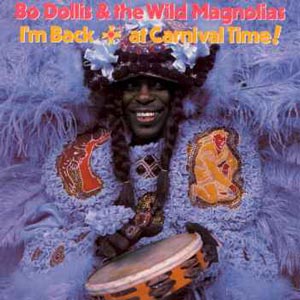
Big Chief Bo Dollis brought the music and rhythms of Mardi Gras Indians to music lovers everywhere. He died January 20 after a long illness.

It wasn’t until the early 70s, that the world heard the real thing outside of New Orleans. Bo Dollis, Big Chief of the Wild Magnolias, and Monk Boudreaux of the Golden Eagles collaborated on recordings, starting with the single Handa Wanda and later two albums in 1974 and 1975 respectively. Both continued to record and perform with their own gang and other musicians over the years. Last Tuesday, January 20, Bo Dollis died and the city is mourning.   Monk continues to perform and will be at this year’s New Orleans Jazz & Heritage Festival.

The Wild Magnolias recordings were followed closely by an album release of Wild Tchoupitoulas. George Landry, otherwise known as Big Chief Jolly of the Wild Tchoupitoulas, fronted a powerful group of musicians, including his nephews Cyril, Art, Charles and Aaron Neville, in a seminal album of Mardi Gras Indian songs. On the back and inside cover of the Neville Brothers’ release Fiyo on the Bayou where they reprise some of the songs, you’ll find a tribute to Chief Jolly.

If you are a Treme fan, then you’ve witnessed the fictional story of Albert Lambreaux, the Big Chief of the Guardians of the Flame. The model for this character is the real chief of the Guardians of the Flame, Donald Harrison Sr. whose son, Donald Harrison Jr. has applied his highly regarded jazz musicianship to fusing jazz and Mardi Gras Indian rhythms in some of his recordings, including Spirits of Congo Square.

To get more detail on the music of Mardi Gras Indians, I recommend this article by former WWOZ Show Host Thomas Morgan. To hear more of this music as well as other great New Orleans music, be sure to tune in on Monday for Sweeney’s Gumbo Ya Ya.

Your 2014 New Orleans music buying guide – Part 1

Here’s my Holiday buying guide of 2014 releases for that special person in your life who digs music from New Orleans.  Don’t know anyone like that?  Yea, you do. (This is actually Part 1. I’ve added a Part 2.)


Let’s stay in touch, sign up on the right to follow my blog


One caveat: I’m still trying to  get KAOS on the distribution list of New Orleans artists. Thank you Basin Street Records, Alligator Records, Vizztone and Louisiana Red Hot Records (all amazing independent labels) for sending KAOS your new releases. If someone’s missing, here’s how they can hook up with my show. 

The Revivalists – – This seven member contemporary rock group with a New Orleans flair has been exciting audiences since 2007. The City of Sound double disc wisely includes a live set so you can get a feel for the band in action.

Hurray for Riff Raff – Alynda Lee Segarra may be from New York but she found her passion and honed her talent on the streets of New Orleans.  Small Town Heroes, the latest from this Americana songwriter puts a fresh spin on roots music.

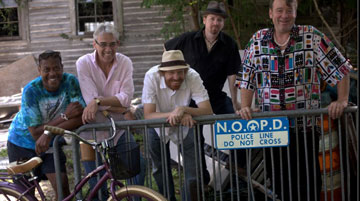
The New Orleans Suspects nail it with their release Ourboros.
The New Orleans Suspects, with journeymen musicians from classic NOLA bands, make their own history with Ouroboros.

New Orleans Suspect – Third release is the charm for this textbook gumbo yaya band that draws direct influences from the Meters, Nevilles, Dirty Dozen Brass Band and The Radiators. Destined to make my overall top 10 list for 2014, Ouroboros means the Suspects no longer need to be compared to their previous projects.

Glen David Andrews – He’s Troy Andrews cousin but don’t expect Trombone Shorty despite Glen’s awesome trombone work. Instead you’ll get a double shot of gospel and soul in Redemption, growled out by an unrepentant preacher who has no intention of ceasing his prowling of nightclubs. Thank goodness.

Jimmy Carpenter – This blues saxman with Walter Wolfman Washington’s band on his resume’ hits full stride on his second solo release, Walk Away.  Carpenter offers up smooth, swingy blues with wonderful touches that make it clear where he calls home.

Ingrid Lucia – If you only know her wonderful version of “Zat You Santa Claus,” Living the Life is your opportunity to fall deeply in love with this voice, starting with her opening track, “Do You Remember Walter.”  We didn’t get this album at KAOS but I’ve gradually been buying tracks, like “Put the Radio On,” since she released this album.

Royal Southern Brotherhood Cyril Neville’s vocals complement this royal group of southern blues artists (Devon Allman, Yonrico Scott, Charlie Wooten and Mike Zito). Another entry for my top ten list,  HeartSoulBlood magically fuses blues to soul and R&B. Speaking of magic, Magic Honey was Cyril’s solo release this year.

Lena Prima comes home in body and spirit with Starting Something.

Lena Prima is living testament to writer Chris Rose’s posit that “New Orleans girls never live anywhere else and even if they do, they always come back.”  Starting Something tracks the return of the prodigal daughter of Louis Prima to New Orleans. The more you listen, the more you’ll be delighted she came home.

Henry Butler – Brilliantly paired with New York trumpeter Steven Bernstein, Henry Butler demonstrates his virtuosity on piano while providing something for almost every Jazz taste on Viper’s Drag.

Louis Prima Jr. – Lena’s little brother demonstrates how to make swing and rock and roll relevant and hip in the 21st Century. With Blow,  Louis Junior goes his own way without straying too far from his pop’s tree. He and his band are not NOLA based but the album provides more than a passing nod to the city where he first connected with music.

The Last Hombres Odd Fellows Rest is a product of a band that has been rambling about for over a decade until the drummer settled down in New Orleans and invited the band to bunker down and find their collective muse. Combine the pedal steel of The New Riders of the Purple Sage with songwriting reminiscent of Tom Petty and throw in some tasteful Hot 8  Brass Band and you have a CD that gets better with every spin.

Flow Tribe – Self described as “bizarrely irresistable,” this funk rock band of six genuine NOLA hipsters (with birth certificates to prove it) give you a taste of what its like to see them live with five upbeat studio tracks on Alligator White. (See if you can catch their reference to what’s been described as the best dive bar in New Orleans.)

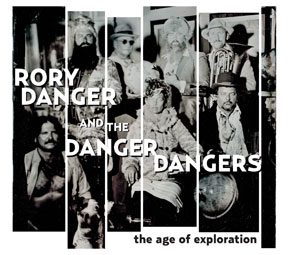
Rockabilly does quite capture the adventure that Rory Danger and the Dangers Dangers offer in The Age of Exploration.
“Rockabilly” does not quite capture the adventure that Rory Danger and the Dangers Dangers set listeners on in The Age of Exploration.

Rory Danger & the Danger Dangers  The perfect gift for the historian/adventurer on your list, Age of Exploration is the first release of this New Orleans rockabilly group. This Shackleton-themed concept album is largely the product of hardworking reeds-woman Aurora Nealand.  Another CD that hasn’t found its way to KAOS, I’ve only heard the two tracks I’ve purchased online but I want more.

The Iguanas – This year brought us, Juarez, the eighth album by a venerable New Orleans group that has been keeping dancers happy by blending Latin styles with New Orleans groove. If you have ever seen them live, say at Rock ‘N’ Bowl, you know what I’m talking about.

Billy Pierce and Friends – Fine slide blues made exceptional on Take Me Back to the Delta by his “friends,” notably Sonny Landreth, Jimmy Carpenter, Waylon Thibodeaux and the guys who put the Bone in Bonerama (Craig Klein, Mark Mullins and Greg Hicks). It’s not all New Orleans music but by the time you get to “Give Me A Dollar,” it won’t matter.

Marcia Ball – She may be from Texas but she has her NOLA residency card for reasons that are amply supplied by The Tattooed Lady and the Alligator Man. How does she do it?

Rebirth Brass Band – Erasing all doubt that they could top their grammy winning Rebirth of New Orleans album of 2012, these guys did that and more with Move Your Body.  After 31 years of playing all night gigs and second lining, Rebirth is doing their most entertaining work.  Want to loosen up a boring party, play the track HBNS.  Oh yea! (A no brainer for my top 10)

Wow!  So much music and I’ve got more to write about and play. I’ve written Part II to this guide. I’ll be playing only new music December 8 and 15, from 10 a.m. to noon, KAOS 89.3 FM, Olympia.

(If you missed December 8, here is the playlist.)

NOLA studio and sound nerd help launch rock and roll era

Behind every great recording and concert, there’s a sound nerd making sure you hear what you’re supposed to hear.  In the case of Cosimo Matassa, what people heard was the beginnings of rock and roll.

Starting with “Good Rockin’ Tonight”, through “The Fat Man,” “Lawdy Miss Clawdy,” “Shake, Rattle and Roll,” “Let the Good Times Roll,” “Tutti Fruti, “Rockin’ Pneumonia,”  “I Hear You Knockin,” and great many more, Matassa ensured the fidelity and sound quality of these early R&B and rock and roll hits.

Cosimo's recording career started out with using primitive equipment located in the back of an appliance and music shop.
Cosimo’s recording career started out with using primitive equipment located in the back of an appliance and music shop.

In 1945 at the tender age of 19, Cosimo opened an appliance store with a partner in New Orleans, hoping to take advantage of the pent up demand for home conveniences and the many new households that were forming after the war. The store also sold records.

His partner suggested they make recordings for their customers. Cosimo, being the more technical of the two, took on the task of getting that business going.  As a former Tulane chemistry major, he was your classic nerd.  But having spent a few years working with his Dad’s jukebox business, repairing the equipment and swapping out 78 rpm records, he was a nerd with an ear for music.

The J&M Music Shop was at the right place at the right time on the corner of Dumaine and Rampart, sitting between the French Quarter and the Fauberg Treme’ neighborhood – a center of African-American and Creole culture and home to many New Orleans musicians.

After World War II, people were ready to have fun.  And the music, particularly from a new generation of black New Orleans musicians raised on jazz, swing and big band music, was ready to make the party happen.

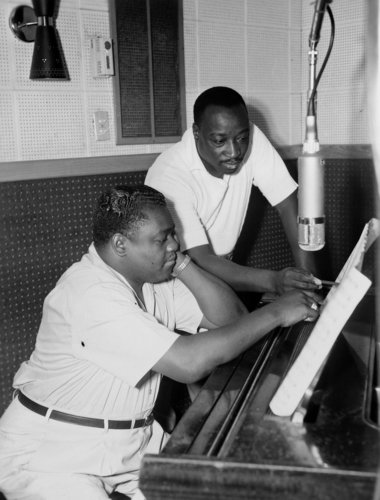
Fats Domino (left) and Dave Bartholomew generated a mountain of hits, all recorded from studios run by Cosimo Matassa.

The studio’s success started with Roy Brown, who had just returned to New Orleans with his Gospel-trained voice and was performing at the famous Dew Drop Inn. It was in the back of the J&M in 1947 that Brown recorded the jump blues song, Good Rockin’ Tonight, a hit that can arguably be considered one of the first Rock and Roll songs.  Just ask Elvis.

Things really took off when horn player and band leader Dave Bartholomew started using the studio for his work as a musician, arranger and talent scout for Imperial Records. Through Bartholomew, early R&B greats like Smiley Lewis, Frankie Ford and Tommy Ridgley would record at the studio. But the star who solidifies the studio’s listing as a Rock and Roll Hall of Fame landmark is Antoine “Fats” Domino.  Through a good chunk of the 50’s, Domino, with able assistance from Bartholomew and Matassa, released a series of R&B hits, finally crossing over into the pop charts with “Ain’t That a Shame” in 1955.  All of the Fats’ recordings as well as hundreds of other R&B and early rock and roll gems were recorded in that little studio.

Cosimo Matassa tat his induction to the Rock and Roll Hall of Fame in 2012.

By 1956, Matassa was no longer selling appliances and had moved his studio to larger digs on Governor Nicholls Street in the French Quarter. Like many successful studios, Matassa’s operation benefitted from a talented group of studio musicians, usually organized by Bartholomew but also by the emerging talent, Allen Toussaint. These musicians included Earl Palmer on drums, Alvin “Red” Tyler and Lee Allen on sax, Frank Fields on bass, Huey Smith on piano and a large rotating cast of others.  The studio sound was so synonymous with success that labels, like Ace, Atlantic, Chess, Savoy, RCA Victor, Imperial and Specialty would send their artists to New Orleans to capture the magic.

Little Richard recorded Tutti Frutti, Good Golly Miss Molly, Lucille, Long Tall Sally and others at J&M studio.

One of the more legendary stories is how Richard Penniman found his mojo at the Dew Drop Inn during a recording break, which led to his breakout hit, Tutti Frutti backed up by the J&M musicians and recorded by Matassa. It’s almost wearying to list the musicians that recorded there, but I’ll add Mac Rebennak (before he became known as Dr. John), Art and Aaron Neville, Professor Longhair, Irma Thomas and Lee Dorsey to this amazing list.

Cosimo Matassa died in September (2014) at 88.  He was generous with his time, so it’s easy to find interviews of him, including one of my favorites.  He modestly takes little credit for the sounds he recorded. But he maintains that the limitations of the early technology were a benefit, requiring musicians to play a song all together from beginning to end, just like a live performance.  His job, he would say, was to get out of the way and let them do their thing.

Obviously, there was more to it than that because all the musicians who worked with him loved this unassuming nerdy son of Sicilian immigrants. His elegance was in his simplicity.  He took care of the technical part, creating an environment where craftsmanship and creativity could merge.

Cosimo Matassa at the controls in Sea-Saint Studios, a studio founded by Allen Toussaint who began his career at J&M Studio. Photo by The Times-Picayune.

“To have a job where you can listen to music all day.  Great way to make a living.  Lot of great New Orleans musicians made me look good.”

Needless to say, I’ll be hammering my collection of Matassa recordings on my next show this Monday, 10 a.m. to noon, KAOS, 89.3 FM. Streaming at www.kaosradio.org.

Going down to St. James Infirmary has been a long trip

“I went down to St. James Infirmary.”

Now that’s an oft taken journey given that song has been a jazz and blues standard since its first recording roughly 90 years ago. One website boasts 121 recorded versions and I’d wager the list is not comprehensive.

sammy duncan
St. James Infirmary is a standard particularly for Dixieland jazz bands like the one lead by Sammy Duncan who played in Atlanta regularly when I was a teenager

As a folk song, St. James Infirmary’s history goes back before the dawn of recording studios. But my history with it started as a teenager when my Dad would take me to see Sammy Duncan, a trumpeter in Atlanta whose band played St. James. It stands as the first song I ever successfully requested at a live music show.

For those unfamiliar, the song is about a man who, upon seeing his dead lover, contemplates his own mortality, including planning his own funeral and making sure he’s buried with a $20 gold piece on his watch chain. A heady story for a hormonal teenager with a coin collection.

The song is often associated with New Orleans perhaps because Louis Armstrong was one of the first to record it (December 1928) and because its often played by New Orleans musicians. However, there is no proven connection to New Orleans where there has never been a St. James Infirmary. In fact, its not clear where St. James Infirmary or Old Joe’s Bar (where the song finds the narrator of the story) are located.

Louis Armstrong may have been the first to record the song as “St. James Infirmary,” but it was earlier recorded as “Gambler’s Blues”

Music lovers and researchers are clearly fascinated by St. James. You’ll find a lot of information on the topic on the web, including two blogs. I’d recommend Robert Harwood’s site which supports his book “I Went Down to St. James Infirmary.”

The short story is the song is believed to have descended from an 18th Century Irish song “The Unfortunate Rake,” about a dying man who laments his life choices, including an affair where he acquired a venereal disease. It’s a cautionary tale of wasted youth– a theme carried out in songs and stories throughout the world.  And according to Harwood, it is not the basis for St. James Infirmary–even though its the explanation you’ll find on Wikipedia.

For Harwood, the song is clearly a product of the “folk” tradition or more accurately, the minstrel tradition that was active at the time. His smoking gun is called “Gambler’s Blues,” first recorded in 1927 by Fess Williams and his Royal Flush Orchestra (cool name) and also printed in Carl Sandburg’s “American Songbag” from 1927. This song is very similar to the Armstrong version recorded a year later.

Robert Harwood’s book “I went down to St. James Infirmary” and his blog dive deeply into song’s lineage and comes up with probably as much ambiguity as answers.

One of the more fascinating mysteries of the song is how the singer transitions from witnessing his dead lover to contemplating his own funeral. The phrase from the Armstrong version is:  “Let her go, let her go, God bless her, wherever she may be. She can look this wide world all over, but she’ll never find a sweet man like me.”

The egotistical phrase was enough to garner a wonderful rant from Sarah Vowell who coincidentally seemed to have connected to the song at about the same age as I did. “The narrator of this song is curiously so stuck up that he feels sorry for his loved one, not because she won’t be doing any more breathing, but because she just lost the grace of his presence. It’s so petty. And so human.

The phrase is not in Gambler’s Blues. According to Harwood, you have to dig back further to a 1909 songbook to find a nearly identical phrase.  “She’s Gone, Let Her Go” is sung by a jilted lover which makes the snide comment a bit more appropriate.  Afterall, its okay to be bitter when your true love just stomped on your heart, right?

So St. James, like many other songs with folk origins, is a cut-and-paste mashup, notes journalist Rob Walker, author of Letters from New Orleans and who describes himself as a St.James obsessive. “Instead of trying to reconcile two disparate piece of cultural material, somebody decided to simply juxtapose them, and let a new meaning, however unsettling or strange or ambiguous, to emerge.”

Though it was opportunistically copywritten by Irving Mills, under the pseudonym Joe Primrose, the song really belongs to musicians and music lovers and should continue to evolve and change–as the many recordings since have demonstrated.  I like the fact the song can be interpreted so many different ways.  I’ll be playing a few on my next show.

To get you warmed up, here’s James Booker’s version and a New Orleans-created and inspired animation using an upbeat remix of a Preservation Hall Jazz Band version. Lots of inside jokes in the animation, including James Booker (with the star patch on his eye) and Morgus and his crew consoling the bereaved lover at Charity (instead of St. James) Hospital.