New Orleans is a homing beacon to musicians worldwide

If Taylor Smith was a moth, New Orleans would be the light.
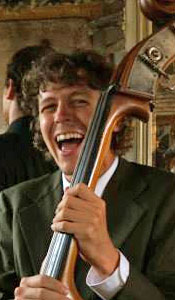
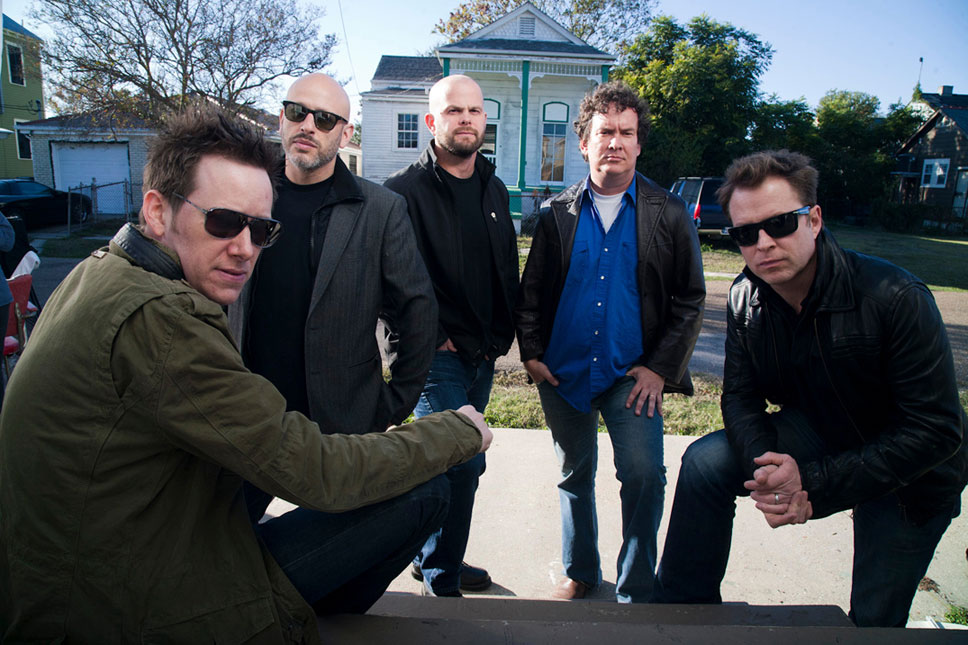
Double Bass Player Taylor Smith found his bliss playing music in New Orleans.

And that light is shining bright for a lot of musicians, young and old, who have found their muse in New Orleans. The Roamin’ Jasmine‘s bandleader initially visited New Orleans as part of the ancient college ritual, Spring Break.

But fortunately, the music major managed to wander beyond the beer-chugging Bourbon Street scene to where the real magic happens. As a University of Miami senior, he had yet to find his musical niche in Florida so, as it has for generations before him, New Orleans proved to be both eye and ear opening.

Captivated by the scene, he and his roommate moved to New Orleans after graduation in 2010. He stayed for a year but then went looking for greener pastures, doing a couple of tours with bands and ending up in his hometown Boston.

“But I realized I wasn’t playing music that much. I came back to visit one time while I was living in Boston and thought why did I ever leave this. Every minute I was here, I was going to jam sessions, going to people’s houses and they’re having a campfire and playing tunes.  I even played on the streets a few times.”
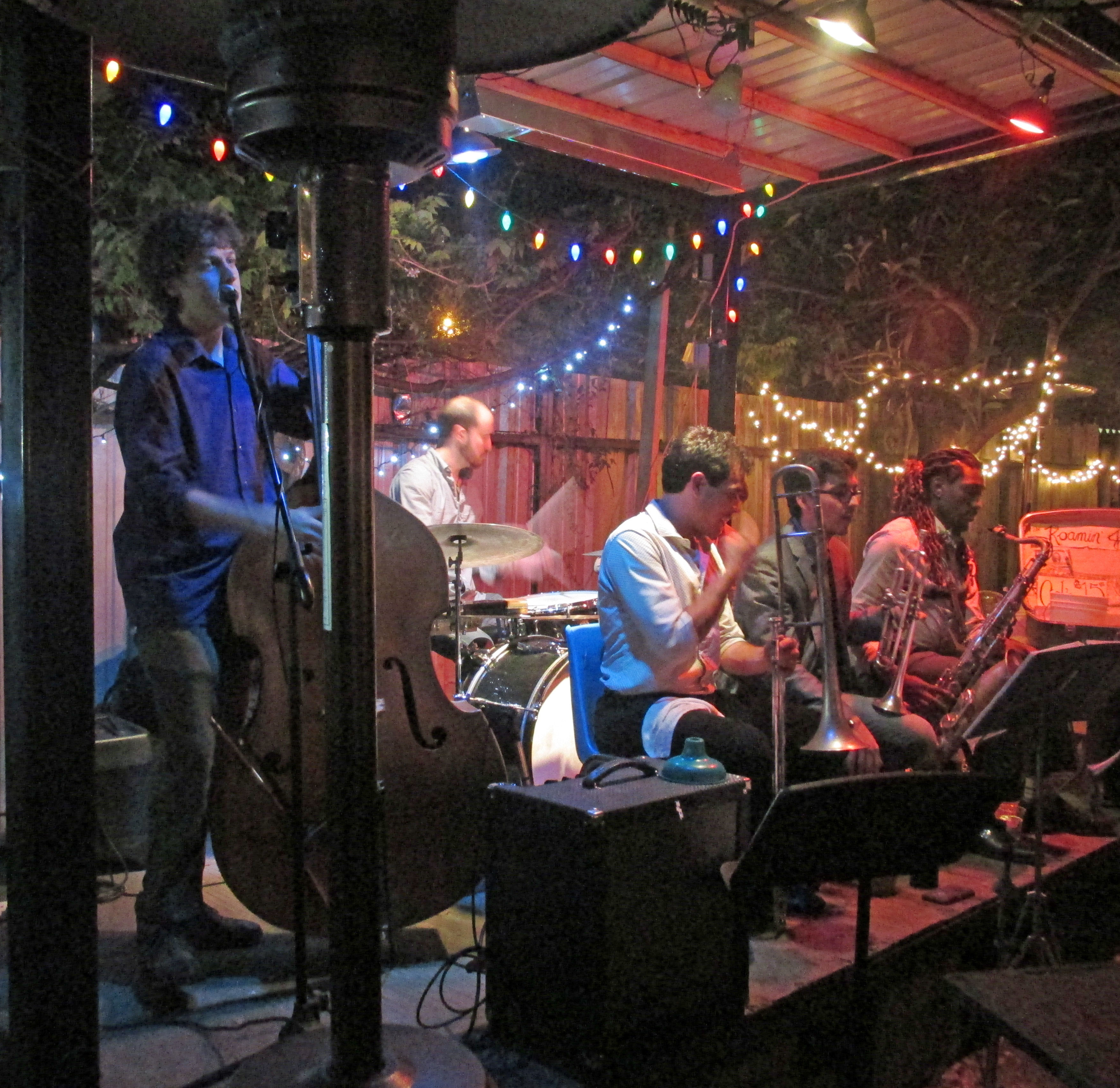
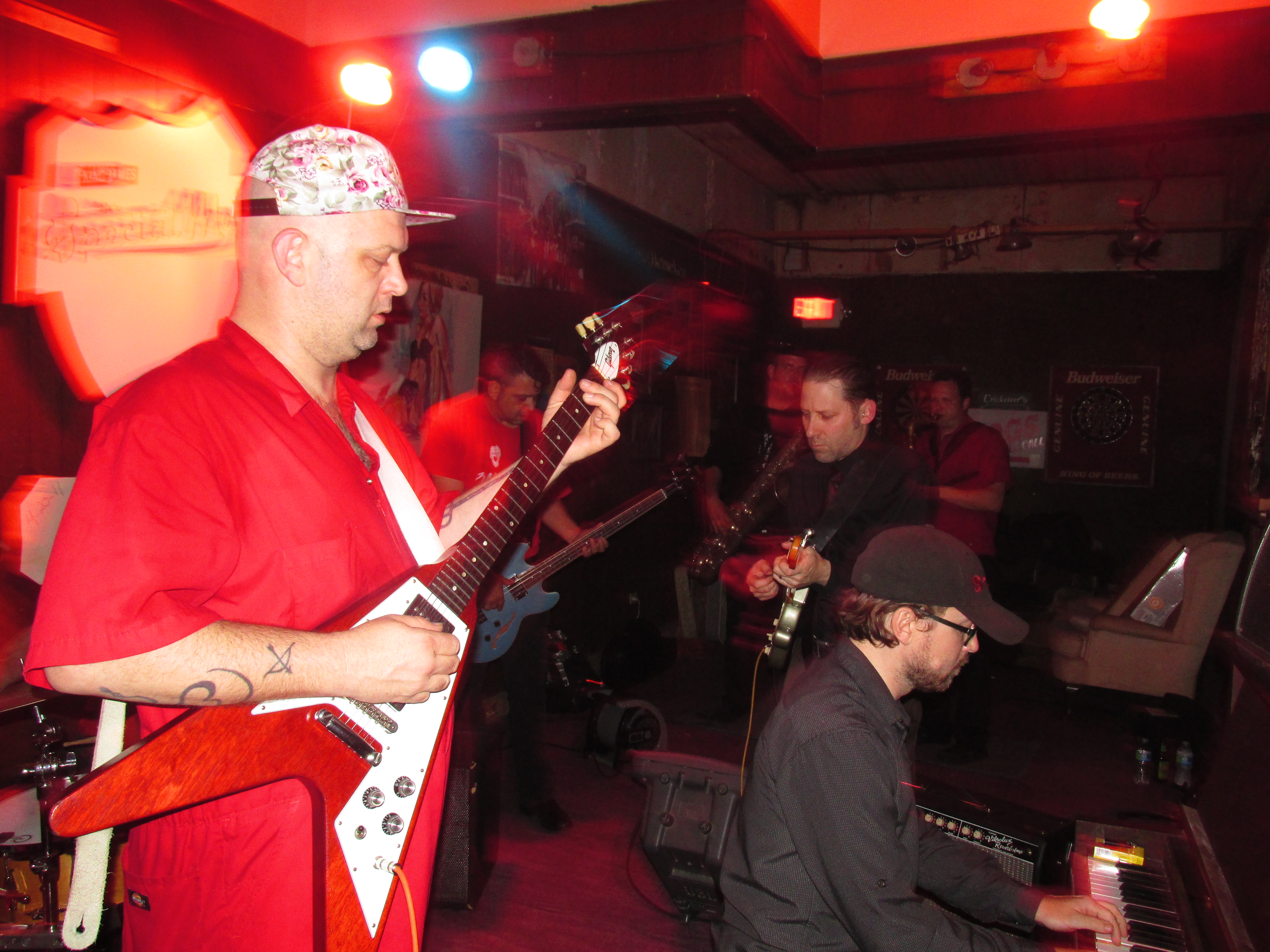
The Roamin' Jasmine performing at Bacchanal. Taylor is on bass (left).
The Roamin’ Jasmine performing at Bacchanal. Taylor is on bass (left).

Smith returned to New Orleans in 2012 and soon after formed The Roamin’ Jasmine which plays regularly in New Orleans and is currently doing a tour in Alaska. Smith’s experience is not unique.

Throughout the years, musicians have been finding their way to the birthplace of Louis Armstrong, Sidney Bechet, Fats Domino and The Meters. Jon Cleary, who has mastered a wide range of New Orleans piano styles, was raised in England but took a one-way trip to the city as a young musician.

In 1995, Japanese blues guitar sensation June Yamagishi abandoned an established career to immigrate to New Orleans — much to the benefit of the Wild Magnolias and Papa Grows Funk. Matt Perrine, whose sousaphone and bass anchor countless New Orleans recordings, migrated from California to the city in 1992. Others, like guitarist/songwriter Alex McMurray and the founding members of Galactic, were college students (Tulane and Loyola respectively) who decided to stick around after graduation. University of New Orleans jazz program also has contributed a number of new residents as well.
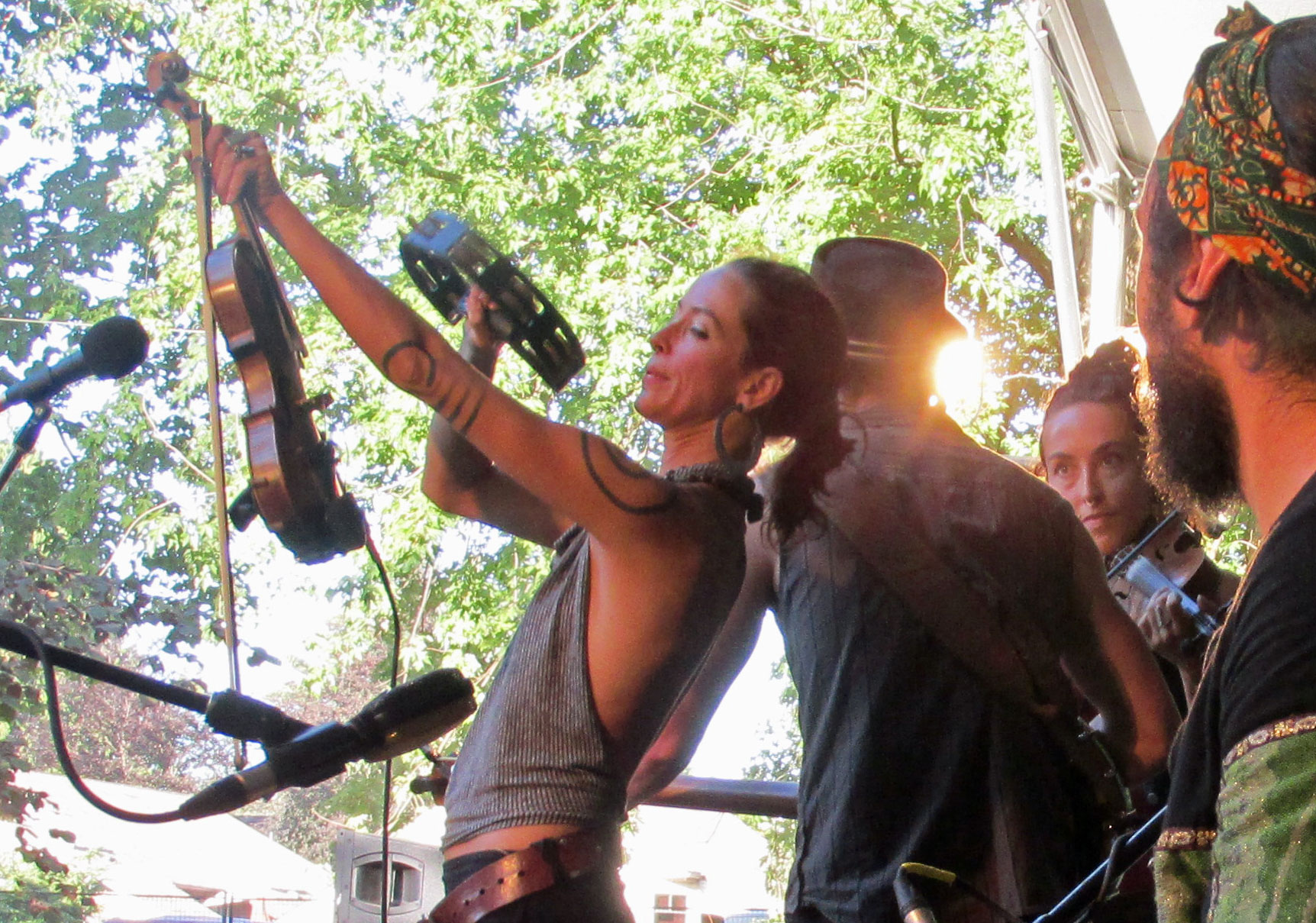
Sisters Leah Song (left) and Chloe Smith of Rising Appalachia lived and performed in New Orleans for seven years.

The magnetic force of New Orleans seems to have only gotten stronger since Hurricane Katrina. Last week, I attended a Rising Appalachia concert where the two sisters that fronted the band referred often to the enriching years they spent in New Orleans following Katrina.

In my last visit to New Orleans, every musician I talked with (and most are delighted to chat) was from some other place. Pianist Bart Ramsay (Zazou City) has lived in the city a long time but hails from Chicago.  Another pianist was from New Jersey.  A saxophone player was from the Midwest. Everyone had a story about how they came to New Orleans and found their bliss.

Josh Wilson, whose Seattle-based band Tubaluba is heavily influenced by the New Orleans brass sound, did a pilgrimage to New Orleans specifically to improve his New Orleans piano skills.  He connected with Jelly Roll Morton specialist Tom McDermott and seriously considered moving to the city permanently.

But its more than just the professional milieu that is attractive. The daily infusion of tourists and the large number of clubs and venues provide a wealth of employment opportunities for musicians — allowing them to lead a reasonably normal life. They can catch their child’s soccer game in the afternoon, play a gig in the evening and sleep in their own bed that night.

“I’ve never been to any city where I’ve met so many working-class musicians. New Orleans is really nurturing in that way; the quality of life is very good,” Kristin Diable told American Songwriter magazine. Diable, Americana singer/songwriter, is from Baton Rouge but for a time she tried her luck in New York City. “Within a year of being in New Orleans, I was making 10 times more money than I ever made in New York City.” The influx of new talent is not without its controversy. Some have argued that newcomers don’t take the time to learn the history, culture and style of New Orleans music.
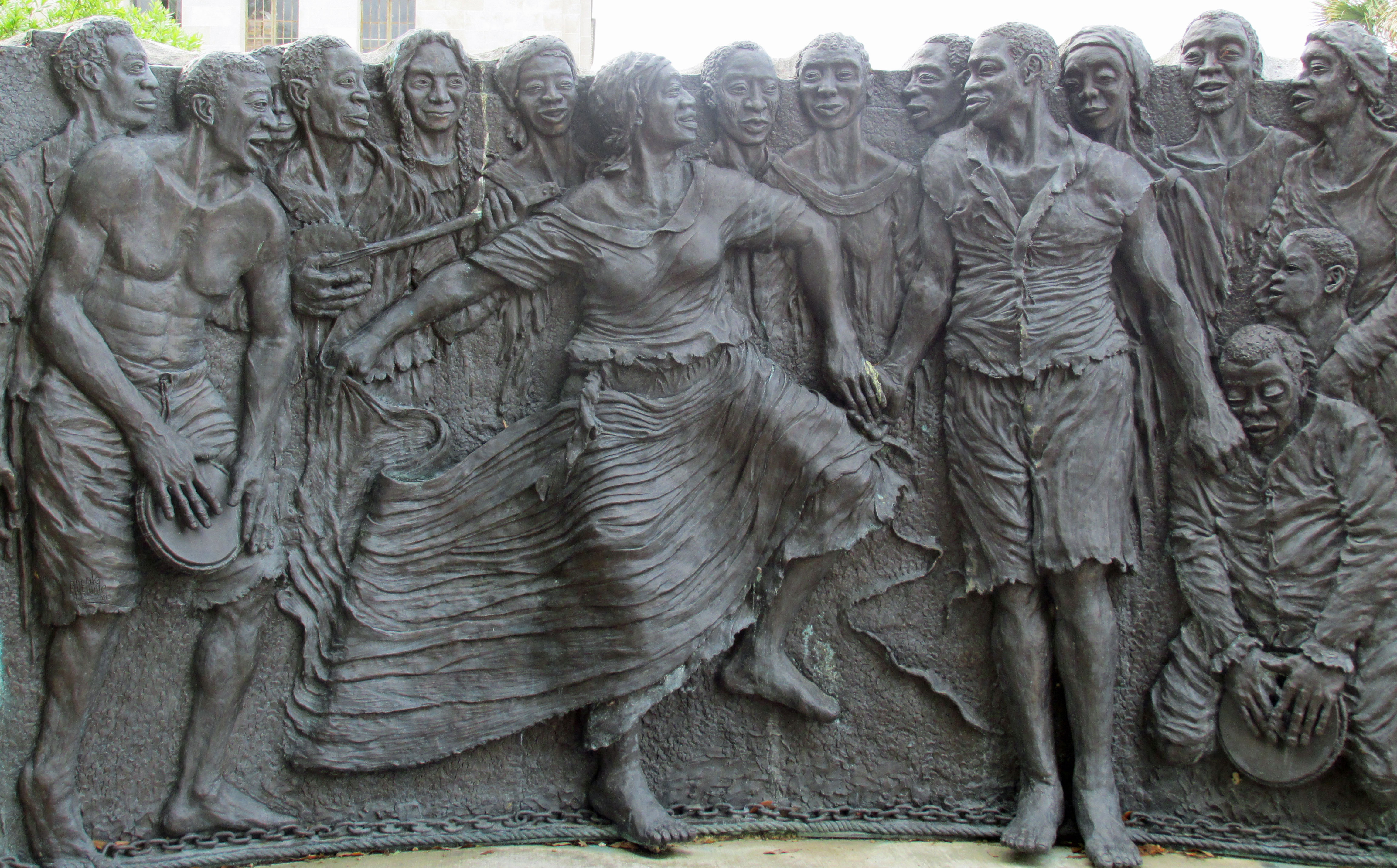
Congo Square is where slaves congregated on Sundays in 19th Century New Orleans and is considered where jazz was born.

The debate raises the question of what is New Orleans music. Is it jazz, R&B, bounce, funk, roots, hip hop Mardi Gras Indian? Or is it all of the above and more. The lesson and legacy of Congo Square is that the city’s musical storehouse relies on its continued ability to welcome and nurture different styles.

So I’ll keep playing music from New Orleans whether or not you might think its New Orleans music. For this Monday’s show, I’ll emphasize music by those who made a conscious decision to make New Orleans their home. Oh yea, and I’ll have a little more of my interview with the effervescent Taylor Smith. (Whoops. Left the interview on the wrong computer. I’ll include with podcast and air it next week.)

Tuts Washington holds solid place in New Orleans piano legacy

The rich creative humus that nurtures New Orleans music is built upon generations of musicians who, mostly in historical anonymity, shared their art and craft with younger musicians. (Here’s the edited version of the radio based on this post.)

If not for one solo recording and a fortuitous film that captured his brilliance and his legacy, Isidore “Tuts” Washington might have easily have been lost to future audiences. But his contribution to New Orleans music will not be forgotten

Isidore
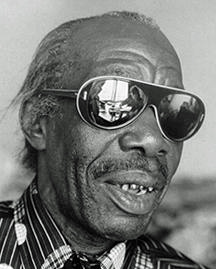
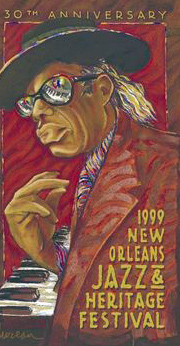
Isidore “Tuts” Washington at New Orleans Jazz and Heritage Festival

Born in 1907, Washington was old enough to follow the early jazz masters perform on the streets of his hometown. Mostly self-taught on the piano, he would whistle the brass band tunes he would hear until he could work them out on the keyboard.

At an early age, he excelled in the boogie woogie, improvisational style of piano common in the New Orleans clubs called barrelhouse. He played with a number of New Orleans bands throughout the 1920’s and 3o’s, including backing up a singer whose missing front teeth got him dubbed “Smiling” Lewis.

In the late 30’s while playing in these clubs, Washington nurtured a young pianist named Roy. He even painted a charcoal mustache on his face to help him get into clubs under age so he could perform with him.  Years later, Roy, otherwise known as Professor Longhair, would talk fondly of his mentor’s clean playing style and the long stretch of his fingers on the keyboards.

Cover of Tuts Washington's only solo recording
Cover of Tuts Washington’s only solo recording

After the war, when the now “Smiley” Lewis began to record, first with DeLuxe Records and then with Imperial Records, Washington found himself at the vanguard of Rhythm & Blues, playing piano on songs like “Turn On Your Volume,” “Tee-Nah-Nah,” and “Gumbo Blues.”  But recordings would be a rare experience for Washington who would not return to the studio again until he was deep into his 70’s.

Washington left the city and was gone for most of the J&M Studio R&B heyday.  When he returned to New Orleans, he played jazz with Papa Celestin and the Clyde Kerr Orchestra and held down regular gigs at places like the Court of Two Sisters Restaurant–solidifying his reputation in the 60’s and 70’s as a New Orleans institution.

He regularly performed at the New Orleans Jazz and Heritage Festival and collapsed from heart failure while performing at the 1984 New Orleans Worlds Fair.

As mentioned above, he was a direct influence on Professor Longhair but also other New Orleans piano players, including James Booker and Allen Toussaint. This is evident when you watch this excerpt from Piano Players Rarely Ever Play Together.  This film by Stevenson Palfi captures Tuts Washington and Professor Longhair near the end of their lives and Toussaint in his mid-40s.

Professor Longhair (top), Allen Toussaint (middle) and Tuts Washington performing Boogie Woogie in Piano Players Rarely Play Together

The film features interviews and historical footage but the most exciting part of the film is the three masters playing pianos all lined up so the camera can catch them in the same shot.  While the YouTube version is muddy, the film has been digitally restored.

If you don’t want to watch the whole film, skip to the end when the filmmaker shows the three playing a boogie woogie tune to its full length. The number (available on Longhair’s anthology) starts with Professor Longhair giving a little coaching, scatting a bit to describe how to avoid cutting in on his master, Tuts Washington.

Hear this amazing artist on my next show, (recording of the show) Monday at 10 a.m.

Portland Blues Festival serves up a sweet NOLA line up

Portland’s Waterfront Blues Festival seems to have a serious jones for New Orleans music.

In previous years, the festival has held Second Line parades, filled its dancing stage with Zydeco and Cajun music and featured New Orleans acts such as Rebirth Brass Band, Galactic and the Stooges Brass Band. But this year, as we approach the 10-year anniversary of Katrina, the festival doubled down putting together a stellar New Orleans line up for its Friday (July 3) show.

Yes, we’ll get a return performance by Galactic, a versatile funk and soul band that hit the I-5 Tour as recently as February.  This time, the band will feature Macy Gray on vocals as the band harkens back to its soul and R&B roots when Theryl “Houseman” DeClouet fronted the group. Galactic takes the Brewery Stage at 9 p.m.

Allen Toussaint looking over his shoulder at a Paddlewheeler cruising the Misssissippi while performing at French Quarter Festival this year. He'll be playing by the Willamette River this Friday.
Allen Toussaint looking over his shoulder at a Paddlewheeler cruising the Misssissippi while performing at French Quarter Festival this year. He’ll be playing beside the Willamette River this Friday.

But the headliner for the day is Allen Toussaint (7 p.m. Brewery Stage).  This uber-talented composer, producer and pianist extraordinaire is closely aligned with the New Orleans R&B and funk sound. He was there from the beginning and now at 77, he continues to prove he can do full justice to his amazing legacy of songs.

“Working in a Coal Mine,” “Mother-in-Law,” “Lipstick Traces on a Cigarette,” “Fortune Teller,” “Sneaking Sally through the Alley,” “Night People,” “On Your Way Down,” “Ride Your Pony,” “Yes, We Can” and so many more song that you’ll recognize.  This guy has made a boat load of money from others singing his songs. The pleasant surprise is how ass-kicking good he is when he sings them.

He started his own New Orleans-based record label in the 60’s and he was the first to do a major recording in New Orleans (with Elvis Costello) after Katrina. He’ll have just returned from performing in London when he takes the waterfront stage on July 3 and I’m struck how the Portland setting is so similar to the French Quarter Festival stage where I last saw him perform in April. His band and performance will be as sharp as the suit he’ll be wearing.

Another New Orleans star attraction is Charmaine Neville. Daughter of saxophonist Charles Neville of the Neville Brothers, Charmaine has toured the world but has stayed closer to home in recent years. She and her band will dish up a jazzy soul set at the Brewery Stage starting at 5:15 p.m.

(From Left) Jeff Mercurio, Ben Ellman, Dan Vogel, Jeff Raines and Stanton Moore.
Galactic will perform at the Waterfront Blues Festival on Friday as part of a New Orleans line up.

Likely to hop on the stage with Charmaine is her former band leader now Portland resident, Reggie Houston. This native New Orleans saxophonist has been making Portland a hipper place ever since he called it home in 2004. With over two decades of performing with Fats Domino, you know Houston and his Crescent City Connection band is going to rock the Brewery Stage (3:45 p.m.)

Other highlights include venerable guitarist Paul “Lil Buck” Sinegal (First Tech Stage, noon), Chubby Carrier & the Bayou Swamp Band (First Tech Stage, 8:15 p.m.) and the Dog Hill Stompers (Front Porch Stage, 10 p.m.)

See you there, but if you miss it, I’ll be playing some of what I hear on my show on Monday.  Have a safe Fourth of July.

Professor Longhair “tralla walla” makes us feel fine

This week’s post (and my focus on this week’s radio show) is about the man who sang “we gonna hoola tralla walla malla dalla drink some mellow wine.”

Henry Roeland Byrd, aka Professor Longhair

Henry Roeland Byrd was a tap dancer, card shark, soldier, cook, laborer and general street hustler. He also was one of the greatest New Orleans piano professors of all time – Professor Longhair.

His iconic “Tipitina” inspired the likes of Fats Domino, Allen Toussaint, James Booker, Dr. John and countless others.

Professor Longhair’s style has been described as a rhumba crossed with a blues shuffle.In an interview with Peter Stone Brown not long before he died in 1980, he said:

” I was around a lot of honky-tonk musicians, barrelhouse musicians, blues musicians, and bebop musicians, jazz musicians. I just got a little bit from everybody and used it with what my mother taught me. She played a lot of ragtime music. . . I just mix my ideas up and call it a gumbo. There’s no certain thing at all. It’s just rockin’ rhythm.”

Fess was there at the beginning of the New Orleans Rock and Roll era in New Orleans, cutting his first singles in the J&M Studio (Cosimo Matassa) in 1949.  And in November 1953 with Alvin “Red” Tyler, Lee Allen, Earl Palmer, and Edgar Blanchard backing him up, he recorded “Tipitina” for the first time.

“Girl you hear me calling you. Well you’re three times seven, baby. Knows what you want to do.”

Calibration
Calibration

Born in Bogalusa but raised in New Orleans, Professor Longhair never made the hit parade and never really experienced financial success. By the late 60’s, his career had folded and he was living in poverty. In 1970, Quint Davis and Alison Minor sought him out with the intention of getting him to perform at their fledgling music festival, the New Orleans Jazz and Heritage Festival.

Who they found was a frail, weak man who didn’t seem capable of pounding out his trademark rhythms. But with the help of Davis and Minor, he recovered enough to perform at the second JazzFest in 1971 and demonstrate that, if anything, his playing had gotten better.  His hometown and the world embraced him and his career flourished. Until his death in 1980, he recorded and performed, including at the nightclub created for the purpose of providing him and other aging R&B artists a place to play, named appropriately Tipitina’s.

Join me, won’t you for some Fess and Fess-inspired music this Memorial Day.   Sweeney’s Gumbo YaYa kicks off at 10 a.m. on Monday. Here’s a recording of that show on Mixcloud.

First impressions of French Quarter Festival

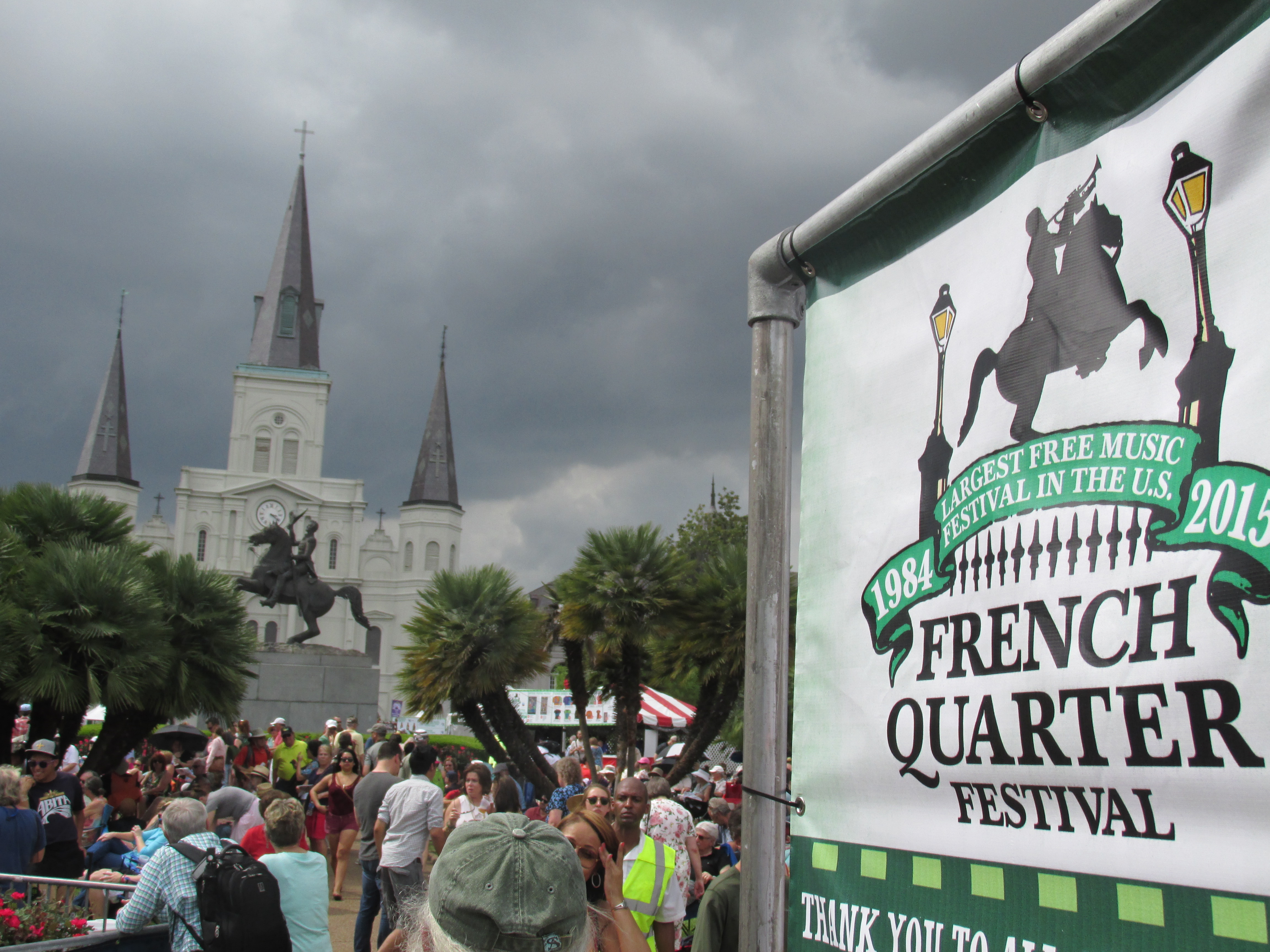
With some time to catch up this morning on day three of the 2015 French Quarter Festival, I’ve had a chance to reflect on my first impression of the largest showcase of Louisiana music in the world

The fest started on Thursday with five stages operating mostly in Woldenberg Riverfront Park near the old Jax Brewery and the Audubon Aquarium. Friday, the festival added seven more stages and 11 more open today. This exponential stage growth levels off at 23 stages, otherwise there might not be any place to walk.

IMG_1454

Actually, there’s lots of room to walk. Anyone intent on catching music at all the stages needs to be prepared to hustle or rent a pedicab.  Stages are grouped together but those groups are scattered over the full river length of the French Quarter from Canal to Esplanade and moving away from the river, there are stages on Royal and Bourbon Streets. Like most music festivals, tough choices have to be made cause you cannot catch it all.

In its four days, French Quarter festival attracts more audience than the better known seven-day New Orleans Jazz and Heritage Festival that starts  later in the month.  But now that I’m here, its quite obvious why.  Jazz Fest participants have to make a conscious effort to get out the Fair Grounds and pay the $70 to get in for a day. As a result, I suspect that Jazz Fest is responsible for drawing in more folks to the city specifically for the festival.

John Boutte performing at French Quarter festival this week.

At French Quarter Festival, many of the attendees appear to be here for other reasons. And therein lies the genius of this event. Like a gill net that traps salmon headed to spawning grounds, the free French Quarter Festival snags tourists as they innocently stumble out of their hotels and bars and provides them with a taste of music they might not otherwise catch.

With the exception of one small stage featuring international acts, the French Quarter Festival showcases local talent. This means the festival provides local musicians with a chance to build a following outside the city.  The fact that the festival can keep 23 stages busy with local talent provides some sense of how deep the musical talent. This year’s lineup includes Allen Toussaint, Irma Thomas, Eric Lindell, Hot 8 Brass Band, John Boutte, Flow Tribe, Bonerama, Little Freddie King, Guitar Slim Jr. and on and on.  All music, by the way, that we play on Sweeney’s Gumbo Ya Ya.

I’m still in New Orleans during the next show but I hope to call in with a brief report. You’ll be in capable hands with Anch who hosts Sundrenched on Tuesdays.

Easy to catch a lot of NOLA music in a short period of time

Catching as much music as possible in New Orleans ain’t hard. But some stamina comes in handy at times.

We arrived on Friday night and hustled down to see late night show of the Soul Rebels at d.b.a.  I’ve yet to catch them at their home bar, Les Bon Temp Roule but its always fun to hear and feel this talented brass band.

Saturday, we took the “Freret Jet” (#15 bus) to the annual Freret Street Festival, getting there in time to catch the swinging last half of the Mississippi Rail Company set. This New Orleans  R&B group is on my list to pick up when I get to the Louisiana Music Factory.

Mark Mullins (left) and Craig Klein are two of the "bones" of Bonerama. Billy Iuso, fronting his own band earlier, added some licks to a Bonerama number.
Mark Mullins (left) and Craig Klein are two of the “bones” of Bonerama. Billy Iuso, fronting his own band earlier, added some licks to a Bonerama number.

One of the advantages of visiting New Orleans is to learn about musicians that don’t get airplay outside of the area. Billy Iuso and the Restless Natives is one of those blues groups that sneaks up on you, starting off without much fanfare but blowing you away by the final beat.

The headliner for the festival was Bonerama — three trombones backed up by guitar, bass and drums. This group, which has played the Winthrop Blues Festival, was in excellent form.

We finished the day back at Frenchmen Street with The Maison’s evening closer Austin soul group The NightOwls.  They put on an energetic show that was almost overshadowed by some of the Spring Break-like antics of the crowd.

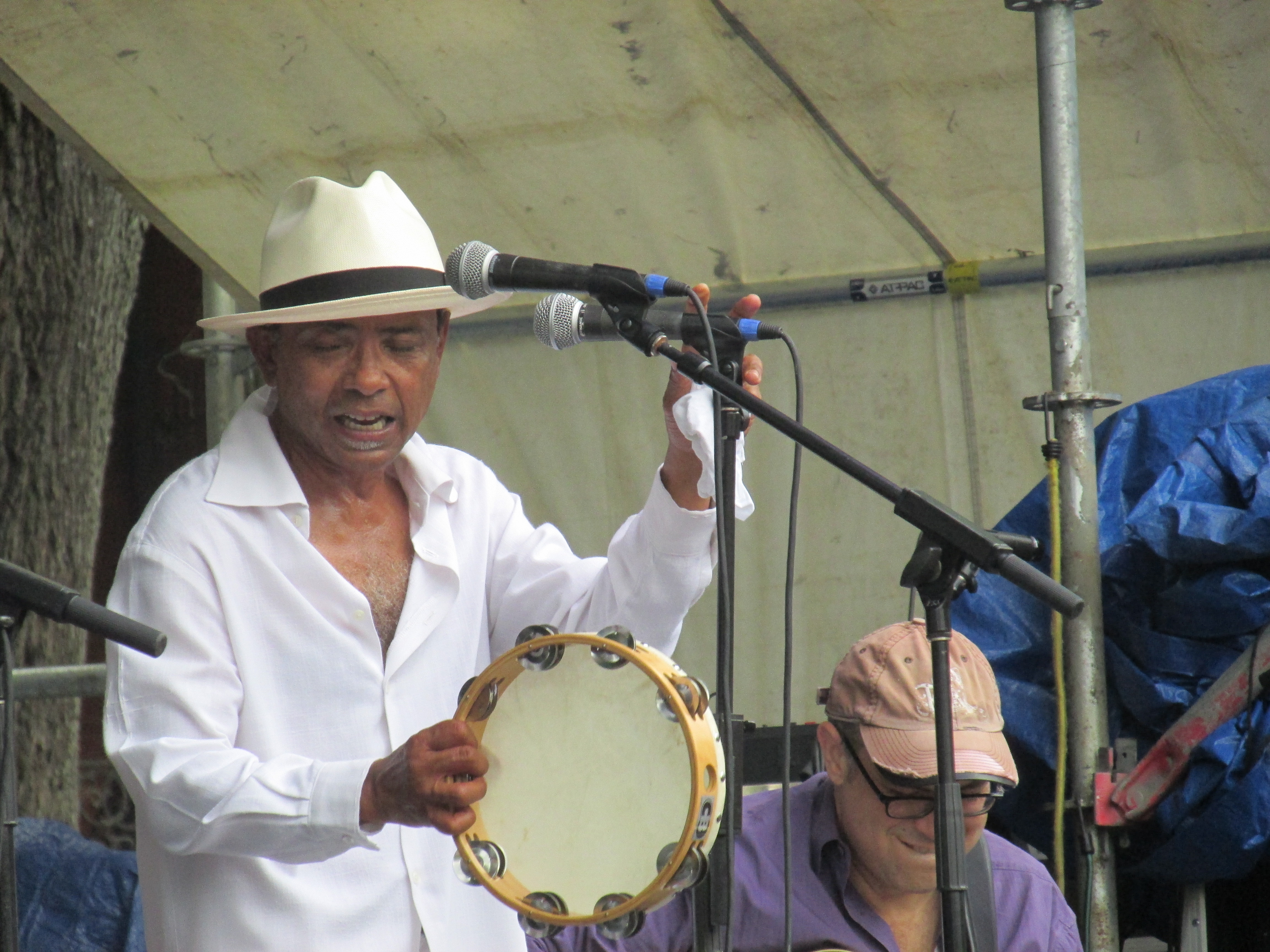
On Sunday evening, we braved Northwest-style rains and winds to sit in Bacchanal’s open courtyard to see The Roamin’ Jasmine.  Now, I’ve aired the Jasmine many times on the show but as usual its a delight to see the band in action, particularly with Taylor Smith, bassist and bandleader, singing.

Yesterday, we rented bikes and pedaled uptown to Carrollton, up Jeff Davis Parkway to City Park and back down Esplanade, stopping at Three Muses where Bart Ramsey, who fronts a Gypsy Jazz band called Zazou City, played a solo piano and sang for the early evening audience. I will definitely be playing some of his music when I get back on the  show in two Monday’s from now.

King James & the Special Men at BJ's Lounge
King James & the Special Men at BJ’s Lounge

I can’t close without mentioning my evening at BJ’s Lounge where King James and The Special Men held court for their regular Monday session.  This was bluesy, boogie woogie rock n’ roll fronted by Jimmy Horn,  who lived briefly in Seattle before stumbling into New Orleans in the 90’s. A disciple of Ernie  and Antoinette K-Doe, Horn seems to possess some of that same confident but endearing swagger. There is no stage at BJ’s.  No barrier between audience and musician and the give and take was, to be understated, uniquely entertaining. As his piano player banged out Fats Domino-like triplets on Blue Monday, I marveled at how I was probably no more than two miles from the Ninth Ward neighborhood bar that Antoine “Fats’ Domino was first discovered by Imperial Records while banging out the beat that became part of rock n’ roll history. A special treat was Jason Mingledorff sitting in with his saxophone.

Kim and I are chilling today but we’ll be catching a lot more beats in the days to come. Keep up with my posts by subscribing (upper right hand side of page.)

Art dealer’s love of jazz inspires creation of Preservation Hall

Perhaps no single entity has helped keep New Orleans jazz alive into the 21st Century more than Preservation Hall and the band its spawned.

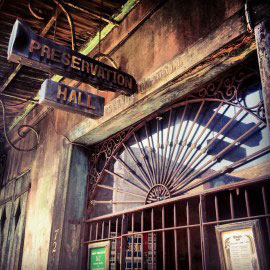
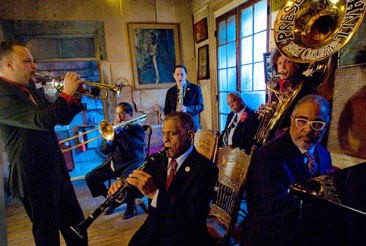
Just off Bourbon Street is a longstanding venue dedicated to keeping New Orleans jazz alive
Just off Bourbon Street is a longstanding venue dedicated to keeping New Orleans jazz vibrant

Like many great ideas, Preservation Hall started out as a simple solution to an understandable need. In 1952, Larry Borenstein opened an art gallery in an 18-century building that to this day seems to have not changed over the years. It’s location, just off Bourbon Street (726 St. Peter) and its nightclubs, meant staying open late preventing Borenstein from pursuing his other passion: listening to jazz. So he took matters into his own hands.

Borenstein hauled an old piano into his gallery, bought some beer and invited musicians to play for him and his guests and gallery customers. To avoid conflict with the musician union, the sessions were called rehearsals.

In an article, written by Borenstein in the 60’s, he related how the session grew organically.

“The concerts took place regularly.  Punch Miller, back from his long years on the road, brought a band to the Gallery Tuesday nights.  Kid Thomas had a “rehearsal” every Thursday night.  Sundays Noon Johnson often stopped by with his trio.

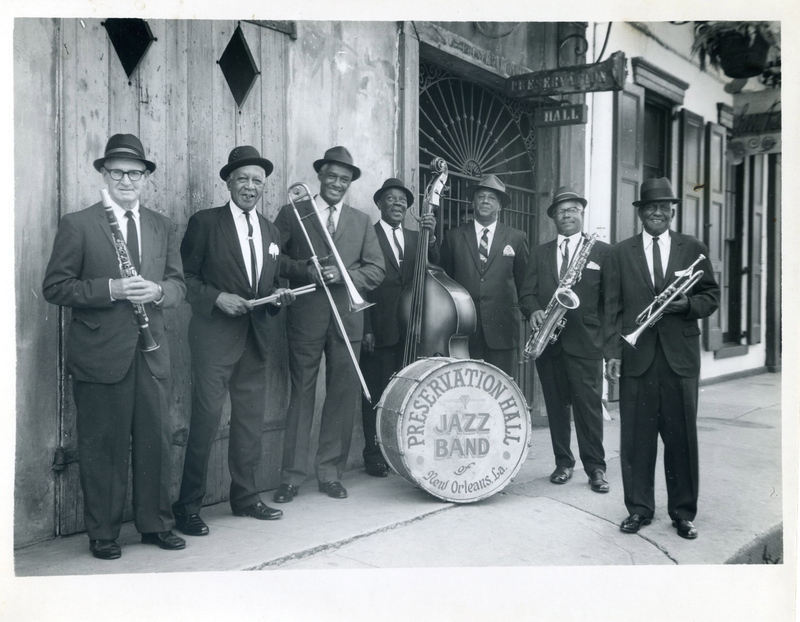
Preservation Hall became sanctuary for jazz musicians of all backgrounds to play together and keep the spirit alive.

“Piano “professors” Stormy Weatherly (sic – Kid Stormy Weather), John Smith (I’m guessing this John Smith) and Isadore (sic – Isidore “Tuts”) Washington often dropped in as did busking guitarists, banjoists and harmonica virtuosos.  Often impromptu sessions got underway just because Lemon Nash dropped in to say “hello” and just happened to have his ukelele with him.”

The informal venue allowed whites and African Americans to mingle at a time when the South still practiced, and enforced, apartheid. Police occasionally raided the jam sessions and hauled the musicians to jail.

“The bands frequently included white and Negro musicians and it was simpler to charge them with ‘disturbing the peace’ than with breaking down segregation barriers.”

The music experience continued to grow though. Eventually, Borenstein moved his gallery next door and in 1961 the venue was officially christened Preservation Hall–an appropriate name for a jazz lover sanctuary.

A couple years later, the Hall’s managers,  Allen and Sandra Jaffe, organized a road tour for Preservation Hall regulars. The success of the the band’s concerts provided additional income for the musicians and helped maintain fan support outside of New Orleans. The band, in various iterations over the last 50 years, has continued to tour, perform and record, building a worldwide audience.

Not a lot of room inside means that every performance is an intimate one.

The Jaffe’s son, Ben took over leadership of the venue and band. A tuba player like his dad, Ben Jaffe has widened the band’s horizons through collaborations with other artists such as Blind Boys of Alabama, the Del McCoury Band, Keb’ Mo’, Dr. John and Tao Seeger. The band’s latest album, “That’s It,” features all original compositions.

Over 50 years after its forming, Preservation Hall entertains locals and tourists alike from it St. Peters Street location with three 45-minute shows every night. The band is drawn from a collective of musicians, many of whom are descendants of early New Orleans jazz musicians.

You can purchase tickets in advance that ensure a front or second row seat or you can pay $15 for general admission. The performances are acoustic and the venue is small. You might need to stand in line for a while but it will be worth the wait.

Tune in to my next show (listed to a recorded edited version) and you will hear what I’m talking about.

Toussaint infused New Orleans sound into pop music

New Orleans
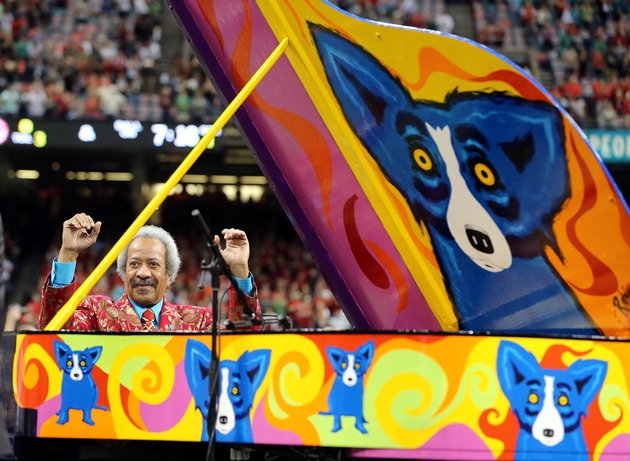
Allen Toussaint plays the National Anthem at the Superdome. Credit: Chuck Cook-USA TODAY Sports

The French Quarter Festival, which showcases local music, could not have scored a better opening headliner this year than with the hometown artist whose creativity has nurtured the New Orleans sound for over a half century. (Listen to the show that complements this post.)

Allen Toussaint was a teenager when he first sat in on Earl King’s band and regularly scored gigs at the legendary Dew Drop Inn.

It wasn’t long before he found his way to the center of the known Rock n’ Roll universe at the time, Cosimo Matassa’s studio, where he laid down piano tracks on recordings by Fats Domino, Huey “Piano” Smith, and Aaron Neville. But it was when he joined Minit Records that his creativity became apparent to the world. Using his parent’s living room as rehearsal space and testing ground for new material, he assembled a parade of hit singles by Jessie Hill, Irma Thomas, Lee Dorsey and this blog’s patron saint, Ernie K-Doe.

Ernie K-Doe best recordings were aided by the songwriting, arranging and producing of Allen Toussaint.

As a keyboard savant, Toussaint could accurately reproduce and synthesize the city’s revered legacy of piano professors, especially the style of Professor Longhair. But as a songwriter and arranger, he was able to weave the full panoply of New Orleans rhythms, vocal traditions and spirit into a clean appealing style for the pop market. In fact, he, along with K-Doe, were responsible for the sole number 1 pop chart hit recorded in New Orleans,  “Mother-in-Law.” (A song written before Toussaint was married and had one.)

Later, he started his own record labels providing a platform for local and national musicians to access the New Orleans sound. With The Meters as his studio house band, Toussaint was a key force behind the New Orleans funk sound that developed in the 70’s. A prolific songwriter, his music has been performed by The Rolling Stones (“Ruler of My Heart”), The Who (“Fortune Teller”), Bonnie Raitt (“What Do You Want the Boy To Do”), Devo (“Working in the Coal Mine”),  Al Hirt (“Java”), The Doors (“Get Out of My Life Woman”),  Jerry Garcia (“I’ll Take a Melody”), Glen Campbell (“Southern Nights”), Robert Palmer (“Sneaky Sally through the Alley”), The Pointer Sisters (“Yes, We Can Can”) and many more.

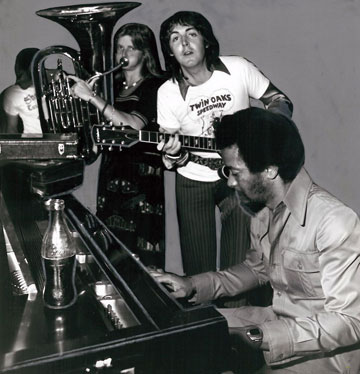
Linda and Paul McCartney performing with Allen Toussaint in his New Orleans studio in 1975.

In 1973, Toussaint had a big hand in producing and performing on Dr. John’s album “In The Right Place.” Two years later, Linda and Paul McCartney moved their entourage to New Orleans to collaborate with Toussaint in his New Orleans studio on their album “Venus and Mars.”

He was inducted into the Rock and Roll Hall of Fame in 1998, the Louisiana Music Hall of Fame in 2009, and the Blues Hall of Fame in 2011. If there’s any question of whether being a senior statesman of New Orleans music has diminished his chops, you need only look as far as his grammy-nominated, post-Katrina collaboration with Elvis Costello, “The River in Reverse,” for evidence that at 77, he still has it.

In addition to being a producer, bandleader, arranger and songwriter, Toussaint is an accomplished pianist and stands with the great New Orleans piano “professors.” Toussaint will take the stage at the French Quarter Festival on April 9 at 3:45 p.m. but you will be able to catch his music on my next show this Monday. (Here’s the recorded show)

Fats Domino got the world to dance

His hometown and the world mourn his passing on October 25, 2017. Click on my show in honor of his 87th Birthday and read the blog post I wrote in 2015.

Fats Domino turns 87 today. While perhaps debatable everywhere else, in my mind he’s the real King of Rock n’ Roll.  And, he also has his professional DNA in ska and reggae.

“Be My Guest” hit 8 in the popular music charts in 1959–one of four Domino songs that got into the Top 40 that year. Not bad, considering he only recorded six songs.

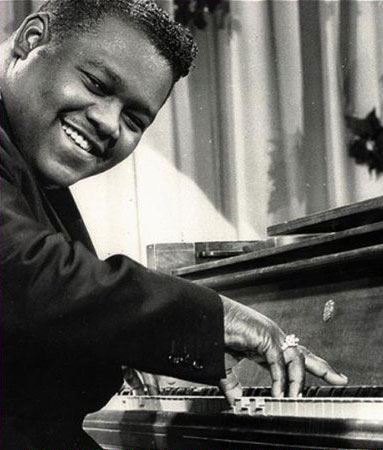
Fats Domino was not only a major force in Rock n' Roll, he help inspire sk.
Fats Domino was not only a major force in Rock n’ Roll, he helped inspire ska.

“Be My Guest” marked a decade of Domino getting young people of all backgrounds to dance together. And with lyrics like “Come on baby and be my guest/Come join the party and meet the rest,” Domino made it a world dance party.

That dancing was particularly important in Jamaica where disk jockeys held dance parties in the street. As the unofficial northern capital of the Caribbean, New Orleans has had a long history with Jamaica. Island workers would arrive in New Orleans to work in canefields and return home with armloads of R&B records. Many argue that ska developed its rhythm from the shuffle and boogie beats that were emanating from Cosimo Matassa’s studio in New Orleans at the time.

New Orleans early Rock n' Roll inspired the Ska rhythm that evolved on the streets of Jamaica.
New Orleans early Rock n’ Roll inspired the Ska rhythm that evolved on the streets of Jamaica.

“Be My Guest” was a huge hit in Jamaica and its 4/4 time with the drummer hitting hard on the offbeat apparently became the foundation of ska.  Its not that Fats was the only inspiration. Professor Longhair, Smiley Louis and other R&B stars of that period were essential. But Domino was top dog, often covered (e.g. Super Cat’s My Girl Josephine) and paid homage in songs like Derrick Morgan’s “Fat Man.”

Bob Marley said reggae started with Fats Domino, according Rick Coleman, author of “Blue Monday: Fats Domino and the Lost Dawn of Rock ‘n’ Roll.”  Whether it did or not, there are lot of people on this planet dancing because of Antoine “Fats” Domino. That alone is worth honoring the day of his birth.

New Orleans funk band plays the I-5 tour this week

Galactic, an ever evolving New Orleans band that tours nationally, will be on the wet side of the Cascades this coming week.

On Thursday February 26, Galactic will take the stage at Bellingham’s Wild Buffalo before rolling down to Seattle’s Showbox on Friday and finishing its tour of Interstate-5 at the Crystal Ballroom in Portland on Saturday.

(From Left) Jeff Mercurio, Ben Ellman, Dan Vogel, Jeff Raines and Stanton Moore.
(From Left) Robert Mercurio, Ben Ellman, Rich Vogel, Jeff Raines and Stanton Moore.

The band formed in 1994 and was inspired by The Meters and other funk bands playing in Benny’s Bar, a long-gone uptown establishment located not more than a football field from where the Nevilles used to live. The band’s original name Galactic Prophylactic was quickly shortened while it led a second wave of New Orleans funk bands.

The first decade, Galactic was powered by the vocals of journeyman R&B and soul singer Theryl “Houseman” DeClouet.  With its jam band tendencies, the group developed a loyal following for its live shows.

While the band has gone through a number of personnel changes over the years, the core of the group includes founding members Jeff Raines (guitar), Robert Mercurio (bass), Stanton Moore (drums) and Rich Vogel (keyboards). Also, saxophonist Ben Ellman, who produced Trombone Shorty’s first two albums, has been a long-time mainstay of the band.

After the departure of DeClouet in 2004, the band got into producing its own music using loops and samples and invited a wide range of mostly New Orleans talent into the studio with them. Ya-ka-may, probably my favorite Galactic album, includes Irma Thomas, Trombone Shorty, John Boutte, Katey Red, Big Freedia, and Big Chief Bo Dollis. The first song also includes a sample from the fright night show Morgus the Magnificent.

Robert Mercurio on bass for Galactic

According to reviews of this tour, the band is reaching back to its roots, while still keeping it contemporary. Check out recent releases “Higher and Higher” featuring JJ Grey and “Dolla Diva” with a duet by Maggie Koerner and David Shaw of The Revivalists. For this tour, Erica Falls is handling the vocals — an excellent choice of a New Orleans singer whose talent far exceeds her current public recognition. But perhaps not for long. Here’s an article that got her on the cover of Offbeat.

Erica Falls, a talented New Orleans singer who has performed with Irma Thomas, John Fogerty and Sting, is the lead singer for Galactic on its current tour.

Individually, Galactic band members are highly active musicians and music producers involved in a wide range of other projects, including some with Seattle saxophonist Skerik (who will be in Portland Maine on Saturday). This week’s I-5 tour is an excellent chance to catch them live. But if you can’t do that, I’ll be playing my favorite Galactic numbers on Sweeney’s Gumbo YaYa on Monday.   (Sneak tip:  I will have tickets to the Portland show to give away.)

Also, consider subscribing (upper right hand column). I write regularly about New Orleans music, particularly as it relates to the Northwest.