The 12th anniversary of Hurricane Katrina and the flooding of New Orleans has been marked by deadly flood waters around the planet–from Houston to Bangladesh. Today’s show, originally aired on KAOS and presented in edited form below, is dedicated to all flood victims. As weather intensifies in the future, we all run the risk of being weather victims.
This week’s show starts with wetland preservation advocate Tab Benoit, singing “Shelter Me.” Clarence “Gatemouth” “Brown follows with his seminal song “Hurricane.” Mr. Brown died of cancer on September 10, 2005 after having to evacuate his Katrina-damaged home in Slidell (near New Orleans) two weeks earlier. Marva Wright re-enacts the ground level experience in New Orleans during the flooding in “The Levee Is Breaking Down” and the Free Agents Brass Band perform their song of survival “We Made It Through the Water.” Here’s the complete playlist.
This week’s show starts with the Young Tuxedo Brass Band in honor of Walter Payton, father of trumpeter Nicholas Payton and the sousaphone player for that storied New Orleans band.
I then take a twist toward more contemporary music with Quintron and Miss Pussycat, Sneaky Pete, Jello Biafra and the New Orleans Raunch and Soul All Stars, Helen Gillet and the Dirty Bourbon River Show. I then head back into R&B, including playing High Blood Pressure from the Huey “Piano” Smith album I bought in Ballard last weekend and another round of brass bands. I mixed tracks from new releases by Benny Turner, Naughty Professor and Stanton Moore. The show, as edited below, finishes with Cowboy Mouth’s relationship dirge “Broken Up.” Enjoy!
No one needs to convince Taylor Smith of the ability of radio to perpetuate musical traditions and nurture new ones.
As the bandleader and composer for The Roamin’ Jasmine, Smith has become well acquainted, as do most successful New Orleans musicians, with the city’s traditional jazz standards. But its been his ability to apply a New Orleans style rhythm and blues spin on classic blues numbers that sets his music apart.
For example, check out his take on Blind Lemon Jefferson’s Wartime Blue (from the band’s second album). With the band’s latest release “Live at Horace’s,” Jefferson’s Hangman Blues gets updated with a New Orleans mambo groove.
“When we started, the guys I recruited to play in the band all played traditional jazz standards, and we all knew a lot of that repertoire so we started playing a lot of that stuff. But soon after coming to New Orleans, I got interested in the classic 1950’s Rhythm and blues tunes and started arranging versions of those tunes for the group.”
“I got to give credit to the great New Orleans radio station WWOZ cause that’s where I’ve heard so much of that music.”
WWOZ, like KAOS, is a community radio station, supported by listeners and underwrites with volunteer deejays. Smith singled out “50’s R&B with Neil Pellegrin” (Tuesdays starting at 5 p.m. West Coast Time) and R & B Oldies with Rare On The Air (Wednesdays at the same hour). From my personal experience, I’ll also add Blues and R&B with Gentilly Jr. same time slot on Mondays.
It was WWOZ’s playing of “That’s a Pretty Good Love” a b-side song to Big Maybelle’s hit Candy that inspired Smith to cover it on his live release.
Smith is a Boston native who graduated from the University of Miami jazz school but fell in love with New Orleans during a college break excursion. His band’s first release was in 2014. They’ve toured England twice and will be performing in Australia this fall as part of a collaboration with Lachlan Bryan (and the Wildes).
Here’s the full interview from my show starting with a spin of “That’s A Pretty Good Love.”
New Orleans does not have a comprehensive museum that tells the city’s story as the birthplace of jazz. In a way, the whole city is a museum. However, Louis Armstrong Park offers a few opportunities to touch the history of New Orleans jazz. This week’s show took a bit of tour through the park.
Louis Armstrong Park sits on Rampart Street across from the French Quarter and on the edge of the oldest African American neighborhood in the U.S.
The park emerged from a botched urban renewal project where sadly many families were displaced and historic buildings destroyed. The park contains the currently unusable municipal auditorium, the Mahalia Jackson Theater for the Performing Arts and a few buildings owned by the New Orleans Jazz National Historical Park. The common space includes a water feature and several cool sculptures.
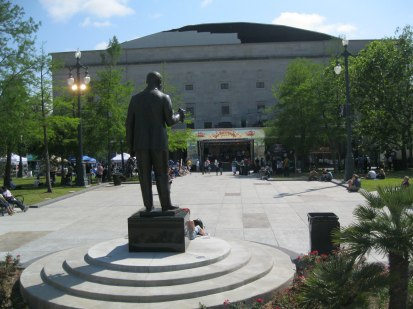
As might be expected, a larger than life statute of Louis Armstrong holds a prominent spot in the park overlooking the unused auditorium.
Louis Armstrong grew up not too far from where his statue stands in the park. In fact, his statue stares in the direction of Storyville – a legal red light district that provided brothels, saloons and steady flow of clientele who enjoyed the music that evolved into jazz. it was this neighborhood that Armstrong grew up and began playing the horn. Once he left New Orleans for Chicago, he rarely returned but his impact on the city looms large like the statue over his park.
The statute of Buddy Bolden in the Louis Armstrong Park captures his improvisational, open style of play.
If any one person could be considered the father of Jazz, Charles “Buddy” Bolden would likely have the strongest claim, and yet there is not a lot we know about his life except that for about seven years, he was the hottest musician in New Orleans. Bolden played his coronet by ear blending the many sounds he heard including rag time, gospel and blues to create an improvisational style of music that inspired other jazz pioneers. His career was cut short in 1907 when he was committed to an asylum possibly suffering from schizophrenia.
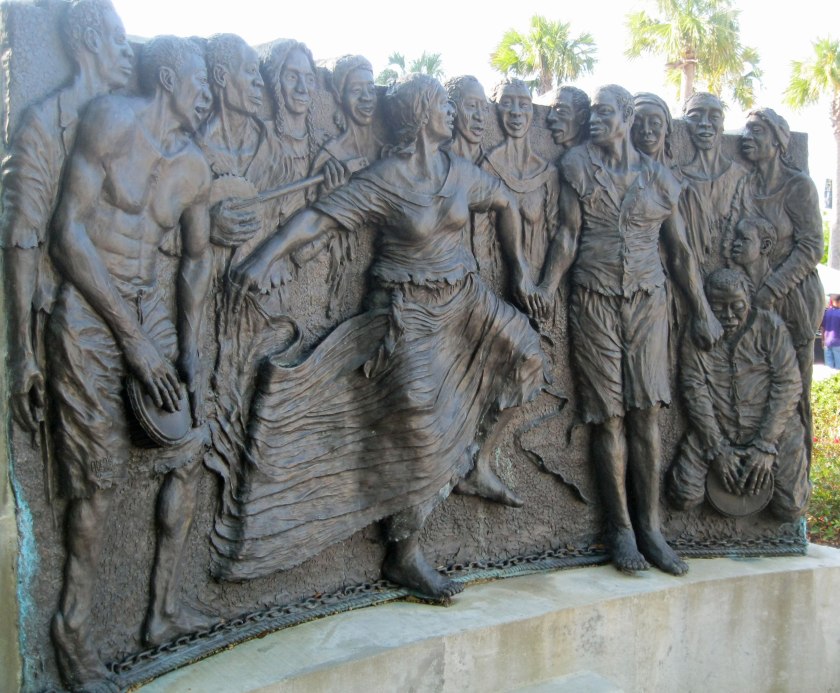
The grounds of the park are sacred because its where African Americans, slaves and free blacks, gathered on Sundays to trade, talk, play music and dance. Congo Square is widely recognized as the cauldron from which the rhythms of jazz emerged. Part of this area has been renovated and a sculpture depicting the Sunday jazz session quickly captures the visitor’s eye.
Congo Square Memorial
The Black Indians of Mardi Gras do not perform jazz but rather perform their own unique percussion based music that includes call and response vocals. The park also includes a statue honoring the Chief of Mardi Gras Indian Chiefs, Allison “Tootie” Montana, Big Chief of the Yellow Pocahontas. Tootie Montana is known for elevating the practice of masking as Native Americans to a high art form. Originally a tradition that involved revenge and violence, Mardi Gras Indians today are revered for their detailed use of beads and feathers in constructing elaborate costumes. The goal is not be the toughest, but the prettiest.
It seems that when a band is ready to push for a bigger audience, the music tends to embrace a broader footprint than what was played when building a local following.
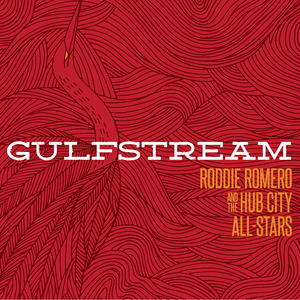
But in the case of Roddie Romero & the Hub City All-Stars, their national coming out party involves cranking up what they’ve been doing for 20 years. From the image rich lyrics of their original numbers to the loving interpretations of Allen Toussaint and Bobby Charles covers, Gulfstream holds a mirror up to just about everything Roddie Romero and his writing partner Eric Adcock hold dear about their native land, Acadiana.
With media images of a flooded Lafayette, Louisiana making it the latest poster child of global weirding, it’s heartwarming to hear such a solid set of music that conveys so much love for their surroundings, their culture, their language, history and music.
“We’ve been called an immersive Louisiana experience,” remarks Adcock in the press release announcing Gulfstream’s release. But their music is part of an evolving contemporary sound that weaves in its musical past without rote repetition.
On my show last week, Roddie explained it this way: “The music scene in Lafayette is forever going forward. . . You’re holding on to your culture and where you’re from but you’re always moving forward. . . This is a beautiful, beautiful time to be where we’re from.”
The pain isn’t over for Baton Rouge and surrounding communities after the recent flooding. Even after this once-in-a-millennium flood, the region continues to be hammered by thunderous afternoon storms dumping inches of water followed by the usual tropical heat blast that Louisiana is famous for in late summer. This week’s show is my annual recognition of Hurricane Katrina.
It’s not as if this area needs any more grist (or precipitation) to sing the blues.
The Great Mississippi Flood of 1927 affected over a half million people, displacing 200,000 African Americans along the lower Mississippi River — many of whom joined the Great Migration that carried jazz and blues to Chicago and other northern cities (and ultimately the world.)
The devastation inspired a great many songs, perhaps most notably When the Levee Breaks by Memphis Minnie who was born in Algiers across the river from New Orleans. She wrote and performed the song with her husband Kansas Joe McCoy but you might be more familiar with the Led Zeppelin adaptation of the song.
And of course, there’s Randy Newman’s seminal Louisiana 1927 which became closely associated with the New Orleans flood following Hurricane Katrina — another song-inspiring catastrophe.
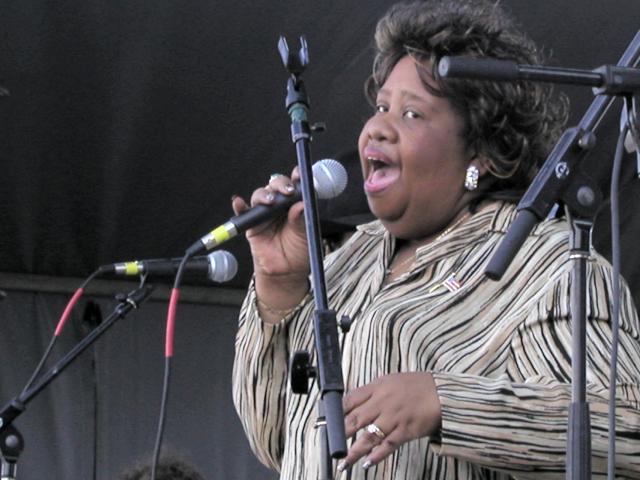
Marva Wright singing at French Quarter Festival 2002 – Photo by C.J. Ryan from her website
Of the many Katrina songs, I think Marva Wright whose eastern New Orleans home was destroyed under eight feet of water best captures the frustration of being stranded in a city surrounded by deep poisonous water and no relief available. Though she was able to leave the city before Katrina, she puts you right up on a baking rooftop waving towels at the helicopters as they fly by in her song The Levee is Breaking Down. She follows that song up on her album “When the Levees Broke,” with a heart crushing lament called Katrina Blues.
This is the 11th anniversary of Hurricane Katrina with the city mostly recovered. But now with the Louisiana Flood of 2016, there’s a new recovery effort that is underway and new music being written to chronicle the struggles.
Check my show out this Thursday, I’ll be playing Memphis Minnie, Marva Wright, Zachary Richard and John Boutte’s version of Louisiana 1927. I’m also expecting to get on the phone with Roddie Romero who fronts the Lafayette-based band, Roddie Romero & the Hub City All-Stars to hear about how things are going over there and to talk about his band’s soon-to-be-released album, “Gulfstream.”
But a musical melting pot is not new to New Orleans which has been stirring up the world’s cultures for three centuries. Congo Square is widely considered to have been the cauldron for brass bands and ultimately jazz. All it takes is a place for musicians of different stripes to gather, meet and mix it up. A place, let’s say, like just about any bar in New Orleans.
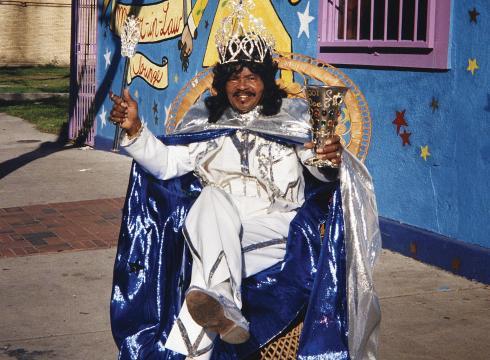
Ernie K-Doe is Emperor regalia outside his Mother-in-Law Lounge. The bar was named after his number one pop chart hit from 1961.
“. . .delight ensued from the lounge’s welcoming environment and the surreal sensory overload that walloped all who crossed the threshold. This physical entrance doubled as the conceptual portal into Ernie K-Doe’s eccentric parallel universe–a festive and unfettered happiness reigned supreme. . .The lounge’s hybrid ambience combined elements of a juke joint, a mosh pit, an R&B museum, and a cinematic set from Satyricon.”
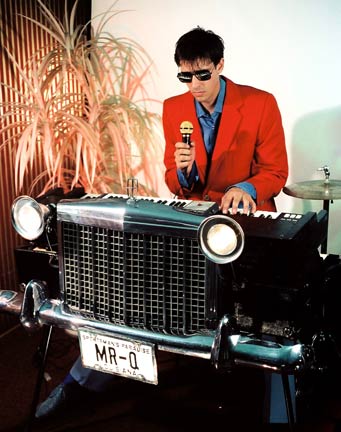
Not surprisingly, the lounge attracted an eclectic mix of clientele particularly while Ernie was still alive. One regular was Robert Rolston a young keyboardist with his own eccentricities. Performing under the name of Quintron , he developed a style of punk, electronica, dance music that he dubbed “Swamp-Tech” –often performing with his artistic partner and wife, under the name of Quintron and Miss Pussycat.
Mr. Quintron shares K-Doe’s affinity for bold, brash performances where there is no such thing as a mistake.
Ernie became friends with Quintron and in a way served as a mentor. Speaking of K-Doe, Quinton is quoted as saying “To him there was no failure onstage; he held stuff up with energy and emotion and screaming and shouting and turning disaster into glorious, successful, beautiful music. . . It was K-Doe’s music that made us gather around him–the way that K-Doe would perform. He was as punk as anyone.”
Quintron engineered and produced Ernie last two recorded songs, taped in the Mother-in-Law lounge. He also coaxed Ernie to be in his surreal infomercial created for one of his musical inventions called a drum buddy. Together, they performed Fever. You got to see it to believe it. And here’s the full 49-minute infomercial.
I’ll be playing Ernie K-Doe, Quintron and many other New Orleans soul and R&B greats on my next show. Tune in. Or listen to the edited podcast of that show (K-Doe and Quintron are saved for the last part of the program)
Say what you want about the old Lawrence Welk show but from the mid 1950’s until 1982, it delivered musical performances weekly into the living rooms of folks who probably wouldn’t otherwise catch a live performance.
Pete Fountain gained national exposure on the Lawrence Welk show
And some of the hippest episodes included solo turns by Pete Fountain, the legendary clarinetist from New Orleans who died last Saturday (August 6). He was 86.
Pierre Dewey LaFountaine Jr. was born in New Orleans and grew up in Mid-City. He began blowing the clarinet initially as a way to build up his lungs, after suffering from respiratory infections. He played in local school bands but apparently never completed high school because by that time, he was playing in the clubs downtown and wasn’t able to stay awake in class. Though he received honorary doctorates in music, he described himself as an alumnus of the Conservatory of Bourbon Street.
Discovered by a talent scout, he performed with the Lawrence Welk show in 1958 and 1959 where he quickly gained national recognition for his solos. Here’s a video of the show where he is playing Tiger Rag. As you might imagine, his style conflicted with Lawrence Welk or as Fountain put it: “Champagne and bourbon don’t mix.”
Later day Pete Fountain performing by his statue at the Musical Legends Park on Bourbon Street
He returned to New Orleans with a recording contract, eventually issuing over a 100 recordings over his career. What I appreciate about Fountain is that despite his fame, he stayed close to home. He opened a night club in French Quarter and founded the Half Fast Walking Club — a parade he led on Mardi Gras mornings.He now joins the many musical legends of the city. You’ll find his statue at the Musical Legends Park on Bourbon Street and you can listen to the Gumbo YaYa episode he inspired.
I took the train to Chicago a couple of weeks ago, just in time to catch the city’s blues festival.
I started by going to Buddy Guy’s Legends club and saw the six-time grammy award winning blues man sing with Shemekia Copeland. George “Buddy” Guy is from Lettsworth Louisiana and began playing professionally in Baton Rouge before making the familiar trek north to Chicago.
Buddy Guy moved up from Louisiana to seek his fame in Chicago.
I say “familiar” because he wasn’t the first Louisiana musician to seek fortune and fame by heading up the Mississippi River.
If you’re a New Orleans jazz fan, you already know this story. After New Orleans was forced to close its red light district during the build up to World War 1, musicians who had been making a living playing the new music in the bars and brothels of Storyville, headed north. One of the best and earliest to do so was Joe “King” Oliver, who took his coronet to Chicago and hooked up with other New Orleans expatriates and recreated and polished the jazz of New Orleans. Things really took off when he convinced his young protege’ Louis Armstrong to come up and join him.
It was good timing. King’s smart professional move came at the beginning of what has become known as the Great Migration where for roughly a half century over 6 million African Americans relocated from the south to northern cities. An estimated 500,000 ended up in Chicago mostly in and around South Chicago.
The first migratory wave moved the unique blend of Afro-Caribbean rhythms and European horns forged in New Orleans’ Backatown into popular awareness ensuring that Jazz would become a distinctly American sound.
Henry Gray, from Kenner Louisiana, became Howlin’ Wolf’s piano player when he moved to Chicago.
And then came blues. Gertrude “Ma Rainey” Pridgett is noted as the first black woman to record. This Georgia-born singer recorded many of her earliest songs in Chicago.But she was followed by others, such as Muddy Waters who moved from Clarksdale, Mississippi to Chicago during World War II and later Henry Gray who was typical of the second wave of the Great Migration. As black soldiers exited service following World War II, they looked for communities with more opportunities and less discrimination. The Louisiana-born pianist landed in Chicago in 1946, playing regularly with the likes of Bo Diddley, Billy Boy Arnold and Jimmy Rogers before hooking up with the Howlin’ Wolf Band. He has since returned to Louisiana and continues to perform on occasion.
Buddy Guy, who had started his career playing in Baton Rouge, got to Chicago in 1957. He was joined later by Lonnie Brooks who had a regional hit in Louisiana, Family Rules, before moving north.I’ll continue to explore the connections between these two fine musical cities (New Orleans and Chicago) on my show. Please join me or catch one of my edited podcasts.
Jon Cleary brings a unique version of the New Orleans sound to the Northwest, steeped in tradition and yet wholly fresh, when he performs at Dimitriou’s Jazz Alley in Seattle this Monday, February 8.
Cleary’s latest album, GoGo Juice, has been nominated for this year’s Best Regional Roots Grammy. A native of England, he’s lived all of his adult life in New Orleans — a city he chose after falling in love with New Orleans R&B and funk at a tender age. Now, at 53, he has firmly rooted himself as a New Orleans piano “professor,” a true practitioner of the New Orleans sound who has broken fresh ground with new compositions and arrangements.
He’ll be backed by the Absolute Monster Gentlemen which includes Jeffery “Jellybean” Alexander on drums, Derwin”Big D” Perkins on guitar and Cornell Williams on bass. If you followed the HBO series Treme, you’ll recognize Cornell Williams who helps a band mate break his drug addiction by putting him on his uncle’s shrimp boat.
In his performance, Cleary will draw from his library of eight albums, including a well-regarded tribute to Allen Toussaint called “Occapella.” Even when he’s not doing Toussaint, he and the Absolute Monster Gentlemen seem totally capable of cleverly funking it up with great lyrics and an awesome groove. Here’s a taste.
Other Upcoming Northwest Performances of New Orleans Artists
Galactic – at the Showbox in Seattle, February 26 and Crystal Ballroom in Portland, February 27.
The Revivalists – at Neumos in Seattle, March 9 and Aladdin Theater in Portland, March 10.
Trombone Shorty – at the Moore Theater in Seattle, April 14 and Keller Auditorium, Portland, April 15.
Walter Wolfman Washington – opening for Bettye LaVette at Dimitriou’s Jazz Alley, May 12 – 15.

 As the bandleader and composer for The Roamin’ Jasmine, Smith has become well acquainted, as do most successful New Orleans musicians, with the city’s traditional jazz standards. But its been his ability to apply a New Orleans style rhythm and blues spin on classic blues numbers that sets his music apart.

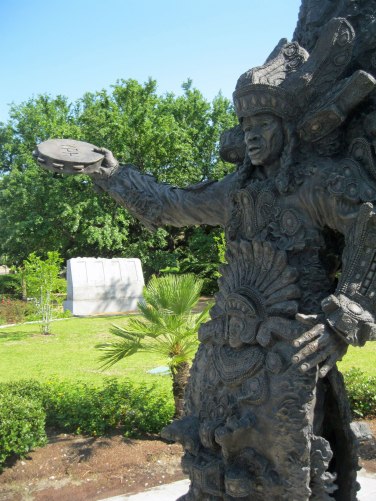 The Black Indians of Mardi Gras do not perform jazz but rather perform their own unique percussion based music that includes call and response vocals. The park also includes a statue honoring the Chief of Mardi Gras Indian Chiefs, Allison “Tootie” Montana, Big Chief of the Yellow Pocahontas. Tootie Montana is known for elevating the practice of masking as Native Americans to a high art form. Originally a tradition that involved revenge and violence, Mardi Gras Indians today are revered for their detailed use of beads and feathers in constructing elaborate costumes. The goal is not be the toughest, but the prettiest.
 With media images of a flooded Lafayette, Louisiana making it the latest poster child of global weirding, it’s heartwarming to hear such a solid set of music that conveys so much love for their surroundings, their culture, their language, history and music.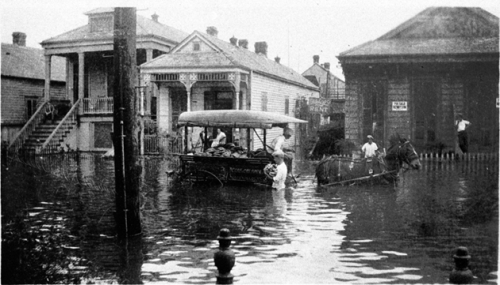


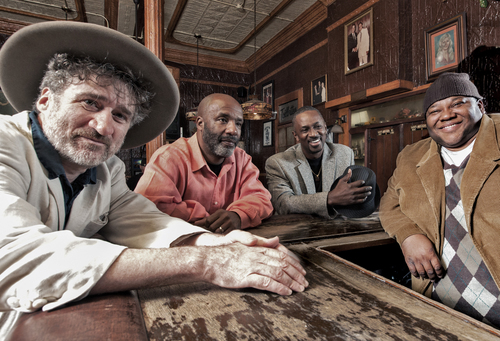 Cleary’s latest album, GoGo Juice, has been nominated for this year’s Best Regional Roots Grammy. A native of England, he’s lived all of his adult life in New Orleans — a city he chose after falling in love with New Orleans R&B and funk at a tender age. Now, at 53, he has firmly rooted himself as a New Orleans piano “professor,” a true practitioner of the New Orleans sound who has broken fresh ground with new compositions and arrangements.
 Sweeney's Gumbo YaYa