Tipitina’s keeps the legacy alive while contributing to the future

Professor Longhair may have memorialized the corner of Rampart and Dumaine in “Mardi Gras in New Orleans” but his memory and spirit live on at a different street corner, Napoleon and Tchoupitoulas, in a music venue that bears the name of another of his classics, “Tipitina.”

A bust of Professor Longhair (Henry Roeland Byrd) sculpted by Coco Robicheaux stands guard at the entrance of the New Orleans music venue that bears the name of his song Tipitina. – Photo by Alex Brandon / Times-Picayune archive

Rampart and Dumaine is the original location of J&M Studios, run by Cosimo Matassa. The location is recognized by the Rock and Roll Hall of Fame as a landmark site and it’s a laundromat – with mixed but generally positive Internet reviews.

Tipitina’s, on the other hand, is a great example of how cool stuff can happen out of love for music and doing the right thing. Just as Preservation Hall is dedicated to keeping New Orleans jazz alive, Tipitina’s was conceived with the notion of honoring the city’s early R&B and Rock ‘n Roll legacy.

When the venue opened in 1977, it’s goal was to provide a public performance space for aging and almost forgotten R&B and Blues artists like Fess (Henry Roeland Byrd), Jessie Hill, Snooks Eaglin, Earl King and others. Tips was born from an act of love by a group of investors who collectively and affectionately became known as the “fabulous fo’teen.”

Neville Brothers in front of the Longhair mural at Tipitina’s. Photo by Leon Morris from the WWOZ website.  WWOZ’s early years were spent located above Tip’s in the beer storage room.

The venue also provided a platform for other local musicians, such as the Radiators, Little Queenie and the Percolators, the Dirty Dozen Brass Band, the Continental Drifters and the Neville Brothers.

Tipitina’s in those earlier years was quite a bit different than it is today.  Music author Jay Mazza described a summer show this way:  “Sometimes it was so humid in the place that the clouds of smoke seemed to be seeded with water.  The smoke hung low in the room. Both bands and patrons alike were soaked to the bone within minutes. A trick learned early on was to bring extra shirts for changing between sets. . . Still everyone loved the place . . there always has been an amazing vibe associated with Tipitina’s.”

While the venue provided many great musical moments in the late 70s and early 80s, it struggled financially and eventually shuttered for about a year and a half. When it reopened in 1986, a major renovation made it far more attractive for musicians and their patrons. The warehouse-like building was opened up, creating a balcony level with higher ceilings, better circulation, improved bathrooms, and air conditioning.

Tacoma band Girl Trouble performing at the Capitol Theater this month. Like Tipitina's the theater has a history of providing local groups a platform to perform.
Tacoma band Girl Trouble performing at the Capitol Theater this month. Like Tipitina’s the theater has a history of providing local groups a platform to perform.

This is a nice example of how some key changes could make an Olympia venue more attractive.

Tipitina’s also kicked up their bookings, continuing to stage local artists but adding national and international acts to the mix, building a worldwide reputation.

To get an idea of the artists who have performed at Tipitina’s, check out its index of musicians, some of whom are honored with additional recognition on the sidewalk outside: the New Orleans Walk of Fame.

Tipitina’s honors New Orleans musical legacy inside and outside with its Walk of Fame.

Another cool feature of Tipitina’s is its Foundation. It’s not every place where you can rock out to amazing music, with the understanding that profits go to support the very music scene you’re enjoying.  The Foundation purchases instruments for Louisiana schools, provides ongoing youth music workshops, offers an after school jazz and digital recording program under the artistic direction of Donald Harrison, Jr. and provides a a statewide network of workforce development and job skills training centers for musicians, filmmakers and other media professionals.

Jazz artist Donald Harrison, Jr. heads up the Tipitina’s internship program.

And you never know what you’ll find at Tips. An Olympia friend told me about how she and her partner on a NOLA visit wandered into the uptown bar on a late Sunday afternoon, ordered a beer and found themselves drawn into a Cajun Fais Do Do.

So next trip to NOLA, put Tips on your list. Until then, you can catch many of the musicians who perform there on Sweeney’s Gumbo YaYa, every Monday from 10 a.m. to noon on your community radio station, KAOS.

Community Stations like KAOS; WWOZ make a difference

Picture yourself at Tipitina’s in the early 80’s preparing to catch some funk by Zigaboo Modeliste and George Porter, Jr., and just as the band is about to begin, a microphone descends from the ceiling.

In the early years of WWOZ, Tipitina’s was the home of the station.

You would have been witnessing an early, glorious moment in community radio. Located in the beer storage room above the uptown New Orleans night club was the nascent community radio station, WWOZ. With that simple, low-tech approach, the station was able to broadcast a live performance–launching a 30-year tradition of supporting local music.

WWOZ has come a long way from that beer closet and now is readily recognized as the “Guardian of the Groove” in New Orleans.

While serving a smaller market, KAOS has a similar reputation for supporting the often overshadowed music scene in Olympia.

With the KAOS Fall Member Drive and the WWOZ Fall Member Drive, I thought it timely to talk about my two favorite radio stations and why financial support is essential to both.

Like many, I listen to more than one station. But I only pledge to KAOS and WWOZ.  I pledge to KAOS because its my default station that I listen to the most, providing a wide range of music and programming. I pledge to WWOZ because I love New Orleans and its music. Listening to the station connects me, albeit remotely, to the city I was born in. Without WWOZ, I would not have had the confidence to launch Sweeney’s Gumbo YaYa – a show that wouldn’t exist without KAOS.

Here are the features I like about these stations.  They both are non-commercial, community radio stations. They both invite and train members of the community to volunteer as on-air hosts (deejays). While being “volunteer powered” means they’re not as slick as some commercial radio stations, the hosts convey an authentic, honest voice, portraying Olympia and New Orleans in a way that gives me a deeper understanding. These deejays work in the same community, walk the same sidewalks,  drink at the same bars (you get the idea.).

Both stations are cheerleaders for local music, regularly announcing live music events, hosting studio performances and interviewing musicians and other performers. This boosterism can matter.  In 1987, KAOS hosted the the first radio broadcast of Nirvana and this summer, Seattle’s Vaudeville Etiquette was written up by the music tracker CMJ because of airplay it received on KAOS.

Just last week, local musician Greg Black stopped by the KAOS table at Arts Walk and offered the station his new CD, recorded two blocks away at Dub Narcotic Studio. You’ll hear it, along with other local music, on KAOS.

rampb-emperor-biography-hails-ernie-k-doe-291g96r6-x-large
Ernie K-Doe, New Orleans singer and lounge owner, was a deejay with New Orleans community radio station WWOZ.

And like WWOZ whose shows have been hosted by musicians like James Booker, David Torkanowsky and Ernie K-Doe (this blog’s patron saint), many of the KAOS on-air hosts are musicians themselves.

Both stations offer more than music. WWOZ , owned by the same folks who bring us Jazz Fest, focuses on programs that delve into the music and culture of New Orleans. KAOS has a broader mission, providing alternative perspectives such as National Native News, Counter Spin and Workers Independent News. as well as locally produced public affairs programs like Parallel University, Speaking of Wellness and the one I contribute to, Community Connections Report.

Strong listener support for these stations are crucial. The additional funding helps enrich the quality of the programming. But it also demonstrates to underwriters and funders that the station is a valued resource worthy of their support. Please take the time to pledge to KAOS and pledge to WWOZ this week or whenever you read this.

There’s more to NOLA than Bourbon Street

Even if you only know a little about New Orleans, you probably know about Bourbon Street.  And if that street is your only knowledge of the city, please keep reading.

19699918-mmmain
Bourbon Street on Mardi Gras Day – NOLA.Com

Nowadays, Bourbon Street is almost a caricature of people’s perceptions of the city.  A noisy, flashy street loaded with T-shirt and souvenir shops, bars that sell drinks called “Hand Grenades” and strip clubs. The street seems designed to allow visitors to sin without fear of discovery or retribution by their neighbors back home.

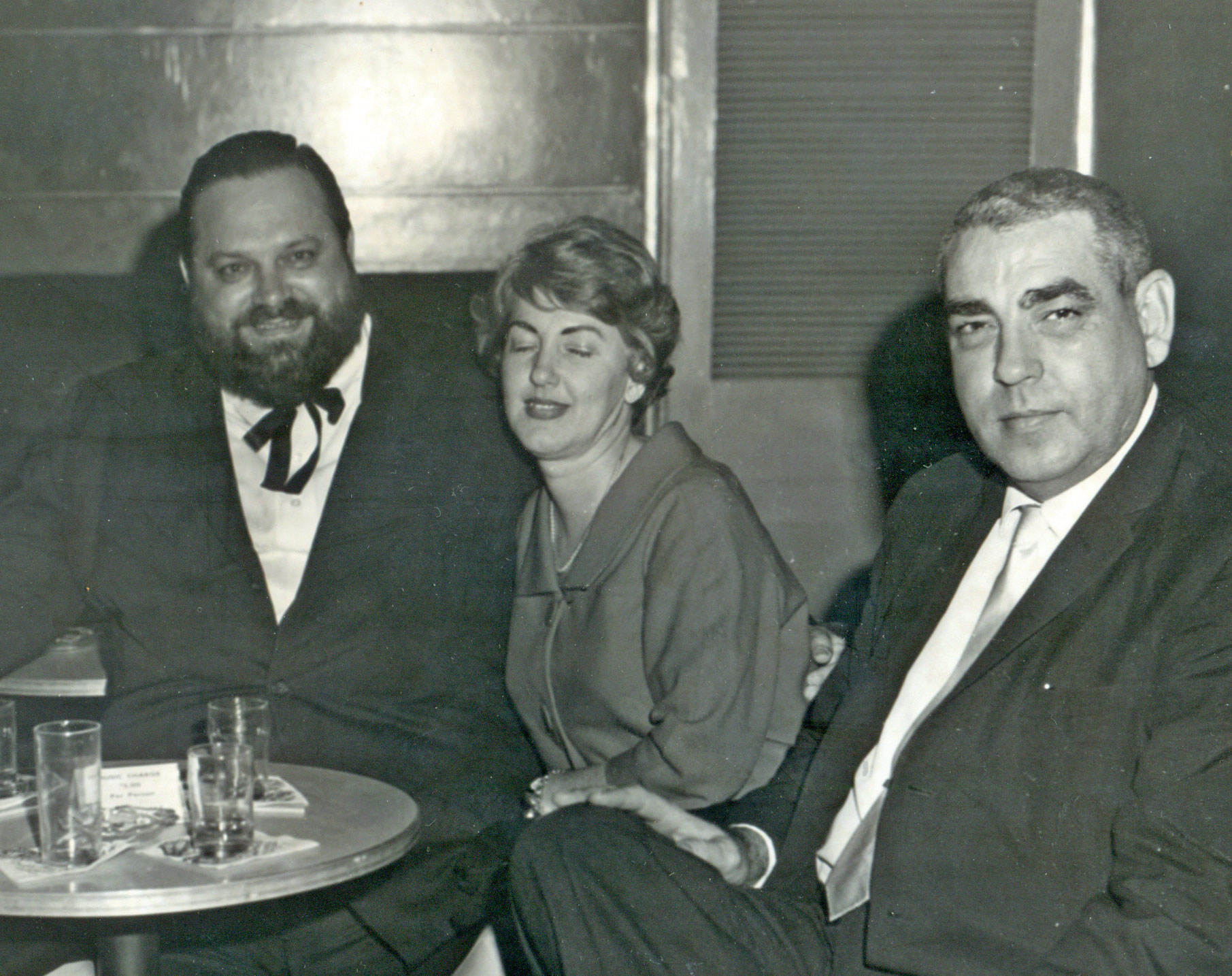
My own experience with the street dates back to the early 60’s when my parents’ idea of a fun family night was to pack us all up in our Rambler station wagon and drive slowly down the street (now restricted to pedestrians at night). My dad would stop the car when the doormen to the “dance clubs” would open the doors providing us a scandalous peak at the activities inside.  Yes, we all have undergone therapy since.

When not driving a Rambler full of kids down Bourbon Street, parents were often inside night clubs like this one with Al Hirt.
My parents with Al Hirt at his club on Bourbon Street.

Back then, locals still went down to Bourbon Street for live music at clubs such as those owned by famous home boys, Al Hirt and Pete Fountain.

The street still offers live music, mostly versatile cover bands capable of playing Rock favorites and cabaret music. The street is an important employment base for local musicians and other performers, according to Brad Rhines’s article, Pride on Bourbon Street.  Also, the restaurant Galatoire’s and Irvin Mayfield’s Jazz Playhouse are two well-regarded establishments on Bourbon that attract a local clientele.  But generally speaking, the locals leave Bourbon Street for the tourists.

Fortunately, New Orleans has another locus of live music that both locals and tourists frequent.  Downriver from the French Quarter is the end of Frenchmen Street located in the Faubourg Marigny neighborhood. Any cabby can get you there. If you’re in the French Quarter, it’s a reasonable walk– head away from downtown on either Decatur or Chartres (pronounced Charter) Streets. After you cross Esplanade, you’ll run into Frenchmen. There are roughly a dozen places offering live music in this three-block area.

If you have watched the wonderful HBO series  “Treme,” then you’ve seen a number of Frenchmen Street clubs featured as settings for the show, including the Spotted Cat, The Blue Nile, and the venerable Snug Harbor. There are music clubs literally next door to each other. In one scene in Treme, band leaders in adjacent clubs go back and forth stealing the other’s audience, illustrating just how easy it is for you to bounce from one music venue to another.

One of my most recent experiences on Frenchmen was almost magical. Kim and I landed on the street one afternoon after a long day of slogging through torrential rains. We walked into The Three Muses tired, wet and hungry. We were just looking for a place to sit and maybe eat.  We ordered a couple of small food plates and there on the tiny stage next to us was a cellist using a digital delay, a loop pedal and other electronic wizardry to create a roomful of haunting music.

In the dozen years that Helen Gillet has lived in New Orleans, she has established herself as an original artist, capable of integrating New Orleans sounds and heritage into her music.  And here she was doing an intimate performance for us as we refreshed ourselves with excellent food and drink.

Cellist Helen Gillet

On your next trip to New Orleans, visit Frenchmen Street. Meanwhile, you can hear Helen Gillet, Al Hirt and Pete Fountain on my next show, Sweeney’s Gumbo YaYa, starting at 10 a.m., Monday, on KAOS, www.kaosradio.org, 89.3 FM.