Focus on Tradition and Youth Ignites a Musical Rebirth

It’s not every retirement that results in a musical revitalization. But that’s what happened when veteran jazz performers Danny and Blue Lu Barker returned to New Orleans in 1965.
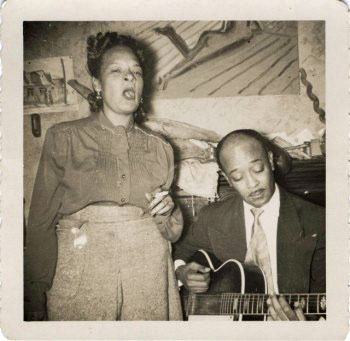
MRDannyLuBarker
Louise “Blue Lu” and Danny Barker were life partners who performed together as an act. One of their most famous numbers was Don’t You Feel My Leg

I suspect they sought a slower pace after 35 years of performing with Jelly Roll Morton, Louis Armstrong, Cab Calloway, Billie Holiday and a long list of other jazz notables. But retirement for Danny Barker didn’t mean doing nothing.

Danny went to work as an assistant curator for the New Orleans Jazz Museum– gone now but the collection resides in the Old U.S. Mint building.  He also continued his reputation for performing and writing bawdy songs like the one that made him and Blue Lu famous, Don’t You Feel My Leg.

Danny continued to perform with his guitar and banjo regularly around town, even maintaining a weekly spot with the band at the Palm Court Jazz Café until near his death in 1994.   (The gig inspired his song Palm Court Strut. See it performed at Seattle’s Fremont Solstice Parade.)

But it was volunteer work organizing a youth band for his 7th Ward neighborhood church at the request of his pastor that would leave a lasting impact on New Orleans music.

When Barker began recruiting young musicians for the Fairview Baptist Church Christian Marching Band in 1970, brass bands were the province of old men. There was some concern whether the tradition would get carried forward. Fortunately, there were plenty of young musicians developing through the public school’s music system. All they needed was some guidance.
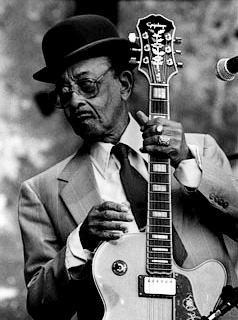
Leroy Jones, who lived only an Archie Manning pass away from the church, was one of the first to get recruited. Danny found the future member of the New Orleans Jazz Hall of Fame practicing in his parent’s garage. Years later, Jones described his initial impressions of Barker this way to Offbeat Magazine:

“We didn’t really know who Danny was in terms of his status. I just thought he was a cool guy. He wore a nice hat and these slick, creased pants and Stacy Adams shoes. He had a cool, hip walk. He was the epitome of coolness. These guys today have nothing on Danny Barker.” (Hear Leroy Jones describe his meeting with Barker on this WWOZ podcast.)

The list of band members that Barker assembled makes it clear he had eye for talent because it reads like a “whose who” of New Orleans musicians: Wynton Marsalis, Gregg Stafford, Herlin Riley, Michael White, Lucien Barbarin, Kirk Joseph, Alton “Big Al” Carson,  and Anthony “Tuba Fats” Lacen, among others.

The Fairview Band played for about four years before Barker had to quit the project because of concerns raised by the local music union. But the band continued, evolving into the Hurricane Brass Band and then Tornado Brass Band–names suggestive of the power produced by these young lungs.
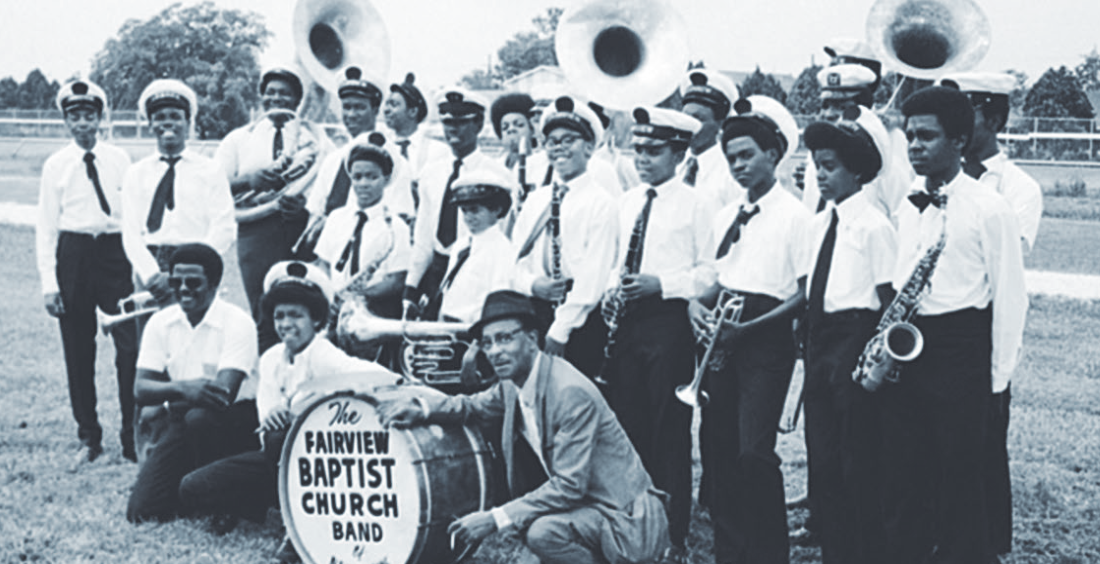
use of union issues, Danny Barker had to stop leading the church band which was renamed Hurricane Brass Band. Here the young band members are marching on St. Denis toward the church.

Three of the band members, Gregory Davis, Kirk Joseph, and Kevin Harris, would form the the Dirty Dozen Brass Band which captured the attention of music lovers all over the world by blending traditional brass sounds with funk, bepop and R&B.  The band was a major inspiration for the founding members of the Rebirth Brass Band and other brass bands that followed. Without Danny Barker’s efforts with Fairview, the brass band scene in New Orleans would not be as robust as it is today.

Also, many of the Fairview band members such as Jones, Stafford and White, would carry on the tradition of New Orleans jazz, helping to sustain and grow the city’s reputation as the birthplace of jazz.

In reading the many articles about the Fairview Brass Band and Barker’s influence (a good example), I’m struck by how a string musician could affect so dramatically brass band music. He did it by teaching these young players the history and tradition of jazz. particularly New Orleans jazz. He demonstrated the importance of showing up on time, dressing appropriately and being prepared to perform–what workforce professionals now call the “soft skills.” In short, he taught kids who had musical talent how to be professional musicians.

You’ll hear some of Danny’s proteges in this week’s edition of Sweeney’s Gumbo YaYa.  See you on the radio.
Cajun Throwdown raises questions about music and food

Food and music go together rather nicely. Or as Satchmo would say: “red beans and ricely.”

I bring this up because on Friday, October 3, I’ll be a tasting judge at the Cajun Throwdown at Centro (formerly Alpine Experience – 408 Olympia Ave NE) starting at 7 p.m. during the Olympia Fall Arts Walk.

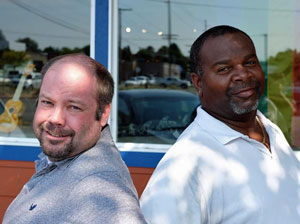
Upstart Joe Hyer (left) goes up against the pro, Rodney O'Neill in Friday's Cajun Throwdown.
Upstart Joe Hyer (left) goes up against the pro, Rodney O’Neill in Friday’s Cajun Throwdown.

Rodney O’Neal, barbecue and Southern cook extraordinaire and owner of Barb’s Soul Cuisine, will be challenged by the upstart, usurper Joe Hyer who claims that because he’s visited New Orleans a few times, he can cook like a cajun.  We’ll see.  (I guess I’ll be the judge of that.) It’s all for a good cause with proceeds from food sales benefiting the charitable organization, Barb O’Neill’s Family and Friends.

While this is mostly an assignment for my taste buds, I have been preparing my ear buds. After all, this is a blog about a show called “Gumbo YaYa.”

Food about music is fairly boundless.  Jimmy Buffet’s Cheeseburger in Paradise and the Presidents of the United States’ Peaches, come to mind. But, as usual, I’ll stick to New Orleans music.

Jelly Roll Morton’s name didn’t come from a pastry

The tricky part is what might sound like food isn’t always the case. Ferdinand Joseph LaMothe didn’t take up the name Jelly Roll Morton because of a fondness for sponge cake. The moniker of the piano player who began his career performing in Storyville whorehouses has more do with a woman’s private parts than a pastry. Given that context, I’m leaving his 1923 song, Big Fat Ham, alone.

Similarly, the New Orleans jazz standard “Struttin’ with Some Barbecue”  originally recorded by Louis Armstrong and his Hot Five likely has nothing to do with ribs. According to Cab Calloway’s Jive Dictionary, “barbecue” was jive for a girlfriend or beauty.  I imagine Lil Hardin, the piano playing composer of the song and Armstrong’s wife at the time, was thinking she was the “barbecue” that Pops was strutting with.

When Satchmo and his Hot 5 recorded “Struttin with Some Barbecue,” his barbecue was likely his wife, piano player and song composer Lil Hardin.

Dan Raye, who added lyrics to the music years later, took the song at face value. “And mister waiter if you please, Another rib or two. And I’ll go strut, strut, struttin’, Struttin’ with some barbecue.”

Zydeco King Clifton Chenier was more transparent when he recorded, Hot Tamale Baby. There’s absolutely no reason to believe his song is about a starchy food wrapped in a corn husk.

But a classic Cajun song , “Jambalaya.” is about food, right? Well, true, the singer has to say goodbye to Joe (me oh my oh) so he can go see his girl (ma cher amio). But he also waxes rather poetically about “Jambalaya, and a crawfish pie and file’ gumbo.”

While I doubt Hank Williams ever poled “a pirogue down the bayou,” he did manage to capture a slice of cajun life, albeit a caricature, in this often covered song.

I think Professor Longhair got it right when he sang “Got my red beans cookin” in the aptly named song “Red Beans.” Not much to the lyrics except him cooking red beans–which can take some time to do right. I have to say, though, I’m not sure how pure his intent was when he finished with “I’m gonna have all these women, jumping for joy.”

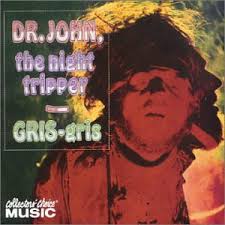
gumboyaya johnNot surprisingly, songs about gumbo are my favorite. Gris Gris Gumbo YaYa, the first cut off of  Dr. John’s debut album, was partly the inspiration for the name of my radio show. This creole dish is a perfect example of the melange of cultures that come together to form New Orleans cuisine and music.  In a pot of gumbo, you’ll find hints of West Africa, France, Spain, the Caribbean, Germany and Choctaw.

My favorite gumbo song is the quirky “Shrimp and Gumbo” by Dave Bartholomew. At the height of his reputation as a talent scout and R&B music producer, Bartholomew cranked out this little mambo ditty, heavy on percussion (thank you Earl Palmer) and a three saxophone melody reminiscent of the theme song of “I Dream of Jeannie.” Recorded in 1955, Shrimp and Gumbo predates the 60’s TV sitcom. The lyrics are rather limited playing off the fun of singing “mambo” and “gumbo” in tandem.

Well, I’ve given you a “taste” of what to expect on my Monday show (Sept. 29), 10 a.m. to noon (PST) on KAOS, 89.3 FM. But for a real taste, stop by Centro next Friday during Arts Walk for the Cajun Throwdown where you just might find jambalaya, a crawfish pie and file’ gumbo.