In New Orleans, the show must go on unless you can’t keep the musicians dry or if lightning threatens the audience. Over the course of the 2015 French Quarter Festival in New Orleans, we had a good bit of rain and a few lightning bolts.
So periodically, stages have been closed, including Tricia Boutte’s show right as she was beginning. Bummer!
A hard rain on Friday pushed crowds under cover. Saturday and Sunday also had rained out venues at times.
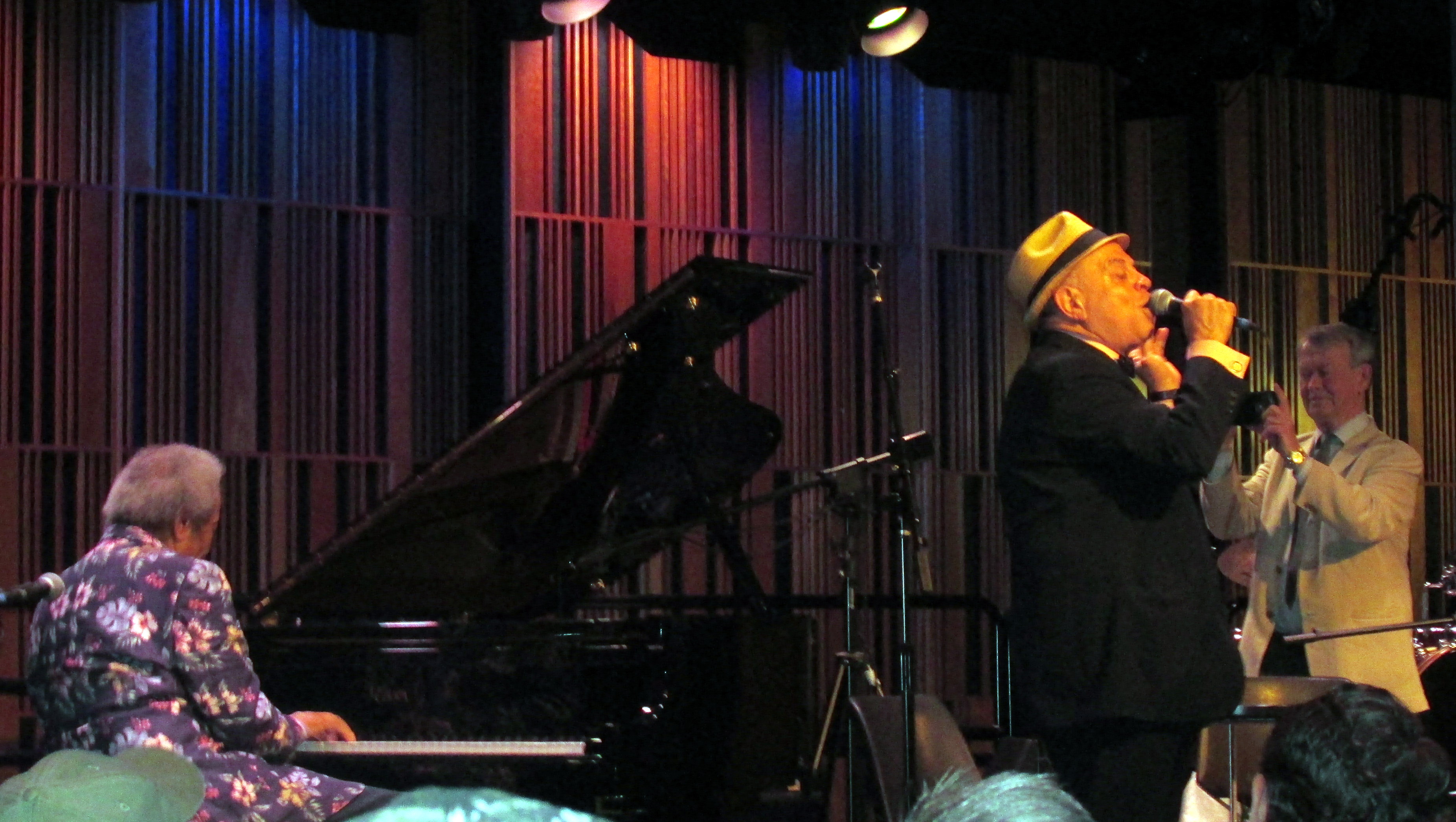
The highlight for me today was indoors though when Allen Toussaint and Deacon John sat down with author John Broven. The one-hour program started with Toussaint going right to the Steinway and banging out his hit originally done by Irma Thomas, “It’s Raining.” This time, Deacon John sang it, with a few appropriate ad libs.
The stated purpose of the program was to reminisce about Cosimo Matassa and the heyday of New Orleans R&B and early Rock n’ Roll–a period of time that launched the careers of both Allen Toussaint and Deacon John. More on Mr. Toussaint and more on Mr. Matassa.
Allen Toussaint (piano) played “It’s Raining” and Deacon John sang at the French Quarter Festival Conversations on Louisiana Music.
Of Cosimo and his studio, Toussaint said “It was our doorway and window to the world . . .He and Dave Bartholomew put us on the map. . .He (Cosimo) saw the big picture long before we did cause we were just having fun. “
Deacon John described getting discovered by Toussaint at the Dew Drop Inn one night and the next day going into Matassa’s studio to help Ernie K-Doe record “There’s a will, there’s a way.”
As I mentioned in my previous post, I won’t be hosting this Monday’s show. Anch of Sundrenched will handle affairs and I plan to call in during the show. Consider subscribing to this blog so you can be alerted the next time I post. (see upper right hand of page)
Allen Toussaint was a teenager when he first sat in on Earl King’s band and regularly scored gigs at the legendary Dew Drop Inn.
It wasn’t long before he found his way to the center of the known Rock n’ Roll universe at the time, Cosimo Matassa’s studio, where he laid down piano tracks on recordings by Fats Domino, Huey “Piano” Smith, and Aaron Neville. But it was when he joined Minit Records that his creativity became apparent to the world. Using his parent’s living room as rehearsal space and testing ground for new material, he assembled a parade of hit singles by Jessie Hill, Irma Thomas, Lee Dorsey and this blog’s patron saint, Ernie K-Doe.
Ernie K-Doe best recordings were aided by the songwriting, arranging and producing of Allen Toussaint.
As a keyboard savant, Toussaint could accurately reproduce and synthesize the city’s revered legacy of piano professors, especially the style of Professor Longhair. But as a songwriter and arranger, he was able to weave the full panoply of New Orleans rhythms, vocal traditions and spirit into a clean appealing style for the pop market. In fact, he, along with K-Doe, were responsible for the sole number 1 pop chart hit recorded in New Orleans, “Mother-in-Law.” (A song written before Toussaint was married and had one.)
Later, he started his own record labels providing a platform for local and national musicians to access the New Orleans sound. With The Meters as his studio house band, Toussaint was a key force behind the New Orleans funk sound that developed in the 70’s. A prolific songwriter, his music has been performed by The Rolling Stones (“Ruler of My Heart”), The Who (“Fortune Teller”), Bonnie Raitt (“What Do You Want the Boy To Do”), Devo (“Working in the Coal Mine”), Al Hirt (“Java”), The Doors (“Get Out of My Life Woman”), Jerry Garcia (“I’ll Take a Melody”), Glen Campbell (“Southern Nights”), Robert Palmer (“Sneaky Sally through the Alley”), The Pointer Sisters (“Yes, We Can Can”) and many more.
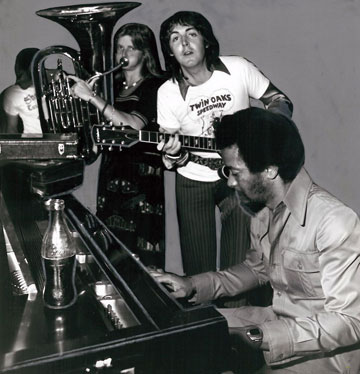
Linda and Paul McCartney performing with Allen Toussaint in his New Orleans studio in 1975.
In 1973, Toussaint had a big hand in producing and performing on Dr. John’s album “In The Right Place.” Two years later, Linda and Paul McCartney moved their entourage to New Orleans to collaborate with Toussaint in his New Orleans studio on their album “Venus and Mars.”
He was inducted into the Rock and Roll Hall of Fame in 1998, the Louisiana Music Hall of Fame in 2009, and the Blues Hall of Fame in 2011. If there’s any question of whether being a senior statesman of New Orleans music has diminished his chops, you need only look as far as his grammy-nominated, post-Katrina collaboration with Elvis Costello, “The River in Reverse,” for evidence that at 77, he still has it.
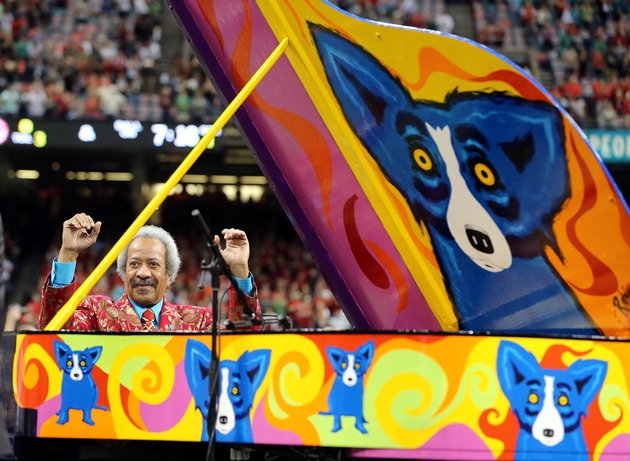
In addition to being a producer, bandleader, arranger and songwriter, Toussaint is an accomplished pianist and stands with the great New Orleans piano “professors.” Toussaint will take the stage at the French Quarter Festival on April 9 at 3:45 p.m. but you will be able to catch his music on my next show this Monday. (Here’s the recorded show)
Behind every great recording and concert, there’s a sound nerd making sure you hear what you’re supposed to hear. In the case of Cosimo Matassa, what people heard was the beginnings of rock and roll.
Cosimo’s recording career started out with using primitive equipment located in the back of an appliance and music shop.
In 1945 at the tender age of 19, Cosimo opened an appliance store with a partner in New Orleans, hoping to take advantage of the pent up demand for home conveniences and the many new households that were forming after the war. The store also sold records.
His partner suggested they make recordings for their customers. Cosimo, being the more technical of the two, took on the task of getting that business going. As a former Tulane chemistry major, he was your classic nerd. But having spent a few years working with his Dad’s jukebox business, repairing the equipment and swapping out 78 rpm records, he was a nerd with an ear for music.
The J&M Music Shop was at the right place at the right time on the corner of Dumaine and Rampart, sitting between the French Quarter and the Fauberg Treme’ neighborhood – a center of African-American and Creole culture and home to many New Orleans musicians.
After World War II, people were ready to have fun. And the music, particularly from a new generation of black New Orleans musicians raised on jazz, swing and big band music, was ready to make the party happen.
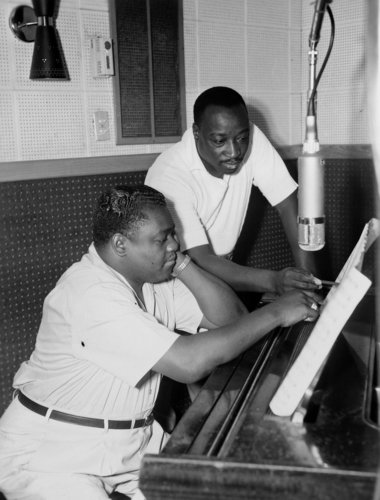
Fats Domino (left) and Dave Bartholomew generated a mountain of hits, all recorded from studios run by Cosimo Matassa.
The studio’s success started with Roy Brown, who had just returned to New Orleans with his Gospel-trained voice and was performing at the famous Dew Drop Inn. It was in the back of the J&M in 1947 that Brown recorded the jump blues song, Good Rockin’ Tonight, a hit that can arguably be considered one of the first Rock and Roll songs. Just ask Elvis.
Things really took off when horn player and band leader Dave Bartholomew started using the studio for his work as a musician, arranger and talent scout for Imperial Records. Through Bartholomew, early R&B greats like Smiley Lewis, Frankie Ford and Tommy Ridgley would record at the studio. But the star who solidifies the studio’s listing as a Rock and Roll Hall of Fame landmark is Antoine “Fats” Domino. Through a good chunk of the 50’s, Domino, with able assistance from Bartholomew and Matassa, released a series of R&B hits, finally crossing over into the pop charts with “Ain’t That a Shame” in 1955. All of the Fats’ recordings as well as hundreds of other R&B and early rock and roll gems were recorded in that little studio.
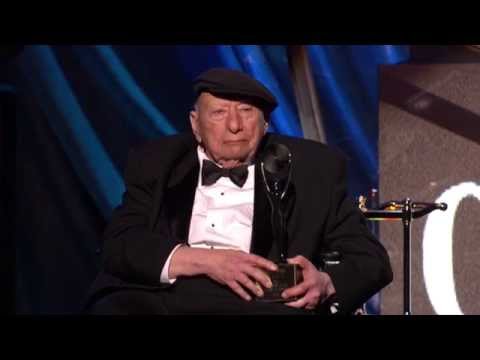
Cosimo Matassa tat his induction to the Rock and Roll Hall of Fame in 2012.
By 1956, Matassa was no longer selling appliances and had moved his studio to larger digs on Governor Nicholls Street in the French Quarter. Like many successful studios, Matassa’s operation benefitted from a talented group of studio musicians, usually organized by Bartholomew but also by the emerging talent, Allen Toussaint. These musicians included Earl Palmer on drums, Alvin “Red” Tyler and Lee Allen on sax, Frank Fields on bass, Huey Smith on piano and a large rotating cast of others. The studio sound was so synonymous with success that labels, like Ace, Atlantic, Chess, Savoy, RCA Victor, Imperial and Specialty would send their artists to New Orleans to capture the magic.
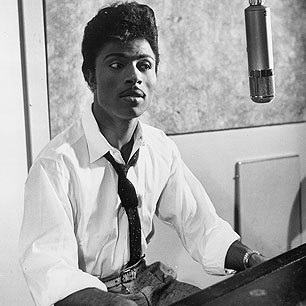
Little Richard recorded Tutti Frutti, Good Golly Miss Molly, Lucille, Long Tall Sally and others at J&M studio.
One of the more legendary stories is how Richard Penniman found his mojo at the Dew Drop Inn during a recording break, which led to his breakout hit, Tutti Frutti backed up by the J&M musicians and recorded by Matassa. It’s almost wearying to list the musicians that recorded there, but I’ll add Mac Rebennak (before he became known as Dr. John), Art and Aaron Neville, Professor Longhair, Irma Thomas and Lee Dorsey to this amazing list.
Cosimo Matassa died in September (2014) at 88. He was generous with his time, so it’s easy to find interviews of him, including one of my favorites. He modestly takes little credit for the sounds he recorded. But he maintains that the limitations of the early technology were a benefit, requiring musicians to play a song all together from beginning to end, just like a live performance. His job, he would say, was to get out of the way and let them do their thing.
Obviously, there was more to it than that because all the musicians who worked with him loved this unassuming nerdy son of Sicilian immigrants. His elegance was in his simplicity. He took care of the technical part, creating an environment where craftsmanship and creativity could merge.
Cosimo Matassa at the controls in Sea-Saint Studios, a studio founded by Allen Toussaint who began his career at J&M Studio. Photo by The Times-Picayune.
“To have a job where you can listen to music all day. Great way to make a living. Lot of great New Orleans musicians made me look good.”
Needless to say, I’ll be hammering my collection of Matassa recordings on my next show this Monday, 10 a.m. to noon, KAOS, 89.3 FM. Streaming at www.kaosradio.org.
Professor Longhair may have memorialized the corner of Rampart and Dumaine in “Mardi Gras in New Orleans” but his memory and spirit live on at a different street corner, Napoleon and Tchoupitoulas, in a music venue that bears the name of another of his classics, “Tipitina.”
A bust of Professor Longhair (Henry Roeland Byrd) sculpted by Coco Robicheaux stands guard at the entrance of the New Orleans music venue that bears the name of his song Tipitina. – Photo by Alex Brandon / Times-Picayune archive
Tipitina’s, on the other hand, is a great example of how cool stuff can happen out of love for music and doing the right thing. Just as Preservation Hall is dedicated to keeping New Orleans jazz alive, Tipitina’s was conceived with the notion of honoring the city’s early R&B and Rock ‘n Roll legacy.
When the venue opened in 1977, it’s goal was to provide a public performance space for aging and almost forgotten R&B and Blues artists like Fess (Henry Roeland Byrd), Jessie Hill, Snooks Eaglin, Earl King and others. Tips was born from an act of love by a group of investors who collectively and affectionately became known as the “fabulous fo’teen.”
Neville Brothers in front of the Longhair mural at Tipitina’s. Photo by Leon Morris from the WWOZ website. WWOZ’s early years were spent located above Tip’s in the beer storage room.
The venue also provided a platform for other local musicians, such as the Radiators, Little Queenie and the Percolators, the Dirty Dozen Brass Band, the Continental Drifters and the Neville Brothers.
Tipitina’s in those earlier years was quite a bit different than it is today. Music author Jay Mazza described a summer show this way: “Sometimes it was so humid in the place that the clouds of smoke seemed to be seeded with water. The smoke hung low in the room. Both bands and patrons alike were soaked to the bone within minutes. A trick learned early on was to bring extra shirts for changing between sets. . . Still everyone loved the place . . there always has been an amazing vibe associated with Tipitina’s.”
While the venue provided many great musical moments in the late 70s and early 80s, it struggled financially and eventually shuttered for about a year and a half. When it reopened in 1986, a major renovation made it far more attractive for musicians and their patrons. The warehouse-like building was opened up, creating a balcony level with higher ceilings, better circulation, improved bathrooms, and air conditioning.
Tacoma band Girl Trouble performing at the Capitol Theater this month. Like Tipitina’s the theater has a history of providing local groups a platform to perform.
This is a nice example of how some key changes could make an Olympia venue more attractive.
Tipitina’s also kicked up their bookings, continuing to stage local artists but adding national and international acts to the mix, building a worldwide reputation.
To get an idea of the artists who have performed at Tipitina’s, check out its index of musicians, some of whom are honored with additional recognition on the sidewalk outside: the New Orleans Walk of Fame.
Tipitina’s honors New Orleans musical legacy inside and outside with its Walk of Fame.
Another cool feature of Tipitina’s is its Foundation. It’s not every place where you can rock out to amazing music, with the understanding that profits go to support the very music scene you’re enjoying. The Foundation purchases instruments for Louisiana schools, provides ongoing youth music workshops, offers an after school jazz and digital recording program under the artistic direction of Donald Harrison, Jr. and provides a a statewide network of workforce development and job skills training centers for musicians, filmmakers and other media professionals.
Jazz artist Donald Harrison, Jr. heads up the Tipitina’s internship program.
And you never know what you’ll find at Tips. An Olympia friend told me about how she and her partner on a NOLA visit wandered into the uptown bar on a late Sunday afternoon, ordered a beer and found themselves drawn into a Cajun Fais Do Do.
So next trip to NOLA, put Tips on your list. Until then, you can catch many of the musicians who perform there on Sweeney’s Gumbo YaYa, every Monday from 10 a.m. to noon on your community radio station, KAOS.






 Sweeney's Gumbo YaYa