Dew Drop Inn played key role in New Orleans R&B era

Perhaps its a stretch to compare the Dew Drop Inn to Congo Square. But I see similarities between the two. (You can listen to the show while reading this post)

Just as Congo Square served as a gathering place for African American commerce and cultural exchange up through the mid-19th Century, the Dew Drop Inn in New Orleans provided a safe and comfortable place for New Orleans musicians of the mid-20th Century to gather, support each other and play music.
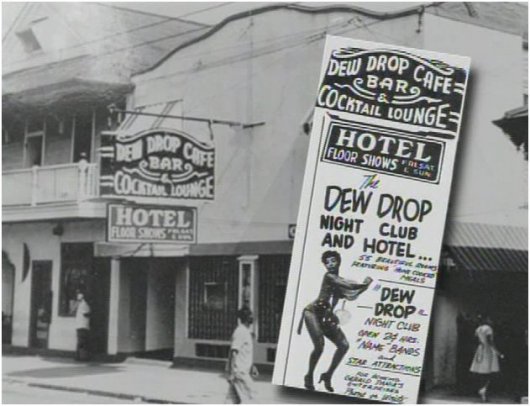
Through the 40's til Hurricane Katrina, the Dew Drop Inn was an
Located in New Orleans Central City neighborhood, the Dew Drop became a second home for musicians.

One served as the genesis for Jazz and the other was an incubator for New Orleans R&B and early rock and roll. The Dew Drop Inn was not just a nightclub and bar, it was a vital regional center for African Americans, particularly musicians, at a time when the South and New Orleans enforced apartheid.

I’m not sure if those thoughts initially entered Frank Painia’s head when he decided to expand his barbershop on LaSalle Street to include a restaurant and bar. Most likely, he just saw a business opportunity across the street from where one of the largest housing projects in New Orleans was being built (the Magnolia Projects). By expanding his business, he provided employment for his brothers and eventually other relatives. He christened it the Dew Drop Inn in 1939.

With America mobilizing for the war effort, Painia added a hotel next door so African Americans on the move would have a place to stay when visiting or passing through New Orleans. The combination of barbershop, restaurant, lounge and hotel made the Dew Drop Inn a convenient stop for travelers.

But it was Painia’s venture into booking performers that would put the Dew Drop solidly into music history. He started by producing shows at a nearby boxing arena and high school auditorium. Since he had the Dew Drop, he could house and feed the touring musicians, who in turn would jam in the lounge after the official performance. It wasn’t long though before he started booking local acts to perform at the Dew Drop.

Then in 1945, just in time to entertain returning soldiers and their dates, Painia built the “Groove Room.” Located behind the Dew Drop, this two-story music and dance hall with a balcony and elevated band stage established an upscale ambiance with top-flight performers of the day, including Billie Holiday, Big Joe Turner, Clarence “Gatemouth” Brown, and Amos Milburn. Later Ray Charles, James Brown, Solomon Burke, and Bobby “Blue” Bland would grace the stage. Many homegrown performers including Earl King, Huey “Piano” Smith, and Allen Toussaint launched their careers from the Dew Drop.

The Dew Drop was home for many musicians, whether passing through or getting their act together. It was a 24-hour operation where musicians could eat, meet, clean up with a haircut, shoeshine and shower, and plan their next step. They would play for white audiences downtown then head back to the Dew Drop and jam with the house band or whoever was performing until daylight.
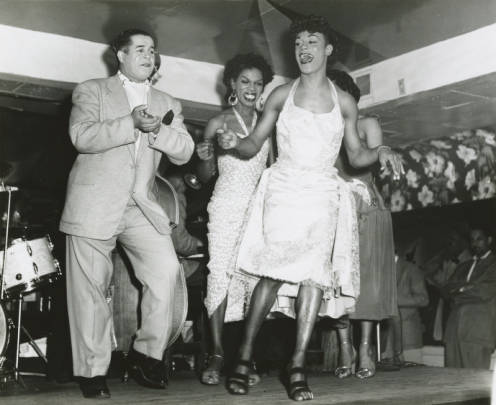
A dance contest for female impersonators at the Dew Drop Inn with Bobby Marchan  on stage. Ralston Crawford Collection,William Ransom Hogan Jazz Archive, Howard-Tilton Memorial Library, Tulane University
A dance contest for female impersonators at the Dew Drop Inn with Bobby Marchan on stage. Ralston Crawford Collection,William Ransom Hogan Jazz Archive, Howard-Tilton Memorial Library, Tulane University

The nightclub show included an emcee, comedians, magicians, dancers and, of course, the bands. It was not uncommon for the emcee or some of the dancers to be female impersonators (to use the term of that day). Bobby Marchan, who would sing with Huey Smith and the Clowns, got his start in New Orleans as part of a drag show called the Powder Box Revue.

Most New Orleans musicians of that period have stories about the Dew Drop. Grandpa Elliot Small of Playing for Change remembers watching his uncle play the harmonica there. Deacon John tells of how he broke into the recording business when he was approached by Allen Toussaint while playing guitar at the Dew Drop. “My head just popped open at the opportunity . .  .the very next day we were in Cosimo’s studio recording with the great Ernie K-Doe. “

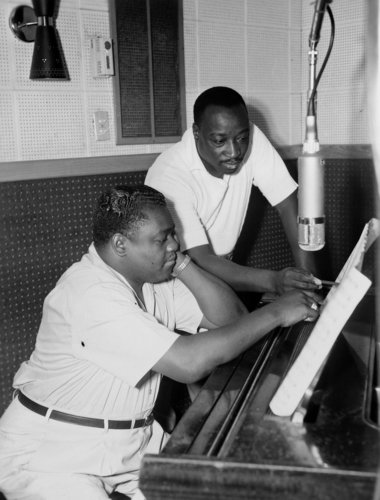
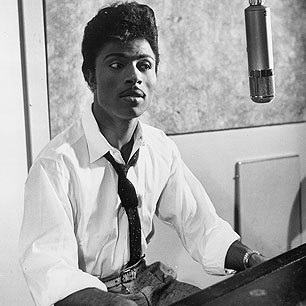
But my favorite story is how Richard Penniman got his mojo at the Dew Drop Inn. Things weren’t popping in J&M studio that September day in 1955. Producer Robert “Bumps” Blackwell, a native of Seattle, called for a break and took his young protege for a drink. It was a slow day at the Dew Drop until Richard discovered the upright piano in the corner and banged out a tune so bawdy that Blackwell had to hire a writer to clean up the lyrics. Little Richard’s Tutti Frutti was a crossover hit that propelled him to national fame.

While the Dew Drop Inn was established, owned and frequented by African Americans, white patrons were allowed in. But this meant that Painia was arrested at times when police raided his business and charged him with  “racial mixing.” Eventually, he successfully sued the city, establishing the right for businesses to serve any customer they wanted.
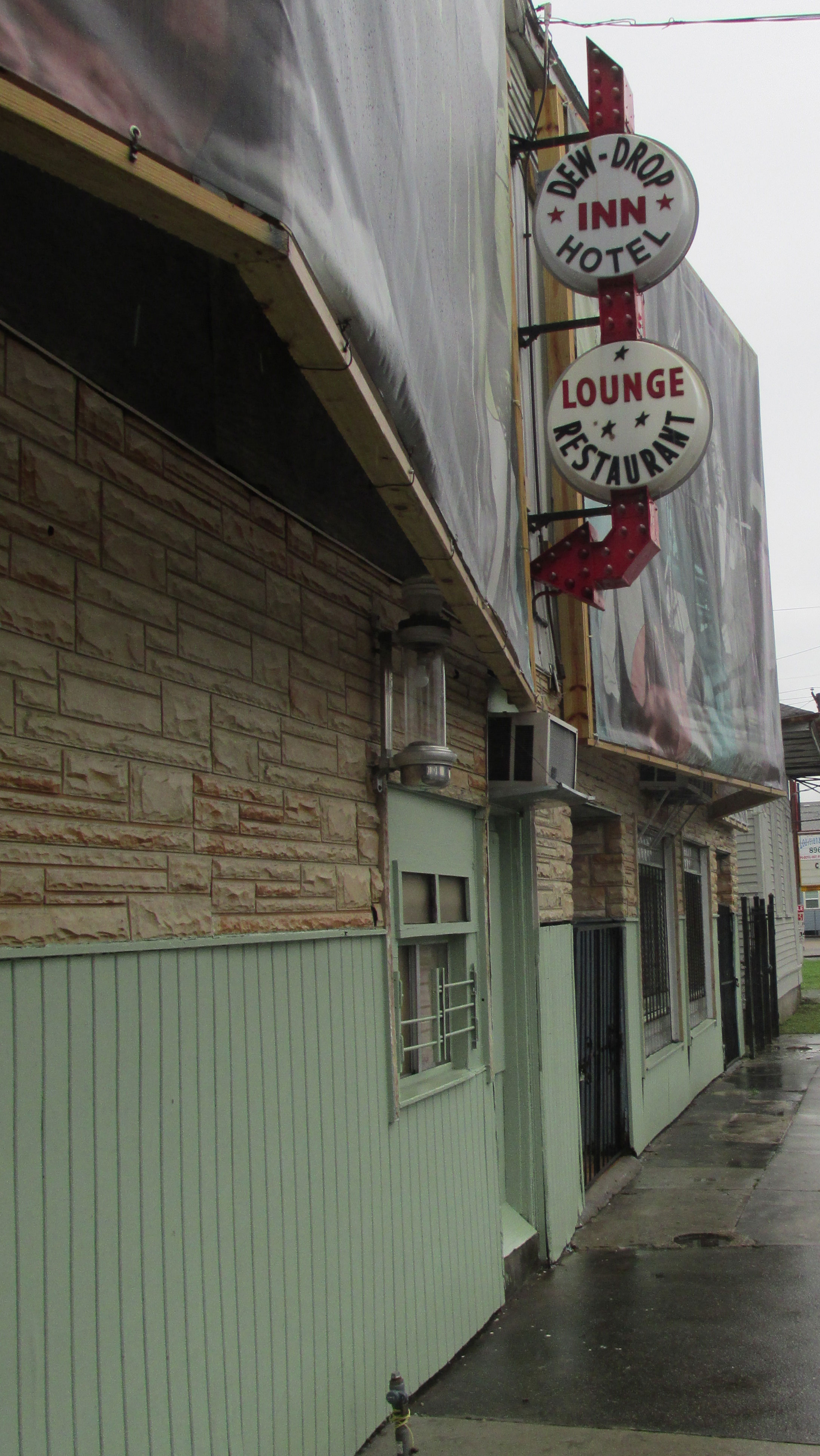
The Dew Drop today is shuttered today but there's hope it can once again entertain people.
The Dew Drop today is shuttered today but there’s hope it can once again entertain people.

By the end of the 60’s, changing musical trends, desegregation and Painia’s declining health brought an end to Dew Drop Inn’s musical performances. The business carried on mostly as a hotel until Hurricane Katrina caused so much damage, it could not reopen.

The building still stands in its Central City neighborhood but is shuttered. Yet, Painia’s grandson, Kenneth Jackson carries a long-held torch that the Dew Drop will once again serve as a social and music hub for the community.

I’ll have that story in next week’s post (available now). Here’s the podcast of the show featuring  musicians who played at the Dew Drop Inn and we’ll hear in Mr. Jackson’s own words about the Dew Drop’s glory days.

Tuts Washington holds solid place in New Orleans piano legacy

The rich creative humus that nurtures New Orleans music is built upon generations of musicians who, mostly in historical anonymity, shared their art and craft with younger musicians. (Here’s the edited version of the radio based on this post.)

If not for one solo recording and a fortuitous film that captured his brilliance and his legacy, Isidore “Tuts” Washington might have easily have been lost to future audiences. But his contribution to New Orleans music will not be forgotten

Isidore
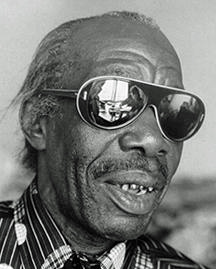
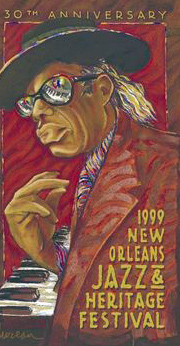
Isidore “Tuts” Washington at New Orleans Jazz and Heritage Festival

Born in 1907, Washington was old enough to follow the early jazz masters perform on the streets of his hometown. Mostly self-taught on the piano, he would whistle the brass band tunes he would hear until he could work them out on the keyboard.

At an early age, he excelled in the boogie woogie, improvisational style of piano common in the New Orleans clubs called barrelhouse. He played with a number of New Orleans bands throughout the 1920’s and 3o’s, including backing up a singer whose missing front teeth got him dubbed “Smiling” Lewis.

In the late 30’s while playing in these clubs, Washington nurtured a young pianist named Roy. He even painted a charcoal mustache on his face to help him get into clubs under age so he could perform with him.  Years later, Roy, otherwise known as Professor Longhair, would talk fondly of his mentor’s clean playing style and the long stretch of his fingers on the keyboards.

Cover of Tuts Washington's only solo recording
Cover of Tuts Washington’s only solo recording

After the war, when the now “Smiley” Lewis began to record, first with DeLuxe Records and then with Imperial Records, Washington found himself at the vanguard of Rhythm & Blues, playing piano on songs like “Turn On Your Volume,” “Tee-Nah-Nah,” and “Gumbo Blues.”  But recordings would be a rare experience for Washington who would not return to the studio again until he was deep into his 70’s.

Washington left the city and was gone for most of the J&M Studio R&B heyday.  When he returned to New Orleans, he played jazz with Papa Celestin and the Clyde Kerr Orchestra and held down regular gigs at places like the Court of Two Sisters Restaurant–solidifying his reputation in the 60’s and 70’s as a New Orleans institution.

He regularly performed at the New Orleans Jazz and Heritage Festival and collapsed from heart failure while performing at the 1984 New Orleans Worlds Fair.

As mentioned above, he was a direct influence on Professor Longhair but also other New Orleans piano players, including James Booker and Allen Toussaint. This is evident when you watch this excerpt from Piano Players Rarely Ever Play Together.  This film by Stevenson Palfi captures Tuts Washington and Professor Longhair near the end of their lives and Toussaint in his mid-40s.

Professor Longhair (top), Allen Toussaint (middle) and Tuts Washington performing Boogie Woogie in Piano Players Rarely Play Together

The film features interviews and historical footage but the most exciting part of the film is the three masters playing pianos all lined up so the camera can catch them in the same shot.  While the YouTube version is muddy, the film has been digitally restored.

If you don’t want to watch the whole film, skip to the end when the filmmaker shows the three playing a boogie woogie tune to its full length. The number (available on Longhair’s anthology) starts with Professor Longhair giving a little coaching, scatting a bit to describe how to avoid cutting in on his master, Tuts Washington.

Hear this amazing artist on my next show, (recording of the show) Monday at 10 a.m.

Portland Blues Festival serves up a sweet NOLA line up

Portland’s Waterfront Blues Festival seems to have a serious jones for New Orleans music.

In previous years, the festival has held Second Line parades, filled its dancing stage with Zydeco and Cajun music and featured New Orleans acts such as Rebirth Brass Band, Galactic and the Stooges Brass Band. But this year, as we approach the 10-year anniversary of Katrina, the festival doubled down putting together a stellar New Orleans line up for its Friday (July 3) show.

Yes, we’ll get a return performance by Galactic, a versatile funk and soul band that hit the I-5 Tour as recently as February.  This time, the band will feature Macy Gray on vocals as the band harkens back to its soul and R&B roots when Theryl “Houseman” DeClouet fronted the group. Galactic takes the Brewery Stage at 9 p.m.

Allen Toussaint looking over his shoulder at a Paddlewheeler cruising the Misssissippi while performing at French Quarter Festival this year. He'll be playing by the Willamette River this Friday.
Allen Toussaint looking over his shoulder at a Paddlewheeler cruising the Misssissippi while performing at French Quarter Festival this year. He’ll be playing beside the Willamette River this Friday.

But the headliner for the day is Allen Toussaint (7 p.m. Brewery Stage).  This uber-talented composer, producer and pianist extraordinaire is closely aligned with the New Orleans R&B and funk sound. He was there from the beginning and now at 77, he continues to prove he can do full justice to his amazing legacy of songs.

“Working in a Coal Mine,” “Mother-in-Law,” “Lipstick Traces on a Cigarette,” “Fortune Teller,” “Sneaking Sally through the Alley,” “Night People,” “On Your Way Down,” “Ride Your Pony,” “Yes, We Can” and so many more song that you’ll recognize.  This guy has made a boat load of money from others singing his songs. The pleasant surprise is how ass-kicking good he is when he sings them.

He started his own New Orleans-based record label in the 60’s and he was the first to do a major recording in New Orleans (with Elvis Costello) after Katrina. He’ll have just returned from performing in London when he takes the waterfront stage on July 3 and I’m struck how the Portland setting is so similar to the French Quarter Festival stage where I last saw him perform in April. His band and performance will be as sharp as the suit he’ll be wearing.

Another New Orleans star attraction is Charmaine Neville. Daughter of saxophonist Charles Neville of the Neville Brothers, Charmaine has toured the world but has stayed closer to home in recent years. She and her band will dish up a jazzy soul set at the Brewery Stage starting at 5:15 p.m.

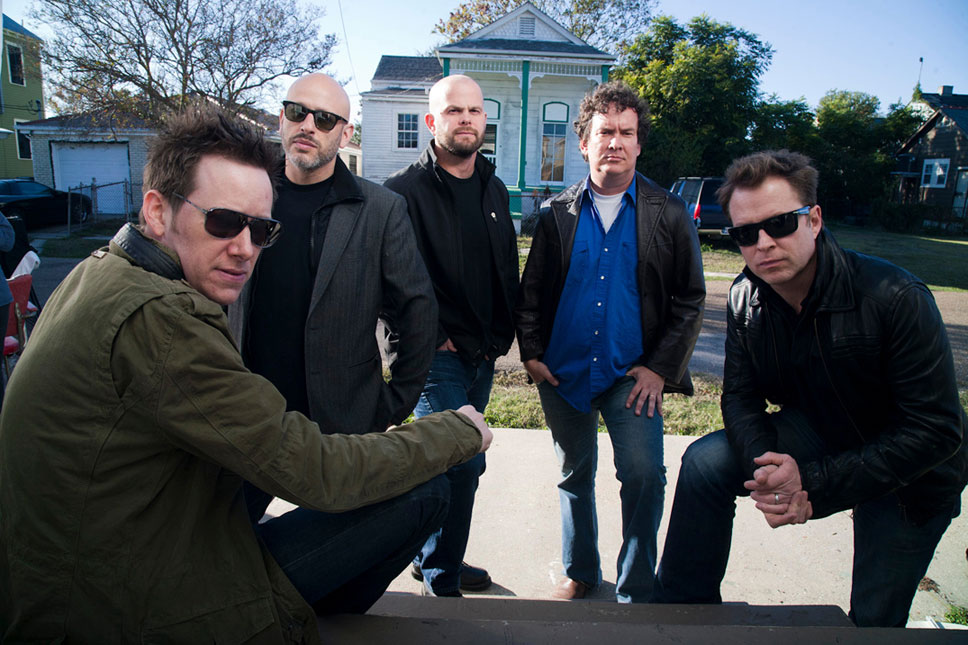
(From Left) Jeff Mercurio, Ben Ellman, Dan Vogel, Jeff Raines and Stanton Moore.
Galactic will perform at the Waterfront Blues Festival on Friday as part of a New Orleans line up.

Likely to hop on the stage with Charmaine is her former band leader now Portland resident, Reggie Houston. This native New Orleans saxophonist has been making Portland a hipper place ever since he called it home in 2004. With over two decades of performing with Fats Domino, you know Houston and his Crescent City Connection band is going to rock the Brewery Stage (3:45 p.m.)

Other highlights include venerable guitarist Paul “Lil Buck” Sinegal (First Tech Stage, noon), Chubby Carrier & the Bayou Swamp Band (First Tech Stage, 8:15 p.m.) and the Dog Hill Stompers (Front Porch Stage, 10 p.m.)

See you there, but if you miss it, I’ll be playing some of what I hear on my show on Monday.  Have a safe Fourth of July.

Professor Longhair “tralla walla” makes us feel fine

This week’s post (and my focus on this week’s radio show) is about the man who sang “we gonna hoola tralla walla malla dalla drink some mellow wine.”

Henry Roeland Byrd, aka Professor Longhair

Henry Roeland Byrd was a tap dancer, card shark, soldier, cook, laborer and general street hustler. He also was one of the greatest New Orleans piano professors of all time – Professor Longhair.

His iconic “Tipitina” inspired the likes of Fats Domino, Allen Toussaint, James Booker, Dr. John and countless others.

Professor Longhair’s style has been described as a rhumba crossed with a blues shuffle.In an interview with Peter Stone Brown not long before he died in 1980, he said:

” I was around a lot of honky-tonk musicians, barrelhouse musicians, blues musicians, and bebop musicians, jazz musicians. I just got a little bit from everybody and used it with what my mother taught me. She played a lot of ragtime music. . . I just mix my ideas up and call it a gumbo. There’s no certain thing at all. It’s just rockin’ rhythm.”

Fess was there at the beginning of the New Orleans Rock and Roll era in New Orleans, cutting his first singles in the J&M Studio (Cosimo Matassa) in 1949.  And in November 1953 with Alvin “Red” Tyler, Lee Allen, Earl Palmer, and Edgar Blanchard backing him up, he recorded “Tipitina” for the first time.

“Girl you hear me calling you. Well you’re three times seven, baby. Knows what you want to do.”

Calibration
Calibration

Born in Bogalusa but raised in New Orleans, Professor Longhair never made the hit parade and never really experienced financial success. By the late 60’s, his career had folded and he was living in poverty. In 1970, Quint Davis and Alison Minor sought him out with the intention of getting him to perform at their fledgling music festival, the New Orleans Jazz and Heritage Festival.

Who they found was a frail, weak man who didn’t seem capable of pounding out his trademark rhythms. But with the help of Davis and Minor, he recovered enough to perform at the second JazzFest in 1971 and demonstrate that, if anything, his playing had gotten better.  His hometown and the world embraced him and his career flourished. Until his death in 1980, he recorded and performed, including at the nightclub created for the purpose of providing him and other aging R&B artists a place to play, named appropriately Tipitina’s.

Join me, won’t you for some Fess and Fess-inspired music this Memorial Day.   Sweeney’s Gumbo YaYa kicks off at 10 a.m. on Monday. Here’s a recording of that show on Mixcloud.

Music and history carry on despite rain during French Quarter Festival

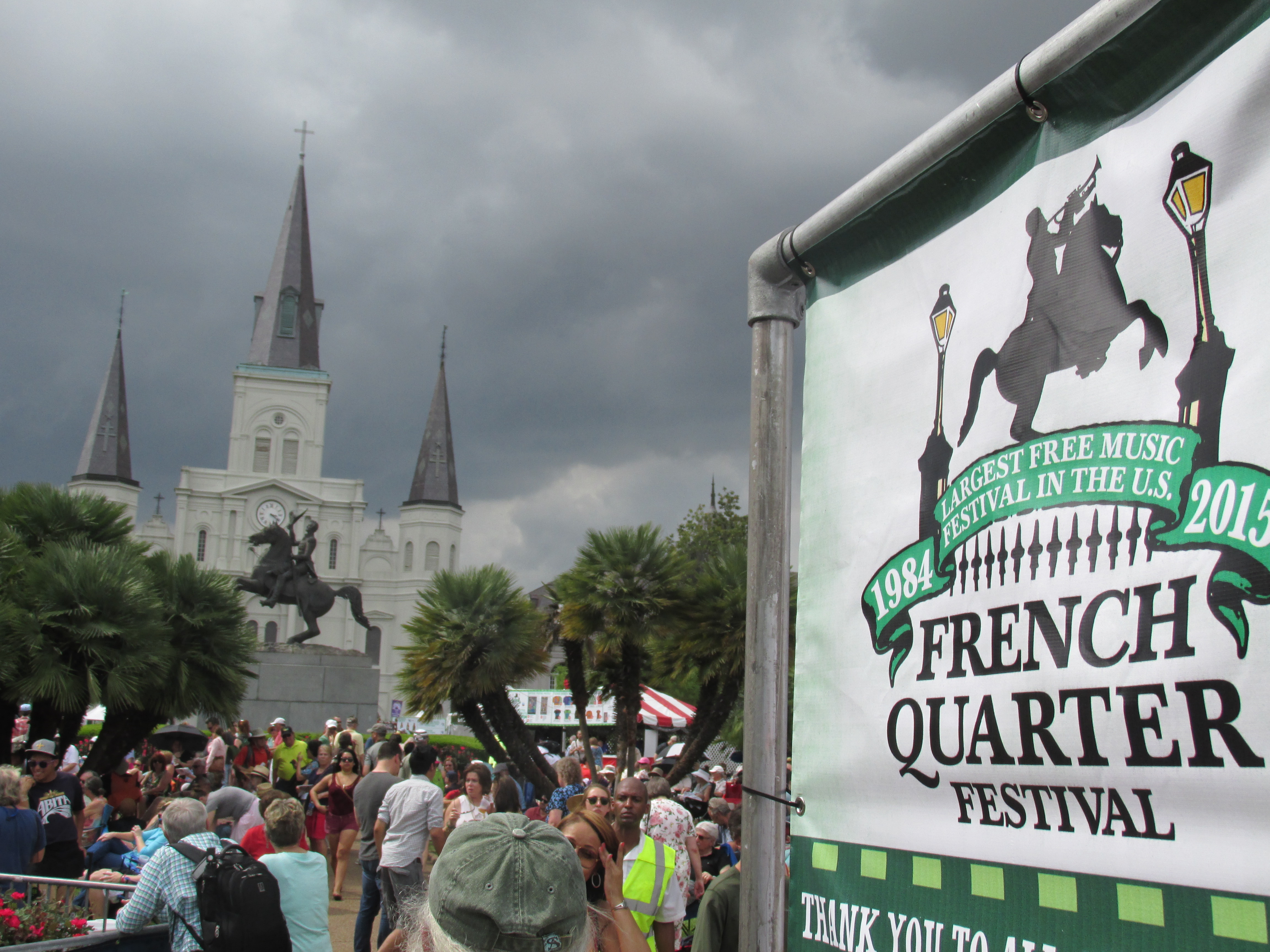
In New Orleans, the show must go on unless you can’t keep the musicians dry or if lightning threatens the audience. Over the course of the 2015 French Quarter Festival in New Orleans, we had a good bit of rain and a few lightning bolts.

So periodically, stages have been closed, including Tricia Boutte’s show right as she was beginning. Bummer!

A hard rain on Friday pushed crowds under cover. Saturday and Sunday also had rained out venues at times.

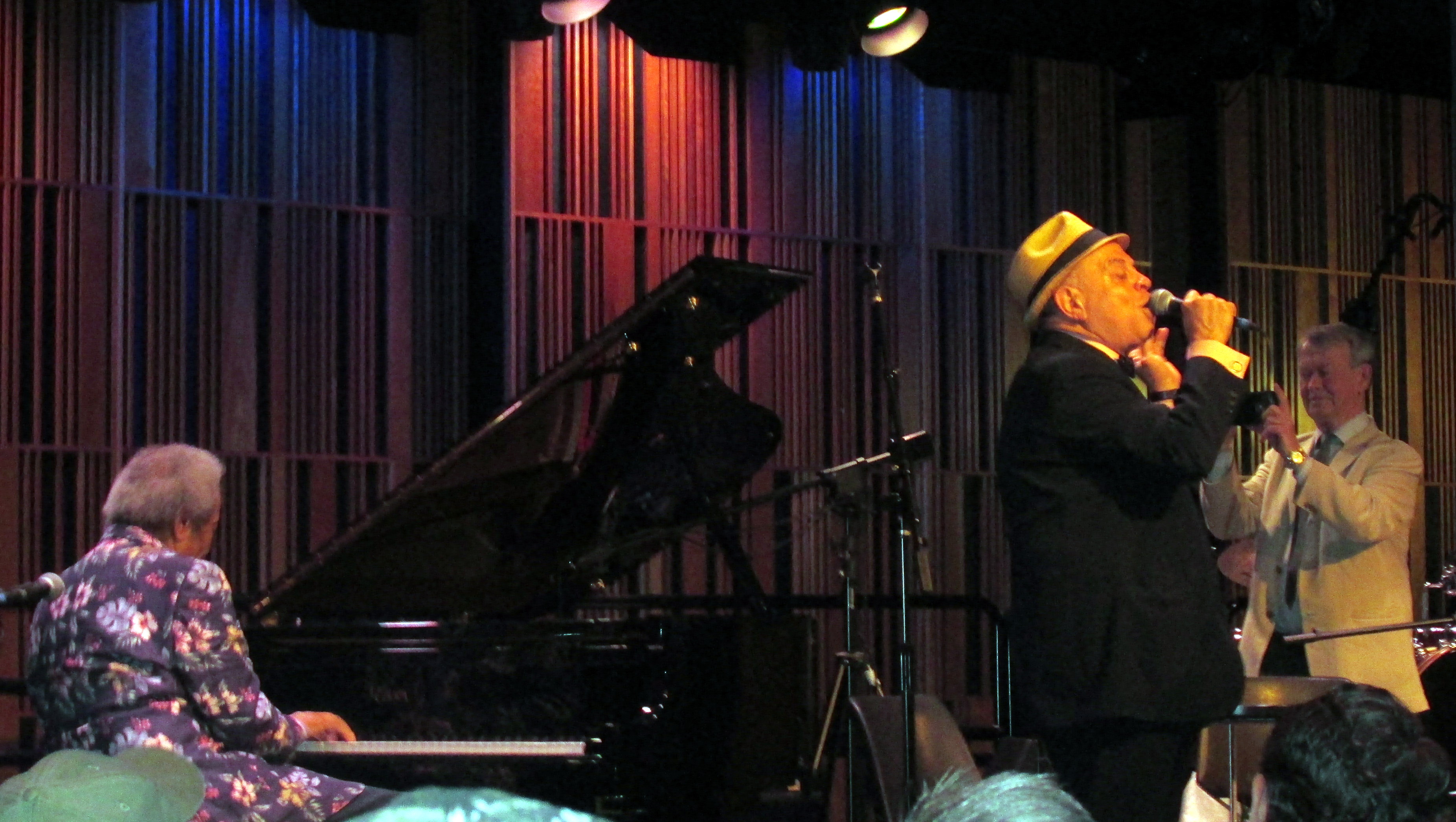
The highlight for me today was indoors though when Allen Toussaint and Deacon John sat down with author John Broven. The one-hour program started with Toussaint going right to the Steinway and banging out his hit originally done by Irma Thomas, “It’s Raining.” This time, Deacon John sang it, with a few appropriate ad libs.

The stated purpose of the program was to reminisce about Cosimo Matassa and the heyday of New Orleans R&B and early Rock n’ Roll–a period of time that launched the careers of both Allen Toussaint and Deacon John. More on Mr. Toussaint and more on Mr. Matassa.

Allen Toussaint (piano) played
Allen Toussaint (piano) played “It’s Raining” and Deacon John sang at the French Quarter Festival Conversations on Louisiana Music.

Of Cosimo and his studio, Toussaint said “It was our doorway and window to the world . . .He and Dave Bartholomew put us on the map. . .He (Cosimo) saw the big picture long before we did cause we were just having fun. “

Deacon John described getting discovered by Toussaint at the Dew Drop Inn one night and the next day going into Matassa’s studio to help Ernie K-Doe record “There’s a will, there’s a way.”

As I mentioned in my previous post, I won’t be hosting this Monday’s show. Anch of Sundrenched will handle affairs and I plan to call in during the show. Consider subscribing to this blog so you can be alerted the next time I post. (see upper right hand of page)

First impressions of French Quarter Festival

With some time to catch up this morning on day three of the 2015 French Quarter Festival, I’ve had a chance to reflect on my first impression of the largest showcase of Louisiana music in the world

The fest started on Thursday with five stages operating mostly in Woldenberg Riverfront Park near the old Jax Brewery and the Audubon Aquarium. Friday, the festival added seven more stages and 11 more open today. This exponential stage growth levels off at 23 stages, otherwise there might not be any place to walk.

IMG_1454

Actually, there’s lots of room to walk. Anyone intent on catching music at all the stages needs to be prepared to hustle or rent a pedicab.  Stages are grouped together but those groups are scattered over the full river length of the French Quarter from Canal to Esplanade and moving away from the river, there are stages on Royal and Bourbon Streets. Like most music festivals, tough choices have to be made cause you cannot catch it all.

In its four days, French Quarter festival attracts more audience than the better known seven-day New Orleans Jazz and Heritage Festival that starts  later in the month.  But now that I’m here, its quite obvious why.  Jazz Fest participants have to make a conscious effort to get out the Fair Grounds and pay the $70 to get in for a day. As a result, I suspect that Jazz Fest is responsible for drawing in more folks to the city specifically for the festival.

John Boutte performing at French Quarter festival this week.

At French Quarter Festival, many of the attendees appear to be here for other reasons. And therein lies the genius of this event. Like a gill net that traps salmon headed to spawning grounds, the free French Quarter Festival snags tourists as they innocently stumble out of their hotels and bars and provides them with a taste of music they might not otherwise catch.

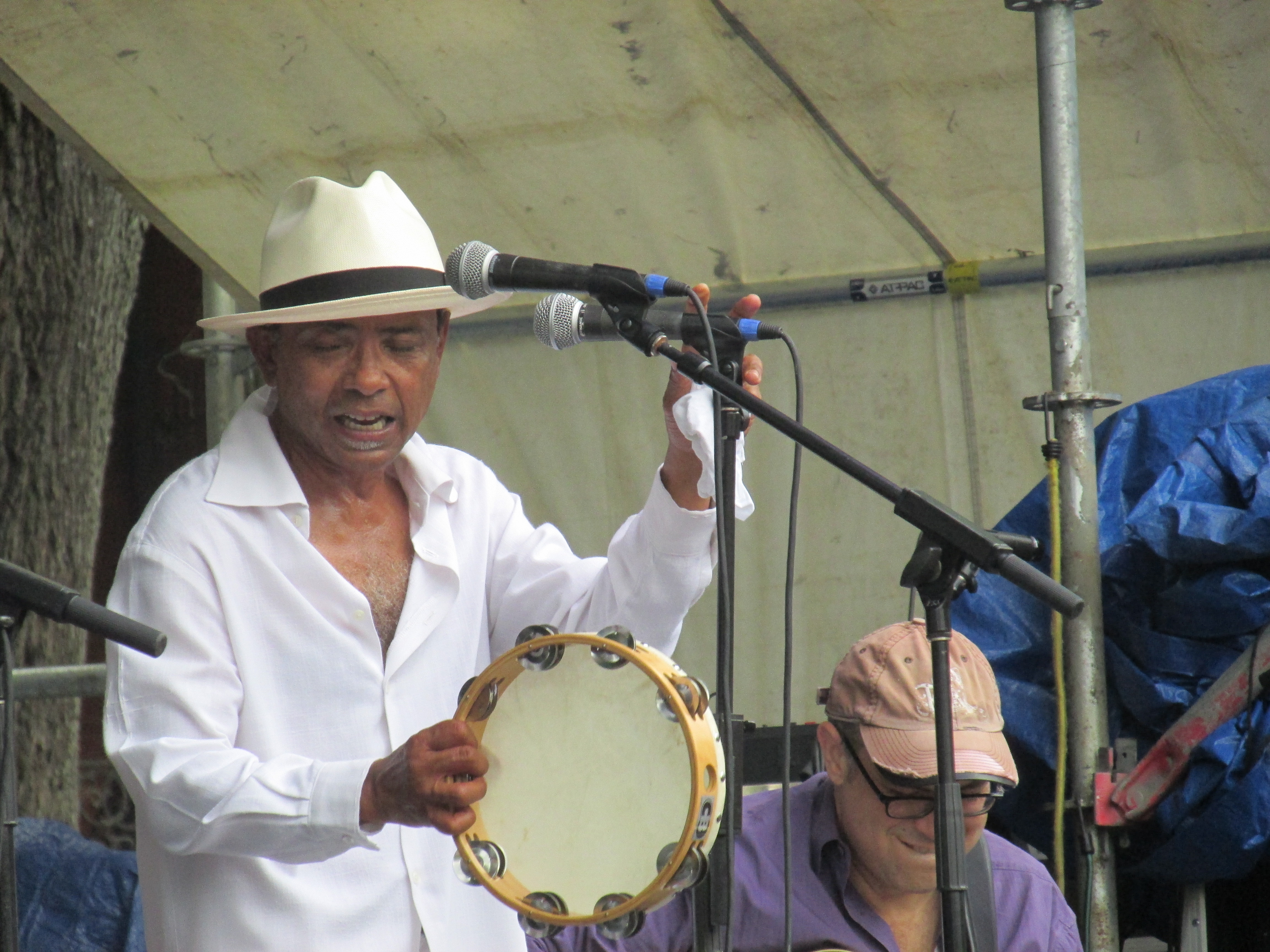
With the exception of one small stage featuring international acts, the French Quarter Festival showcases local talent. This means the festival provides local musicians with a chance to build a following outside the city.  The fact that the festival can keep 23 stages busy with local talent provides some sense of how deep the musical talent. This year’s lineup includes Allen Toussaint, Irma Thomas, Eric Lindell, Hot 8 Brass Band, John Boutte, Flow Tribe, Bonerama, Little Freddie King, Guitar Slim Jr. and on and on.  All music, by the way, that we play on Sweeney’s Gumbo Ya Ya.

I’m still in New Orleans during the next show but I hope to call in with a brief report. You’ll be in capable hands with Anch who hosts Sundrenched on Tuesdays.

Toussaint infused New Orleans sound into pop music

New Orleans
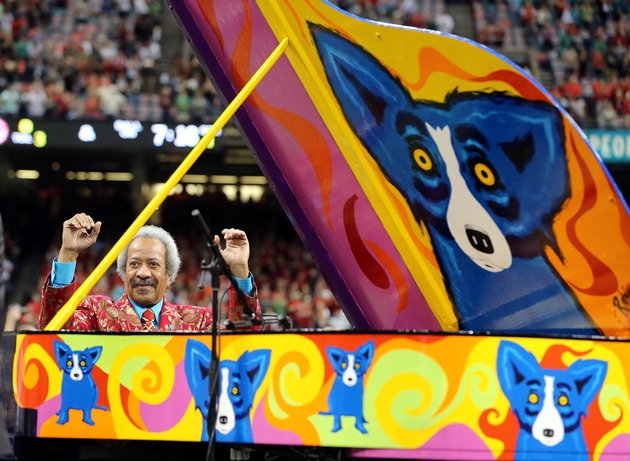
Allen Toussaint plays the National Anthem at the Superdome. Credit: Chuck Cook-USA TODAY Sports

The French Quarter Festival, which showcases local music, could not have scored a better opening headliner this year than with the hometown artist whose creativity has nurtured the New Orleans sound for over a half century. (Listen to the show that complements this post.)

Allen Toussaint was a teenager when he first sat in on Earl King’s band and regularly scored gigs at the legendary Dew Drop Inn.

It wasn’t long before he found his way to the center of the known Rock n’ Roll universe at the time, Cosimo Matassa’s studio, where he laid down piano tracks on recordings by Fats Domino, Huey “Piano” Smith, and Aaron Neville. But it was when he joined Minit Records that his creativity became apparent to the world. Using his parent’s living room as rehearsal space and testing ground for new material, he assembled a parade of hit singles by Jessie Hill, Irma Thomas, Lee Dorsey and this blog’s patron saint, Ernie K-Doe.

Ernie K-Doe best recordings were aided by the songwriting, arranging and producing of Allen Toussaint.

As a keyboard savant, Toussaint could accurately reproduce and synthesize the city’s revered legacy of piano professors, especially the style of Professor Longhair. But as a songwriter and arranger, he was able to weave the full panoply of New Orleans rhythms, vocal traditions and spirit into a clean appealing style for the pop market. In fact, he, along with K-Doe, were responsible for the sole number 1 pop chart hit recorded in New Orleans,  “Mother-in-Law.” (A song written before Toussaint was married and had one.)

Later, he started his own record labels providing a platform for local and national musicians to access the New Orleans sound. With The Meters as his studio house band, Toussaint was a key force behind the New Orleans funk sound that developed in the 70’s. A prolific songwriter, his music has been performed by The Rolling Stones (“Ruler of My Heart”), The Who (“Fortune Teller”), Bonnie Raitt (“What Do You Want the Boy To Do”), Devo (“Working in the Coal Mine”),  Al Hirt (“Java”), The Doors (“Get Out of My Life Woman”),  Jerry Garcia (“I’ll Take a Melody”), Glen Campbell (“Southern Nights”), Robert Palmer (“Sneaky Sally through the Alley”), The Pointer Sisters (“Yes, We Can Can”) and many more.

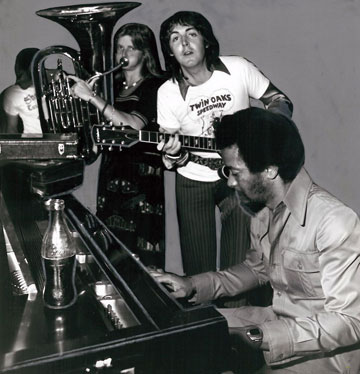
Linda and Paul McCartney performing with Allen Toussaint in his New Orleans studio in 1975.

In 1973, Toussaint had a big hand in producing and performing on Dr. John’s album “In The Right Place.” Two years later, Linda and Paul McCartney moved their entourage to New Orleans to collaborate with Toussaint in his New Orleans studio on their album “Venus and Mars.”

He was inducted into the Rock and Roll Hall of Fame in 1998, the Louisiana Music Hall of Fame in 2009, and the Blues Hall of Fame in 2011. If there’s any question of whether being a senior statesman of New Orleans music has diminished his chops, you need only look as far as his grammy-nominated, post-Katrina collaboration with Elvis Costello, “The River in Reverse,” for evidence that at 77, he still has it.

In addition to being a producer, bandleader, arranger and songwriter, Toussaint is an accomplished pianist and stands with the great New Orleans piano “professors.” Toussaint will take the stage at the French Quarter Festival on April 9 at 3:45 p.m. but you will be able to catch his music on my next show this Monday. (Here’s the recorded show)

NOLA studio and sound nerd help launch rock and roll era

Behind every great recording and concert, there’s a sound nerd making sure you hear what you’re supposed to hear.  In the case of Cosimo Matassa, what people heard was the beginnings of rock and roll.

Starting with “Good Rockin’ Tonight”, through “The Fat Man,” “Lawdy Miss Clawdy,” “Shake, Rattle and Roll,” “Let the Good Times Roll,” “Tutti Fruti, “Rockin’ Pneumonia,”  “I Hear You Knockin,” and great many more, Matassa ensured the fidelity and sound quality of these early R&B and rock and roll hits.

Cosimo's recording career started out with using primitive equipment located in the back of an appliance and music shop.
Cosimo’s recording career started out with using primitive equipment located in the back of an appliance and music shop.

In 1945 at the tender age of 19, Cosimo opened an appliance store with a partner in New Orleans, hoping to take advantage of the pent up demand for home conveniences and the many new households that were forming after the war. The store also sold records.

His partner suggested they make recordings for their customers. Cosimo, being the more technical of the two, took on the task of getting that business going.  As a former Tulane chemistry major, he was your classic nerd.  But having spent a few years working with his Dad’s jukebox business, repairing the equipment and swapping out 78 rpm records, he was a nerd with an ear for music.

The J&M Music Shop was at the right place at the right time on the corner of Dumaine and Rampart, sitting between the French Quarter and the Fauberg Treme’ neighborhood – a center of African-American and Creole culture and home to many New Orleans musicians.

After World War II, people were ready to have fun.  And the music, particularly from a new generation of black New Orleans musicians raised on jazz, swing and big band music, was ready to make the party happen.

Fats Domino (left) and Dave Bartholomew generated a mountain of hits, all recorded from studios run by Cosimo Matassa.

The studio’s success started with Roy Brown, who had just returned to New Orleans with his Gospel-trained voice and was performing at the famous Dew Drop Inn. It was in the back of the J&M in 1947 that Brown recorded the jump blues song, Good Rockin’ Tonight, a hit that can arguably be considered one of the first Rock and Roll songs.  Just ask Elvis.

Things really took off when horn player and band leader Dave Bartholomew started using the studio for his work as a musician, arranger and talent scout for Imperial Records. Through Bartholomew, early R&B greats like Smiley Lewis, Frankie Ford and Tommy Ridgley would record at the studio. But the star who solidifies the studio’s listing as a Rock and Roll Hall of Fame landmark is Antoine “Fats” Domino.  Through a good chunk of the 50’s, Domino, with able assistance from Bartholomew and Matassa, released a series of R&B hits, finally crossing over into the pop charts with “Ain’t That a Shame” in 1955.  All of the Fats’ recordings as well as hundreds of other R&B and early rock and roll gems were recorded in that little studio.

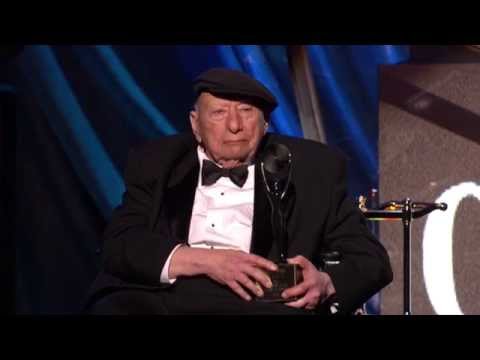
Cosimo Matassa tat his induction to the Rock and Roll Hall of Fame in 2012.

By 1956, Matassa was no longer selling appliances and had moved his studio to larger digs on Governor Nicholls Street in the French Quarter. Like many successful studios, Matassa’s operation benefitted from a talented group of studio musicians, usually organized by Bartholomew but also by the emerging talent, Allen Toussaint. These musicians included Earl Palmer on drums, Alvin “Red” Tyler and Lee Allen on sax, Frank Fields on bass, Huey Smith on piano and a large rotating cast of others.  The studio sound was so synonymous with success that labels, like Ace, Atlantic, Chess, Savoy, RCA Victor, Imperial and Specialty would send their artists to New Orleans to capture the magic.

Little Richard recorded Tutti Frutti, Good Golly Miss Molly, Lucille, Long Tall Sally and others at J&M studio.

One of the more legendary stories is how Richard Penniman found his mojo at the Dew Drop Inn during a recording break, which led to his breakout hit, Tutti Frutti backed up by the J&M musicians and recorded by Matassa. It’s almost wearying to list the musicians that recorded there, but I’ll add Mac Rebennak (before he became known as Dr. John), Art and Aaron Neville, Professor Longhair, Irma Thomas and Lee Dorsey to this amazing list.

Cosimo Matassa died in September (2014) at 88.  He was generous with his time, so it’s easy to find interviews of him, including one of my favorites.  He modestly takes little credit for the sounds he recorded. But he maintains that the limitations of the early technology were a benefit, requiring musicians to play a song all together from beginning to end, just like a live performance.  His job, he would say, was to get out of the way and let them do their thing.

Obviously, there was more to it than that because all the musicians who worked with him loved this unassuming nerdy son of Sicilian immigrants. His elegance was in his simplicity.  He took care of the technical part, creating an environment where craftsmanship and creativity could merge.

Cosimo Matassa at the controls in Sea-Saint Studios, a studio founded by Allen Toussaint who began his career at J&M Studio. Photo by The Times-Picayune.

“To have a job where you can listen to music all day.  Great way to make a living.  Lot of great New Orleans musicians made me look good.”

Needless to say, I’ll be hammering my collection of Matassa recordings on my next show this Monday, 10 a.m. to noon, KAOS, 89.3 FM. Streaming at www.kaosradio.org.

Morgus the Magnificent Inspires Friends of Music

Like most communities, New Orleans loves Halloween. Voodoo Music Fest, for instance, is always timed for around October 31. But this story is about Morgus the Magnificent and the music he inspired.

morgus

If you ever watched horror movies on television during the last century, chances are you’re familiar with the occupation of “Horror Host” — the sometimes creepy, usually campy personality who introduced the late Friday or Saturday night movie with tongue firmly in cheek.

Pioneered by Vampira, who dressed like Morticia Addams and hosted KABC-TV late night movies in Los Angeles in the 50’s, Shock Hosts proliferated across the country after Screen Gems saw a nifty way to cash in on its aging library of horror films. Classic monster movies like Frankenstein, Dracula and The Mummy were packaged with lesser movies and sent to local stations with the suggestion they air the movies using a costumed host.

One of the stations that took up the idea was WWL-TV in New Orleans and the city hasn’t been the same since.

On a Saturday night in January 1959, Morgus the Magnificent, along with his sidekick Chopsley and a talking skull named Eric, hit the local airwaves. He immediately captured the attention of TV viewers and, six decades later, continues to be a favorite in the hearts, minds and T-shirts of NOLA residents.

three ghouls

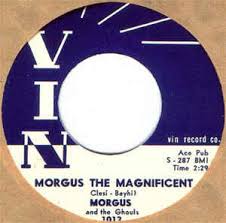
Within four months of his show’s premiere, Morgus would be memorialized in song. Frankie Ford, Jerry Byrne and Mac Rebennak (the future Dr. John) recorded Morgus and the Three Ghouls at Cosimo Matassa’s studio on Governor Nicholls Street. While never a hit, it plays locally on occasion and showed up on Dr. John’s anthology Mos’ Scocious. In 1962, Morgus became the first Horror Host to have his own movie, The Wacky World of Dr. Morgus.

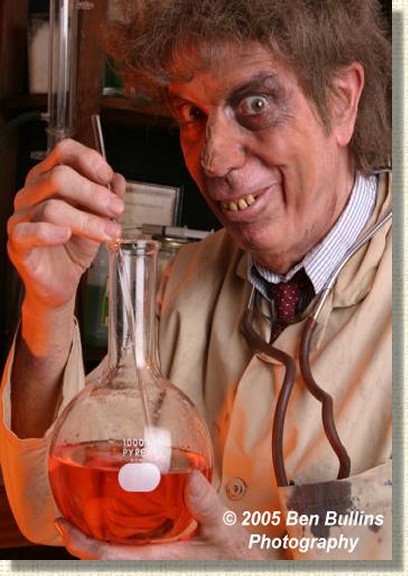
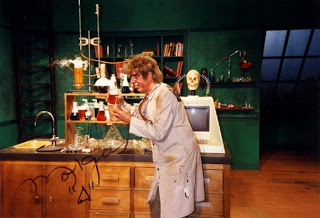
Morgus wasn’t your typical monster or vampire show host. He was a benevolent, though somewhat high strung, mad scientist working out of his laboratory above the Old City Ice House in the French Quarter. Filled with superhuman self confidence in his genius, he would devise ill-conceived schemes and experiments that usually had good intentions but would fail miserably.

Morgus in his laboratory over the Old City Ice House in the French Quarter.

I recollect one show I watched as kid in the 60’s where he created his own weight reduction clinic and during the commercial breaks he demonstrated weight-loss technologies straight out of a Vincent Price movie, including a swinging pendulum (lose weight or else). Needless to say, by the end of the show his clients had lost more than pounds.

Morgus was the creation of Sid Noel Rideau, a native New Orleanian with a wacky imagination. He did a brief stint of Morgus in Detroit where he apparently recorded a surf rock tune called Werewolf under the name of Morgus and the Darringers. Mr. Rideau died August 2020 and his life was celebrated on my show later that month.

But my favorite song representation of him was done by the band Galactic on their 2010 release Ya-Ka-May. The CD’s first track, Friends of Science, samples a typical opening of one of Morgus’ shows. “Good evening my dear students, and of course friends of science and those of the higher order.” You’ll find over a dozen New Orleans artists credited in the CD’s liner notes,  including Allen Toussaint, Irma Thomas, Big Freedia and Trombone Shorty. But there’s no mention of Morgus or Rideau.

Apparently, Galactic had a hard time getting permission from Rideau but finally did with the condition that it would be uncredited.  In promoting the album to Offbeat magazine, Galactic’s bass player Robert Mercurio pondered “how many people are going to get that one. I think maybe you’d have to be from New Orleans to really get that voice.”

Not necessarily. Not if you catch the distinctive voice of Morgus when he’s played on Sweeney’s Gumbo YaYa, this Monday (show now airs on Thursdays), starting at 10 a.m. Also, if you’ve read this far, perhaps you would like to subscribe with the link in the right column.

Postscript: Since this post, this documentary was posted online, focusing on the original run of Morgus.

Larger than Life K-Doe is patron saint of this blog

Meet Ernie K-Doe, a New Orleans performer and a character in a city of characters. He is now officially designated: Patron Saint of this Blog.

Ernest Kador, Jr.

I have no idea what the criterion is to be a blog’s patron saint or even if this is a good idea. I suspect for someone who called himself Emperor of the World, Ernie might consider this gig slumming.  Then again, from what I’ve read, he was a generous and warm fellow despite his boastful swagger.

Ernie K-Doe’s claim to fame is the song Mother-in-Law (written by Allen Toussaint) which became the best-selling record in America in May 1961, topping the pop chart for one week and the R&B chart for five weeks.  No other New Orleans artist has ever reached the top with a song recorded in New Orleans. Fats Domino sold a mountain of records but never had a number one hit.

And Ernie K-Doe never let you forget his claim to fame. Not in his performances nor in his outrageous stints as a volunteer deejay for community radio stations WWOZ and WTUL–where his code phrase was “Burn K-Doe Burn.” He would say there are only two songs that will stand the test of time: Star Spangled Banner and Mother-in-Law.

But its not his R&B career that qualifies him as patron saint though it is an essential part of his resume. It has more to do with his stint as a community radio deejay given that this blog supports my radio show Sweeney’s Gumbo YaYa.  But what puts him over the top for patron canonization is what the Times-Picayune describes as “a robust and unexpected second act as an eccentric, only-in-New Orleans icon.”

Ernie’s turning point was meeting Antoinette Dorsey Fox–a woman with many talents including her ability to sew outlandish outfits to match his personality and to provide love and focus to a man who had taken the textbook life crash of a one-hit wonder.

Ernie in full Emperor regalia outside Mother-in-Law Lounge

Antoinette opened the Mother-in-Law Lounge at 1500 N. Claiborne Street in the shadow of Interstate 10 where K-Doe could perform as well as tend bar.  The lounge became a kitschy memorial to his career, including outsized murals of K-Doe and a jukebox that played his hit every 20 minutes — sometimes accompanied by the real-time K-Doe who kept a wired microphone nearby.

Despite being renovated after Katrina, the lounge closed after Antoinette died in 2009. Kermit Ruffins later bought it and reopened it this year with many of the murals restored.

I recommend reading Ernie K-Doe: The R&B Emperor of New Orleans by Ben Sandmel. The New Orleans writer/folklorist makes it easy to feel a connection to Ernie even though we’ve missed our chance to meet or see him perform. He died in 2001.

Not that death stopped him. A local sculptor was able to adapt a mannequin into a life-size and lifelike rendition of Ernie. For a few years after his death, Antoinette dressed and brought the statute to gatherings around town, including a fundraiser for the benefit of New Orleans cemeteries.  In 2002, the benefit was held at Saint Alphonsus Catholic Church where I once subbed as an altar boy in the 60’s. Apparently the church was also used by Anne Rice as a setting in her novel The Witching Hour.

Antoinette with the Ernie K-Doe statue

Sandmel takes the story from here:   

“Although decommissioned as a place of worship and then reinvented as an arts center, Saint Alphonsus kept its full array of Catholic statuary in place. This holy horde looked on as the Madame Tussaud-esque K-Doe was plunked down in its sacred midst. A bodyguard named Cisco accompanied Ernie’s effigy. He stood stock-still by his charge’s side lest anyone should feel prone to K-Doe kleptomania. But almost everyone else at the church was in frenetic motion.  A zydeco band set up in front of the altar and cranked out upbeat two-steps and slow, low-down blues. This irresistibly danceable blend inspired the cemeteries’ more extroverted friends to twirl, bump and grind by the baptismal font, with their Lestat costumes and Goth garb all a-flutter.  At evening’s end Antoinette disassembled and packed up the statue like all mannequins, it is sectional–with the disarming comment, ‘I’m working poor Ernie to death!’”

Poor Ernie. Now you gotta be my patron saint as well. I’ll be playing Ernie’s Certain Girl — a New Orleans favorite on the September 15th show on KAOS starting at 10 a.m.

POST SCRIPT: And I’ll honor his birthday on the February 23rd show.